Take a tour along the US-Mexico border
Apr 16, 2019, 12:47 PM | Updated: Apr 17, 2019, 1:17 pm
KSL’s sister station in Phoenix, KTAR News, continues to cover the situation at the Arizona-Mexico border. This week is a special series on Arizona’s Immigration Crisis.
U.S.-MEXICO BORDER SOUTHWEST OF YUMA, ARIZONA – The dispatch radio blares a distress call in the SUV of U.S Border Patrol agents working in the Yuma Sector.
Someone had tripped sensors along the Salinity Canal about a mile west of the San Luis Port of Entry.
Agents Justin Kallinger and Jose Garibay drove to the spot, traversing the soft dirt in between what is known as the “triple wall” – three fences designed to keep out the ever-increasing numbers of migrants entering the U.S. away from a port.
They all entered through a loophole of sorts in the triple fence, a pedestrian wall anyone can walk around.
Another agent threw a flotation disk connected to a rope to pull the woman from the water. The agent held the rope as the woman climbed up the side of the canal and onto dry land.
The woman was dressed in jeans, a T-shirt and a jacket. She was barefoot and told agents she lost her shoes inside the canal. She also carried a backpack.
In Spanish, the agent asked her if she had other clothes; she said she did not. He then covered her with an emergency blanket made from heat-reflective, thin plastic.
Then, with the children safe in the Border Patrol truck, the agent asked the woman if she was hurt or hungry. She wasn’t hurt, she replied, but she was hungry.
She told the agents she came from Guatemala, and she decided to get into the water.
“Probably no more than 100 yards away from her was a bridge that she could have crossed, where her two children crossed,” Kallinger said. “It could be so that the smuggler in the area could get away so we wouldn’t identify that person.”
He added the woman might have wanted more attention from Border Patrol.
After the rescue, the agent drove the family to a processing facility, where the woman could ask for asylum and official entry into the U.S.
Kallinger pointed out that, according to federal immigration law 8 USC 1325, the only legal way to enter the U.S. is through a port of entry.
According to the most recent data from U.S. Customs and Border Protection, Border Patrol agents in the Yuma Sector apprehended 8,363 migrants in March. Of those, 6,620 were family unit members. That represents a 273% increase over the year prior.
Along the entire U.S.-Mexico border, federal agents apprehended 103,492 migrants in March, the highest number in one month in more than five years.
Barriers from 30 feet to 3.5 feet tall
Agents Justin Kallinger and Jose Garibay gave KTAR News a tour of 20 miles of border barrier and the specific areas they are protecting.
Matt Bertram, KTAR News
The tour began at the Andrade, California, port of entry, about 10 miles west of Yuma. It featured green, steel sheets that Kallinger described as coming from the Vietnam War era. They stood 12 feet tall with no gaps for agents to peer into Mexico.
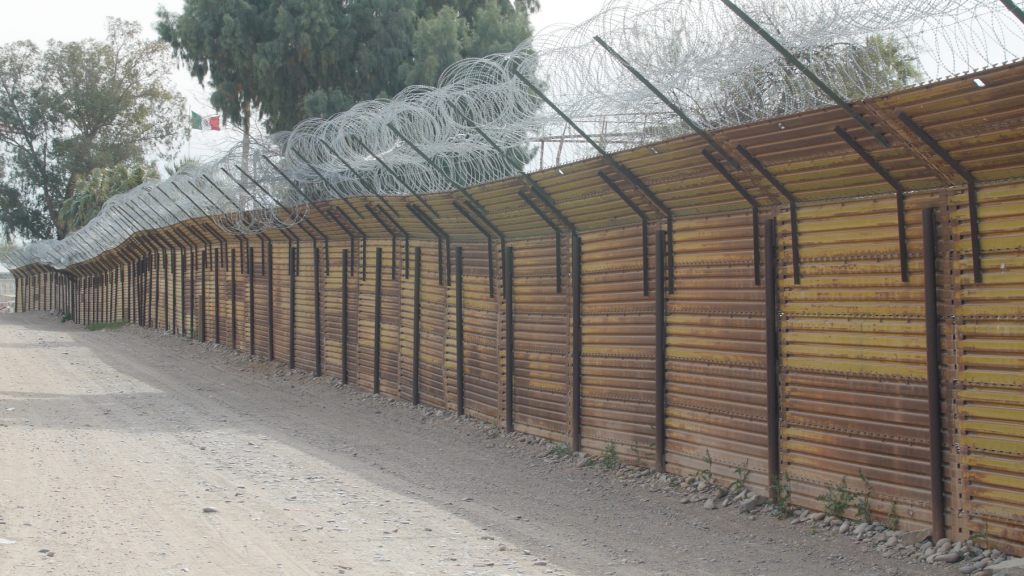
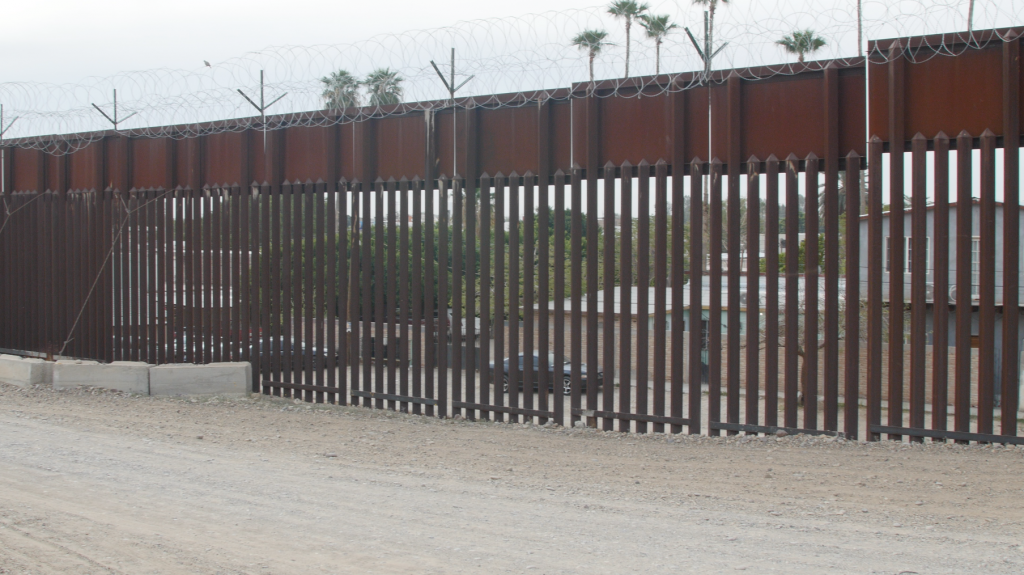
Next came the standard Bollard fencing with steel bars about an inch apart that stood between 16 to 18 feet tall.
Razor sharp concertina wire spanned the top of it.
Matt Bertram, KTAR News
“And yet, it’s still outdated,” Kallinger said. “People still try to climb a 16- to 18-foot fence. We’re looking here in the Yuma Sector to get 30-foot fencing…which seems to be keeping people out in other parts of the country.”
One benefit to this current Bollard barrier, Kallinger noted, was visibility through the bars to spot migrants and criminals.
“We prefer that we can have somewhere to see them, even though they can see us,” Kallinger explained.
Matt Bertram, KTAR News
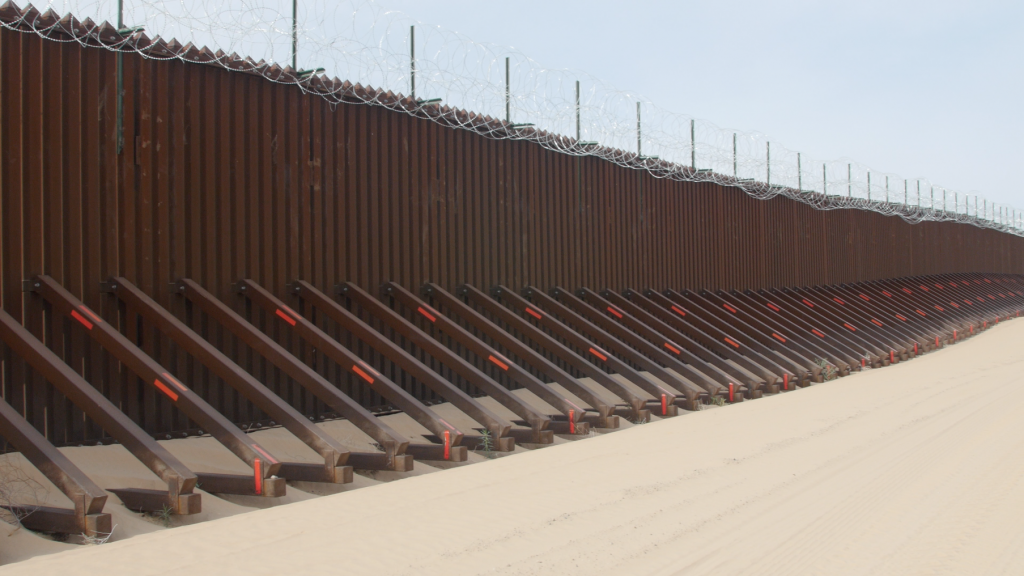
Further west of Andrade was the “floating fence” atop the sand dunes that are constantly blown underneath the fence, building a natural platform for migrants to use for scaling the fence.
“You lift up these sections with a crane, and you can go underneath it and clean out the sand,” Kallinger explained.
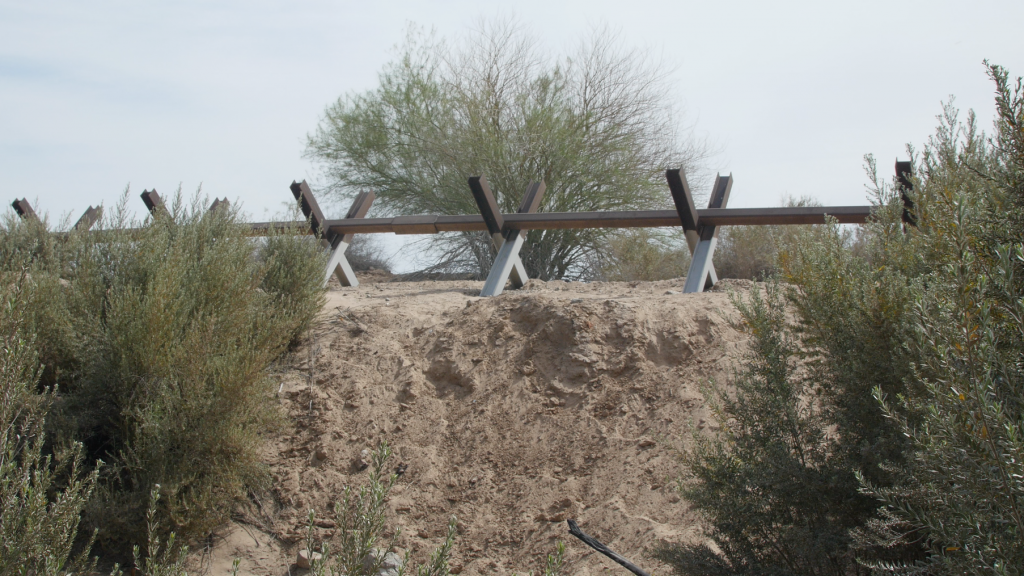
At one stretch, the Colorado River delineates Mexico from the U.S. and only steel Normandy barriers – at 42 inches tall – stand in the way of migrants.
“It wasn’t built to stop pedestrians,” Kallinger explained. Put up in 2006, the Normandy barriers were designed to stop cars bringing migrants and drugs that crossed the river atop sandbags laid in shallow waters.
Matt Bertram, KTAR News
In 2005, the Yuma Sector Border Patrol reported more than 2,700 vehicle incursions along this stretch. That number dropped to ten in 2017.
Closer to San Luis, Kallinger explained the “triple fence” went up between 2007-10, where no fence had been before, at the Sanchez Canal. The area was notorious for hundreds of people rushing from Mexico into the U.S.
“We would have eight to ten assaults per day on agents,” Kallinger said. “It was not a good place to be.”
One stretch of bollard fencing lined the border. About 50 feet north of there stood more bollard fencing. Both were 18 feet tall.
And just north of that stood a chain link fence at six feet tall.
The Yuma Sector stretches 126 miles from the Imperial Dunes in California to the Yuma-Pima county line – and 181,670 square miles of desert terrain.
That terrain ranges from sand to soft dirt along the Colorado River that runs in a canyon, to level hardened earth, to wilderness far from civilization.
Kallinger and Garibay say the types of barriers – like those mentioned above – must serve the terrain and traffic specific to those areas.
Even paved roads would be bad ideas in some stretches, according to their assessment.
“Certain areas that we identify as having soft sand… allow us to drive up to it and see the footprints in the sand,” said Garibay.
But even then, migrants use “carpet booties,” or small cuts of carpeting that they attach to the bottoms of their shoes. The booties tamp out their footprints.
The agents would not identify areas with natural barriers that would prohibit fencing so as not to tip off smugglers and illegal crossers.
“They’re not trying to get away from us”
The tour also included a discussion about differences between previous immigration influxes and the current one – which they called a “humanitarian crisis.”
In 2005-06, Kallinger said single Mexican men – some in groups as large as 300 – would rush across unfenced stretches of the border, hoping to evade Border Patrol agents.
Now families – or adults with children that Border Patrol says are pretending to be families – from Central America are crossing the border. Since fall, when this crisis began, Kallinger described the Border Patrol as, essentially, the welcoming committee.
“They’re not trying to get away from us,” he said. “They’re trying to get to us so that they can be given this piece of paper that says, ‘You need to see the judge on this date.’ Sooner or later, they’re let out into the United States.”
By law – which Kallinger says the migrants and their smugglers know – families with children can only be detained for 20 days. The rule is known as the Flores Agreement, a 1997 legal settlement which prevents family units from being detained for more than 20 days.
“They’re not claiming asylum with us. They’re not claiming credible fear with us,” Kallinger said. “They’re doing it when they get further in the country and they learn how to beat these immigration laws.”
Then, the migrants are released with that piece of paper setting a date for an immigration court appearance – perhaps a year from their release – and an ankle monitor bracelet. It’s typically one bracelet per family.
Kallinger said they often cut their bracelets, trash their papers, and move undetected around the U.S. after being in Arizona for just a handful of days.
Since Dec. 21, 23,700 migrants have been released from Immigration and Customs Enforcement (ICE) custody, and into Arizona. Most are family units seeking asylum into the U.S.
De facto babysitters
At times, Border Patrol agents are de facto babysitters for the children in custody. During KTAR News’ visit in late March, that number was up around 200.
“It’s not uncommon for our agents to hold these kids, to calm them down,” Kallinger said.
One agent put a video of “Dora the Explorer” on his computer screen for a 3-year-old migrant girl.
“She was unaccompanied, she had no family… she had high anxieties,” Kallinger recalled.
Federal agents are constantly trying to determine if the children in their care are being “recycled.”
“We have these smuggling organizations that take these Central American children, place them with adults, and utilize false documents,” he explained. “Then the smuggler sends the child back to the Central American country and places it with another adult group.”
Kallinger recalled times officers went out of their way to provide some of the migrants, especially children, with extra food, clothing, diapers and medicine.
While migrants spend those 20 days in detention, Border Patrol agents take their names, personal information and stories to start case files for their immigration court hearings.
And increasingly, agents also take migrants to Yuma Regional Medical Center for healthcare.
Border Patrol Yuma Sector Deputy Chief Carl Landrum estimated that agents spent 11,000 hours taking migrants to care facilities in fiscal year 2017-18.
“That’s 11,000 hours that our agents were not on the border providing border security and national security,” said Landrum.
He said his sector paid $700,000 from its general law enforcement budget for health care in the last fiscal year.
“We have to take care of them. They are human beings just like the rest of us,” Landrum said. “We have to make sure they are OK. In order to do that, we’re having to pay for that out of our border security budget.”
Garibay, who joined the Border Patrol in 2017, says he has driven countless migrants to Yuma Regional.
“Over Christmas in 2017 and 2018, I was at the hospital with an individual,” Garibay said.
The injuries range from migrants climbing over the fence – and through the sharp Concertina wire. Sometimes, those women are pregnant.
“Many of the individuals that come into our custody that are sick have had these illnesses from the journey,” Garibay explained. “They’ve had these illnesses prior to coming into our custody.”
The wall is just a start
Both Landrum and Kallinger agreed the expansion and addition of a border wall or similar barrier will reduce crime, human trafficking and illegal entries into Arizona and other southwestern states.
“Every single year since 1996 to this year, we have requested border barrier – either new border barrier or enhanced border barrier,” Landrum said.
Construction has begun on more than 28 miles of border barrier in the Yuma Sector previously approved by Congress.
But like other area stakeholders, Kallinger and Garibay agreed a physical barrier is not enough.
“We also need funding for this humanitarian crisis,” Kallinger said. “A lot of this cannot be solved by old school Border Patrol work.”
“We could use all types of different infrastructure, technology, additional manpower, camera towers,” Garibay said. “It’s a whole system that we need to complete our mission along the southwest border.
“We know what we need because we’re doing it here, doing it every day.”