Analysis: After UN visit, Iran faces diminishing choices
Sep 26, 2019, 5:35 AM
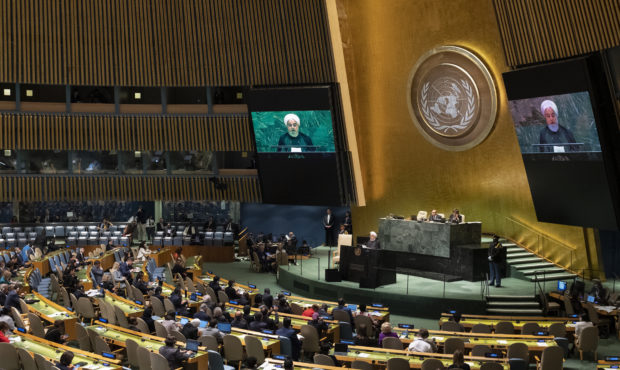
Iran's President Hassan Rouhani addresses the 74th session of the United Nations General Assembly, Wednesday, Sept. 25, 2019. (AP Photo/Craig Ruttle)
(AP Photo/Craig Ruttle)

UNITED NATIONS (AP) — Iran has long prided itself on its forceful defiance of the United States and Israel, a resistance that has defined the Shiite-led Islamic Republic for the 40 years since its revolution.
But the limits of Iran’s ability to go it alone were on display at the United Nations this week as it engaged in a flurry of diplomatic outreach amid increasingly crippling isolation by U.S. sanctions that are eating into its economy and its ability to sell its oil.
For months, the European nations that signed Iran’s nuclear accord have been trying — unsuccessfully — to find ways around U.S. sanctions that were imposed after President Donald Trump pulled the U.S. out of the agreement last year. Trump argues the deal, completed under the Obama administration, fell far short of the curbs needed to block Tehran’s regional ambitions.
Addressing world leaders Wednesday, Rouhani’s message pointed a clear way toward easing tensions and resuming negotiations: “Stop the sanctions.”
But before getting to that, he opened his speech by paying homage “to all the freedom-seekers of the world who do not bow to oppression and aggression.” He also slammed “U.S.- and Zionist-imposed plans” against the Palestinians. Such language characterizes Iran’s self-styled championing of Islamic causes worldwide.
Away from the podium this week, Iran has been engaging in nothing short of a public relations blitz with America’s biggest news outlets. Rouhani met with leaders of media organizations including The Associated Press and granted an interview to Fox News, where Trump and his Iran policies enjoy vehement support.
The Tehran government’s fraught history with the U.S. has essentially locked it out of the global financial system, making it difficult to find partners, allies and countries willing or even able to do business with it.
Rouhani accused the U.S. of engaging in “merciless economic terrorism” against his country, saying America had resorted to “international piracy by misusing the international banking system” to pressure Iran.
As Iran’s nuclear deal with world powers unravels under the weight of Trump’s “maximum pressure” campaign, previously unimaginable alliances are emerging between Gulf Arab states and Israel, united by what they see as a common threat.
Across the Middle East, Iran’s reach is consequential in Syria, Iraq and Yemen, where proxy wars have taken on a sectarian tone that pits Iran-supported Shiites against Saudi-backed Sunnis.
On the battlefields, Tehran’s rivals see it as a menacing and destabilizing force that has exploited failed uprisings, military interventions and chaos to expand its foothold in Arab states.
Iran counters that it was the U.S. that invaded Iraq and Saudi Arabia that invaded Yemen. In his U.N. speech, Rouhani pointed to Iran’s role in fighting Sunni Muslim extremist groups like the Islamic State and al-Qaida. He described Iran as a “pioneer of freedom-seeking movements in the region.”
Iran’s elite paramilitary force has led that charge, cementing Tehran’s footprint far beyond the country’s borders.
The Revolutionary Guard Corps, created after Iran’s 1979 Islamic Revolution in parallel to the country’s armed forces, is effectively a corps of soldiers charged with preserving and advancing the principles of the uprising that created modern Iran.
It answers only to the country’s supreme leader, Ayatollah Ali Khamenei, and its power is not just theoretical but very real: The force directly oversees the country’s ballistic missile program.
It is the Guard Corps that has become a major sticking point in Iran’s relations, or lack thereof, with the United States under Donald Trump.
The Trump administration, Saudi Arabia, the United Arab Emirates and Israel say Iran used money from sanctions relief under the nuclear accord to increase the Revolutionary Guard’s budget.
Those nations say any new negotiations must include discussion about the Guard’s activities in the region and its missile program, and support for that notion seems to be gaining traction.
This week, Britain, France and Germany joined the U.S. and other allies in blaming Iran for an attack on Saudi oil sites earlier this month. The implication: That because missiles were involved in those attacks, so was the Guard.
Speaking at the Council on Foreign Relations in New York this week, a top Saudi diplomat described Iran as being “obsessed with trying to restore the Persian Empire and trying to take over the region.”
“Their constitution calls for the export of the revolution,” Adel al-Jubeir said. “They believe that every Shiite belongs to them. They don’t respect the sovereignty of nations.”
“Iran,” he said, “has to decide: Are you a revolution or are you a nation-state?”
As Rouhani departs a city that is effectively enemy territory and goes back home this week, he and Tehran’s clerical leadership must decide which of those paths to take: Will they merely confront, as the 1979 revolution did? Or, as nation-states do, will they sit down and talk as well?
___
Aya Batrawy covers the Persian Gulf for The Associated Press and has reported from the Middle East for the past 15 years.
___
Follow Aya Batrawy on twitter at https://twitter.com/ayaelb