
Pope abolishes ‘pontifical secret’ in clergy sex abuse cases
Dec 17, 2019, 6:07 AM
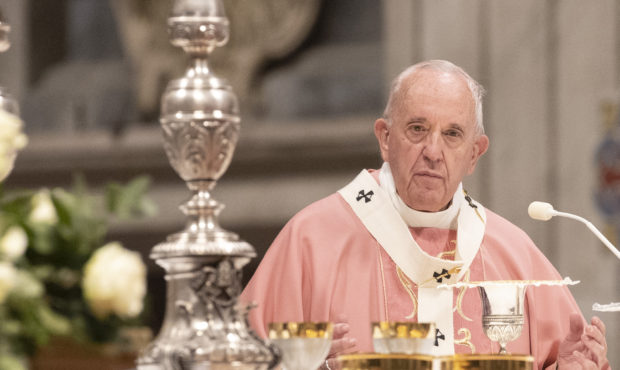
Pope Francis celebrates a Mass for the Philippine community of Rome, in St. Peter's Basilica at the Vatican to Sunday, Dec. 15, 2019. (AP Photo/Alessandra Tarantino)
(AP Photo/Alessandra Tarantino)

VATICAN CITY (AP) — Pope Francis has abolished the “pontifical secret” used in clergy sexual abuse cases, after mounting criticism that the high degree of confidentiality has been used to protect pedophiles, silence victims and keep law enforcement from investigating crimes.
In a new document, Francis decreed that information in abuse cases must be protected by church leaders to ensure its “security, integrity and confidentiality.” But he said “pontifical secret” no longer applies to abuse-related accusations, trials and decisions under the Catholic Church’s canon law.
The Vatican’s leading sex crimes investigator, Archbishop Charles Scicluna, called the reform an “epochal decision” that will facilitate coordination with civil law enforcement and open up lines of communication with victims.
While documentation from the church’s in-house legal proceedings will still not become public, Scicluna said, the reform now removes any excuse to not cooperate with legitimate legal requests from civil law enforcement authorities.
Prominent Irish survivor Marie Collins said the reform was “excellent news” that abuse survivors and their advocates had been pressing for. “At last a real and positive change,” she tweeted.
Francis also raised from 14 to 18 the cutoff age below which the Vatican considers pornographic images to be child pornography.
The new laws were issued Tuesday, Francis’ 83rd birthday, as he struggles to respond to the global explosion of the abuse scandal, his own missteps and demands for greater transparency and accountability from victims, law enforcement and ordinary Catholics alike.
The new norms are the latest amendment to the Catholic Church’s in-house canon law — a parallel legal code that metes out ecclesial justice for crimes against the faith — in this case relating to the sexual abuse of minors or vulnerable people by priests, bishops or cardinals. In this legal system, the worst punishment a priest can incur is being defrocked, or dismissed from the clerical state.
Pope Benedict XVI had decreed in 2001 that these cases must be dealt with under “pontifical secret,” the highest form of secrecy in the church. The Vatican had long insisted that such confidentiality was necessary to protect the privacy of the victim, the reputation of the accused and the integrity of the canonical process.
However, such secrecy also served to keep the scandal hidden, prevent law enforcement from accessing documents and silence victims, many of whom often believed that “pontifical secret” prevented them from going to the police to report their priestly abusers.
While the Vatican has long tried to insist this was not the case, it also never mandated that bishops and religious superiors report sex crimes to police, and in the past has encouraged bishops not to do so.
According to the new instruction, which was signed by the Vatican secretary of state but authorized by the pope, the Vatican still doesn’t mandate reporting the crimes to police, saying religious superiors are obliged to do so where civil reporting laws require it.
But it goes further than the Vatican has gone before, saying: “Office confidentiality shall not prevent the fulfillment of the obligations laid down in all places by civil laws, including any reporting obligations, and the execution of enforceable requests of civil judicial authorities.”
The Vatican has been under increasing pressure to cooperate more with law enforcement, and its failure to do so has resulted in unprecedented raids in recent years on diocesan chanceries by police from Belgium to Texas and Chile.
But even under the penalty of subpoenas and raids, bishops have sometimes felt compelled to withhold canonical proceedings given the “pontifical secret,” unless given permission to hand documents over by the Vatican. The new law makes that explicit permission no longer required.
“The freedom of information to statutory authorities and to victims is something that is being facilitated by this new law,” Scicluna told Vatican media.
The Vatican in May issued another law explicitly saying victims cannot be silenced and have a right to learn the outcome of canonical trials. The new document repeats that, and expands the point by saying not only the victim, but any witnesses or the person who lodged the accusation cannot be compelled to silence.
Individual scandals, national inquiries, grand jury investigations, U.N. denunciations and increasingly costly civil litigation have devastated the Catholic hierarchy’s credibility across the globe, and Francis’ own failures and missteps have emboldened his critics.
In February, he summoned the presidents of bishops conferences from around the globe to a four-day summit on preventing abuse, where several speakers called for a reform of the pontifical secret. Francis himself said he intended to raise the age for which pornography was considered child porn.
The Vatican’s editorial director, Andrea Tornielli, said the new law is a “historical” follow-up to the February summit and a sign of openness and transparency.
“The breadth of Pope Francis’ decision is evident: the well-being of children and young people must always come before any protection of a secret, even the ‘’pontifical secret,'” he said in a statement.
Also Tuesday, Francis accepted the resignation of the Vatican’s ambassador to France, Archbishop Luigi Ventura, who is accused of making unwanted sexual advances to young men.
Ventura turned 75 last week, the mandatory retirement age for bishops, but the fact that his resignation was announced on the same day as Francis’ abuse reforms didn’t seem to be a coincidence.




