Everything you need to know about NASA and SpaceX’s historic astronaut launch, round two
May 29, 2020, 7:42 AM
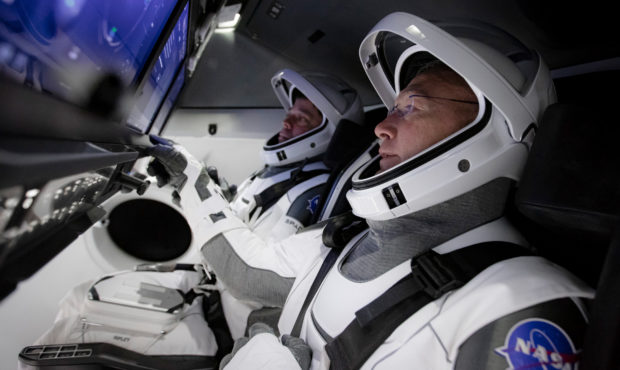
On Thursday, March 19 and Friday, March 20, SpaceX teams in Firing Room 4 at NASA's Kennedy Space Center in Florida and the company's Mission Control in Hawthorne, California, along with NASA flight controllers in Mission Control Houston, executed a full simulation of launch and docking of the Crew Dragon spacecraft, with NASA astronauts Bob Behnken and Doug Hurley participating in SpaceX's flight simulator.

(CNN) — SpaceX and NASA are, once again, gearing up to try to make history by launching two astronauts into Earth’s orbit.
NASA and space fans were disappointed Wednesday when the first attempt was called off due to weather. They have waited nearly a decade for this milestone, which will usher in the return of human spaceflight to US soil.
The next launch is slated for Saturday at 3:22 pm ET. But whether or not the rocket will actually take off will most likely come down to the weather forecast — again.
As of Thursday evening, the 45th Space Wing, an arm of the US military that oversees all East Coat rocket launches, predicts about a 40% chance of the weather holding up enough for launch on Saturday. And the odds are about the same for the next opportunity for liftoff on Sunday, May 31, at 3:00 p.m. ET.
It’s hurricane season in Central Florida, and that means launch officials are dealing with weather conditions that are often severe and extremely fickle. After enduring several thunderstorms and a tornado warning on Wednesday, the sky began to clear up right around liftoff time. But, ultimately, ominous clouds and the risk of lightning was too high to allow the launch to proceed.
With just minutes left on the countdown clock, officials even suggested on Wednesday that the rocket could have taken off if launch time was just 10 or 20 minutes later.
But that’s not a possibility for this mission, as the astronauts are heading to space to link up with the International Space Station, which orbits about 250 miles above Earth and travels more than 17,000 miles per hour. That means the spacecraft will need to stay on an extremely precise launch schedule.
NASA and SpaceX’s plans could change at any moment between now and Saturday afternoon, depending on how the forecast changes.
It will also require quite a bit of luck. The 45th Space Wing must monitor conditions both at the launch pad and across a broad stretch of the Atlantic Ocean. If the rocket misfires and SpaceX’s Crew Dragon capsule needs to use its emergency abort system to jettison the astronauts to safety, they’ll land in the ocean. And that means officials must ensure that landing won’t be made more dangerous by a severe storm or rough waves, so they scan a massive stretch of the ocean all the way to the coast of Ireland. The team also uses all sorts of instruments, including radars and weather balloons, to ensure that the rocket will have a smooth ride all the way through the upper atmosphere.
One other issue Central Florida is facing: controlling crowds amid the Covid-19 pandemic.
Florida beaches opened earlier this month, and during SpaceX’s first launch attempt on Wednesday, local news outlets reported that spectators crowded public viewing sites, even as a series of thunderstorms rolled through the area.
The Kennedy Space Center Visitor Complex, which did not sell any tickets for Wednesday’s launch, officially reopened on Thursday.
The center’s website says the visitor’s center will only welcome a limited number of people for the launch and will require masks and temperature checks for all guests. The tickets for SpaceX’s Saturday launch attempt were quickly sold out.
Why is this launch so important?
The stakes have never been higher for Elon Musk’s SpaceX. This will mark the first time in history that a commercial aerospace company has carried humans into Earth’s orbit. NASA and space fans have waited nearly a decade for this milestone.
The United States hasn’t launched its own astronauts into space since the Space Shuttle program ended in 2011. Since then, NASA’s astronauts have had to travel to Russia and train on the country’s Soyuz spacecraft. Those seats have cost NASA as much as $86 million each.
But the space agency chose not to create its own replacement for the Shuttle. Instead, it asked the private sector to develop a spacecraft capable of safely ferrying astronauts to and from the International Space Station — a controversial decision considering that NASA had never before outsourced the development of a human-rated spacecraft. The thinking was that commercial companies could drive down costs and spur innovation, and NASA would have more time and resources to focus on exploring deeper into the solar system.
In 2014, NASA awarded two contracts: $4.2 billion for Boeing to build its Starliner vehicle, and $2.6 billion to SpaceX, which planned to create a crew worthy version of the Dragon spacecraft that was already flying cargo to and from the International Space Station. NASA had already put money toward SpaceX’s development of the Dragon spacecraft used for transporting cargo. The space agency has said Boeing received more money because it was designing the Starliner from scratch.
Boeing recently suffered a significant setback when a Starliner capsule malfunctioned during a key uncrewed test flight. But if SpaceX can carry out this mission, it’ll be a major win for NASA, which has been pushing for more commercial partnerships.
Not to mention, NASA won’t have to ask Russia for rides anymore.
Is it safe to launch during the pandemic?
Elon Musk, SpaceX’s CEO, has faced steep criticism over his online comments about the coronavirus. He’s repeatedly expressed his belief that the United States’ coronavirus response is overblown and he has shared misinformation about its threat.
But according to NASA, it’s both necessary and safe to move forward with this particular mission.
The space agency needs to keep the International Space Station, a giant orbiting laboratory, fully staffed with US astronauts to keep operations running smoothly.
The astronauts slated to fly on this mission have been in strict quarantine together, and extra precautions are being taken to keep everything clean, NASA has said.
Launch officials and mission controllers will need to gather to support the launch, but they’ve implemented additional safety measures, such as changing control rooms when a new shift begins so that the other room can be deep cleaned.
NASA administrator Jim Bridenstine has said he hopes this launch will inspire awe and uplift the general public during the ongoing health crisis. He and SpaceX chief operating officer Gwynne Shotwell previously implored the public to follow the launch on television in order to prevent crowds of spectators from triggering a Covid 19 outbreak.
Where is liftoff and how can I watch?
The rocket will take off from “Pad 39A,” a historic site at NASA’s Kennedy Space Center in Brevard County, Florida. Pad 39A has been the starting point of missions dating back to the Apollo era, including the first moon landing in 1969. SpaceX is currently leasing the launch pad from NASA.
SpaceX and NASA will be co-hosting a webcast during takeoff beginning around 11 am ET, and they’ll keep that live coverage rolling at least until Crew Dragon docks with the space station about 19 hours after launch.
CNN and other news networks will also be sharing live updates on TV and online.
Who is flying to space?
Two veteran astronauts: Robert Behnken, 49, and Douglas Hurley, 53.
They work for NASA, but they’ve worked closely with SpaceX and have been trained to fly the Crew Dragon capsule, which will become only the fifth spacecraft design — after the Mercury, Gemini, Apollo, and Space Shuttle vehicles — that NASA has certified as safe enough for humans.
Behnken and Hurley both began their careers as military test pilots and have logged hundreds of hours piloting supersonic jets. They also both flew on previous Space Shuttle missions. When NASA selected them for this mission in 2018, it continued a long lineage of military test pilots who were deemed to have the “right stuff” for groundbreaking moments in human spaceflight history.
NASA wants to keep Behnken and Hurley on the space station until another Crew Dragon capsule is ready to send more people on its next mission.
The astronauts told reporters last week that they’re expecting to spend one to three months in space. The maximum length is 110 days, according to NASA.
When Behnken and Hurley return home, they’ll board Crew Dragon, journey back through the atmosphere while the vehicle deploys parachutes and then land in the Atlantic Ocean.
What is Crew Dragon?
It’s a gumdrop-shaped capsule that measures about 13 feet in diameter and is equipped with seven seats and touchscreen controls.
Crew Dragon and the astronauts will ride into orbit atop a SpaceX Falcon 9 rocket, and the astronauts will board the vehicle the day of launch using an aerial “crew access arm.” After the rocket fires the Crew Dragon into the upper atmosphere, the spacecraft will separate and fire up its own thrusters to begin maneuvering toward the space station.
The Crew Dragon capsule is fully autonomous, so the astronauts will mostly need to just monitor the systems and keep in touch with mission control unless something goes awry.
Despite Behnken and Hurley riding with a couple empty seats on board, they’re not planning to bring extra luggage. But they will carry a couple pieces of special cargo: a symbolic piece of art, and a composite photo honoring the 2020 graduates.
The astronauts will spend about 19 hours aboard the spacecraft before arriving at the International Space Station.
And yes, the Crew Dragon does have a toilet — just in case. Details about how it works have not been publicized. But one astronaut who worked on the Crew Dragon program said he has seen the design and said the accommodations are “perfectly adequate for that task.”
What is the International Space Station?
The International Space Station has orbited Earth for two decades. The United States and Russia are the station’s primary operators, but 240 astronauts from 19 countries have visited over the years.
Rotating crews of astronauts have staffed the ISS continuously since the year 2000, allowing thousands of scientific experiments to be carried out in microgravity. Research has included everything from how the human body responds to being in space to developing new medications.
Typically, about six people stay on the International Space Station. But right now, there are only three: NASA’s Christopher Cassidy and Russia’s Anatoli Ivanishin and Ivan Vagner.
What will this cost?
Seats on Russia’s Soyuz launches have cost NASA up to about $90 million each and roughly $55 million on average over the past decade, according to a 2019 report from NASA’s Office of the Inspector General.
That same report estimates that Crew Dragon seats will cost NASA about $55 million each. But those are estimates based on a contract that doesn’t clearly define the per-seat cost and only accounts for the first six missions.
A new analysis from the nonprofit Planetary Society, which promotes science and space exploration, suggests that, overall, NASA’s commercial crew program is a bargain compared to previous human spaceflight programs in the United States.
Is Crew Dragon safe?
Both SpaceX and NASA have had to sign off on Crew Dragon’s development throughout every major testing milestone. And this mission will be no different.
Last week, NASA conducted a “launch readiness review,” which was meant to ensure that all the stakeholders are comfortable moving forward.
Any time a spacecraft leaves Earth there are risks, and there are no perfect measurements for predicting them.
But NASA does try: SpaceX is required to ensure that Crew Dragon has only a 1 in 270 chance of catastrophic failure, based on one metric the space agency uses. There have been numerous attempts to calculate what the risk was for a given Space Shuttle mission. Ultimately, out of 135 missions, there were two Shuttle tragedies — a failure rate of about 1 in every 68 missions.
It should also be noted that Crew Dragon’s previous uncrewed trip to space gives it more experience than other US spacecraft had before humans were allowed on board. The Space Shuttle, for instance, was never taken on an uncrewed test drive.
Crew Dragon is also equipped with a unique emergency abort system designed to jettison astronauts to safety if something goes wrong.
How will this affect the United State’s relationship with Russia?
Officials in both countries have held up their symbiotic relationship on the International Space Station as a beacon of post-Cold War cooperation. But tensions have climbed since the early 2010s, and that has occasionally extended into the countries’ space partnership.
But the International Space Station has survived other geopolitical tensions. US astronauts and Russian cosmonauts are still working closely together.
NASA officials said Russia and Japan, another ISS partner, both joined discussions for a Crew Dragon safety review last week.
How difficult was it for SpaceX to reach this point?
SpaceX’s relationship with NASA has evolved dramatically over the years. In the 2000s, SpaceX first few rocket launch attempts failed, and the company was nearly bankrupt in 2008 before it managed to safely launch one of its early Falcon 1 rockets into orbit. After that, NASA took a chance on the upstart and awarded SpaceX a $1.6 billion contract to fly cargo to the space station using a new capsule, Dragon, and rocket, dubbed Falcon 9.
SpaceX and NASA have worked closely — and sometimes awkwardly — together ever since. Their partnership has survived two failed SpaceX Falcon 9 missions: One in 2015, when a rocket hauling 5,000 pounds of cargo to the space station exploded on the way to orbit. In 2016, another Falcon 9 rocket blew up while sitting on a Florida launch pad, destroying a $200 million telecom satellite.
But the vast majority of the 80-plus Falcon 9 missions that SpaceX has launched so far have gone off without a hitch.
A setback in development of the Crew Dragon spacecraft came last year, when SpaceX was conducting a ground test of the vehicle’s emergency abort engines went explosively wrong.
SpaceX worked for months to reconfigure the Crew Dragon design and clear it with NASA before those abort engines performed flawlessly in a January test flight.
Will Crew Dragon make another trip?
One of SpaceX’s main goals is to bring down the costs of launching objects into space by reusing hardware.
Dragon capsules that fly cargo, for example, have been used up to three times.
And since 2015, SpaceX has managed to safely land a Falcon 9’s first-stage booster, the largest part of the rocket that gives the initial thrust at liftoff, dozens of times.
The rocket used for this week’s mission will be brand new, but SpaceX will attempt to recover the rocket’s first-stage rocket booster by landing it on a seafaring drone ship after launch.
Each Crew Dragon spacecraft could also make multiple trips to space, the company has suggested.
SpaceX’s most ambitious reuse efforts will be with Starship — a gargantuan spacecraft currently in the early stages of development. Musk hopes that every piece of that vehicle, and the giant rocket booster that will vault it into space, will be reusable.
Starship is at the core of Musk’s long-term plan for SpaceX: Sending humans to live on Mars.
The-CNN-Wire
™ & © 2020 Cable News Network, Inc., a WarnerMedia Company. All rights reserved.