US inflation explained: Why it’s so high (7.5%) and when it may ease
Feb 10, 2022, 10:28 AM
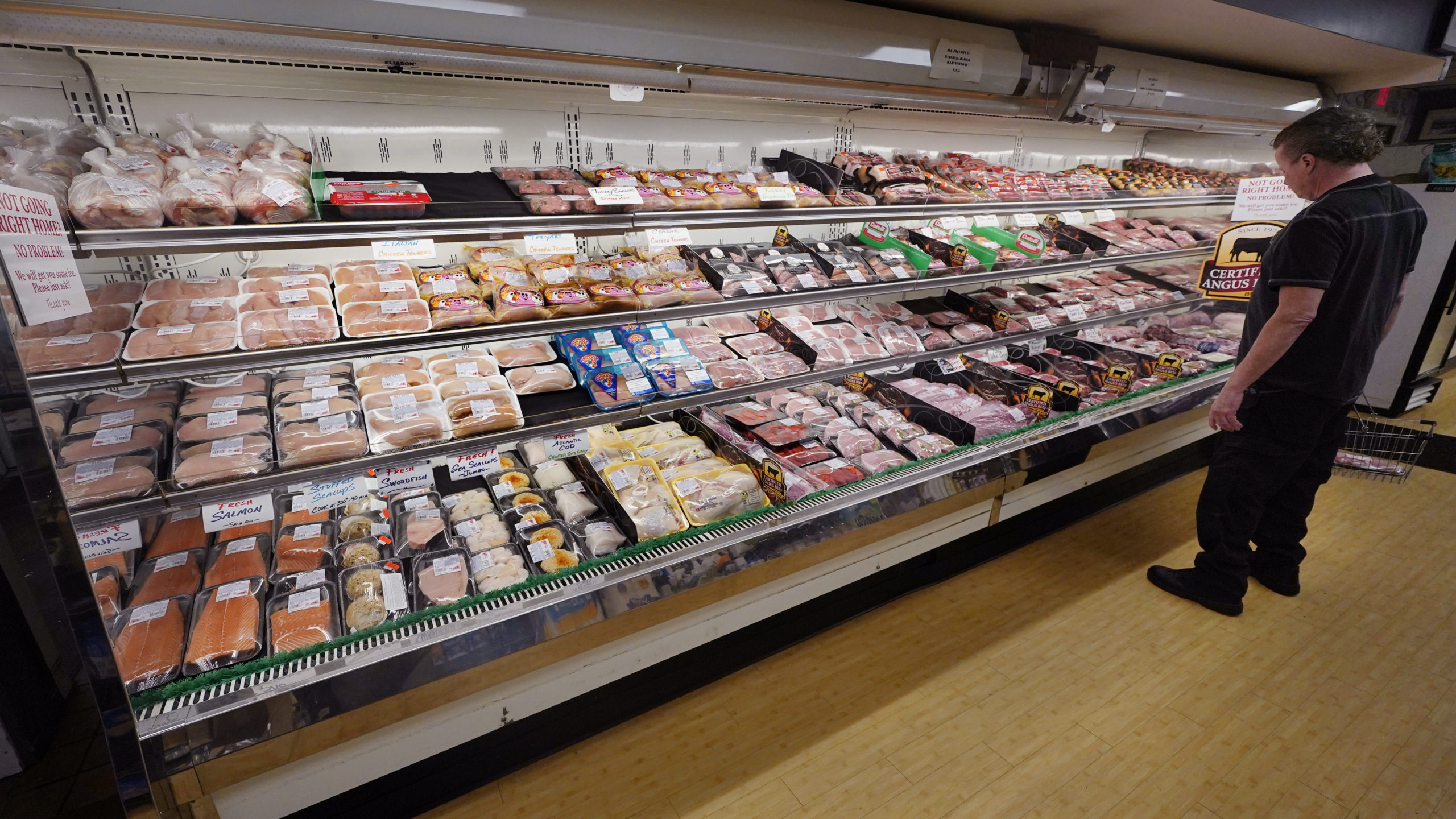
A man looks at beef in the meat department at Lambert's Rainbow Market, on June 15, 2021 in Westwood, Mass. The Labor Department said Thursday, Feb. 10, 2022, that consumer prices jumped 7.5% last month compared with a year earlier, the steepest year-over-year increase since February 1982. The acceleration of prices ranged across the economy, from food and furniture to apartment rents, airline fares and electricity. (AP Photo/Charles Krupa)
(AP Photo/Charles Krupa)
WASHINGTON (AP) — Last year, it was a nasty surprise. And it wasn’t supposed to last. But now, inflation has become an ongoing financial strain for millions of Americans filling up at the gas station, lined up at a grocery checkout lane, shopping for clothes, bargaining for a car or paying monthly rent.
For the 12 months ending in January, inflation amounted to 7.5% — the fastest year-over-year pace since 1982 — the Labor Department said Thursday.
Even if you toss out volatile food and energy prices, so-called core inflation jumped 6% over the past year. That was also the sharpest such jump in four decades.
Consumers felt the price squeeze in everyday routines. Over the past year, prices rose 41% for used cars and trucks, 40% for gasoline, 18% for bacon, 14% for bedroom furniture, 11% for women’s dresses.
The Federal Reserve didn’t anticipate an inflation wave this severe or this persistent. In December 2020, the Fed’s policymakers had forecast that consumer inflation would stay below their 2% annual target and end 2021 at around 1.8%.
But after having been an economic afterthought for decades, high inflation reasserted itself last year with brutal speed. In February 2021, the government’s consumer price index was running just 1.7% ahead of its level a year earlier. From there, the year-over-year price increases accelerated steadily — 2.7% in March, 4.2% in April, 4.9% in May, 5.3% in June.
By October, the figure was 6.2%, by November 6.8%, by December 7.1%.
For months, Fed Chair Jerome Powell and others characterized higher consumer prices as merely a “transitory” problem — the result, mainly, of shipping delays and temporary shortages of supplies and workers as the economy rebounded from the pandemic recession much faster than anyone had anticipated.
Now, many economists expect consumer inflation to remain elevated well into this year, with demand outstripping supplies in numerous areas of the economy.
“Inflation remains the single largest near-term challenge to the economy,” said Jim Baird, chief investment officer at Plante Moran Financial Advisors.
“Although price pressures are expected to ease as the year progresses, inflation will remain above the Fed’s 2% target for some time to come.”
So the Fed has radically changed course. Last month, the central bank signaled that it will begin a series of rate hikes in March. By doing so, the Fed is moving away from the super-low rates that helped revive the economy from 2020’s devastating pandemic recession but that also helped fuel surging consumer prices.
WHAT’S CAUSED THE SPIKE IN INFLATION?
Good news — mostly. When the pandemic paralyzed the economy in the spring of 2020 and lockdowns kicked in, businesses closed or cut hours and consumers stayed home as a health precaution, employers slashed a breathtaking 22 million jobs. Economic output plunged at a record-shattering 31% annual rate in last year’s April-June quarter.
Everyone braced for more misery. Companies cut investment and postponed restocking. A brutal recession ensued.
But instead of sinking into a prolonged downturn, the economy staged an unexpectedly rousing recovery, fueled by vast infusions of government aid and emergency intervention by the Fed, which slashed interest rates, among other things. By spring of last year, the rollout of vaccines had emboldened consumers to return to restaurants, bars, shops and airports.
Suddenly, businesses had to scramble to meet demand. They couldn’t hire fast enough to fill job openings — a near record 10.9 million in December — or buy enough supplies to meet customer orders. As business roared back, ports and freight yards couldn’t handle the traffic. Global supply chains became seized up.
With demand up and supplies down, costs rose. And companies found that they could pass along those higher costs in the form of higher prices to consumers, many of whom had managed to sock away a ton of savings during the pandemic.
But critics, including former Treasury Secretary Lawrence Summers, blamed in part President Joe Biden’s $1.9 trillion coronavirus relief package, with its $1,400 checks to most households, for overheating an economy that was already sizzling on its own.
The Fed and the federal government had feared an agonizingly slow recovery like the one that followed the Great Recession of 2007-2009.
HOW LONG WILL IT LAST?
Elevated consumer price inflation will likely endure as long as companies struggle to keep up with consumers’ demand for goods and services. A recovering job market — employers added a record 6.7 million jobs last year and tacked on 467,000 more in January — means that many Americans can continue to splurge on everything from lawn furniture to electronics.
Many economists foresee inflation staying well above the Fed’s 2% target this year. But relief from higher prices might be coming. Jammed-up supply chains are beginning to show some signs of improvement, at least in some industries. The Fed’s sharp pivot away from easy-money policies toward a more hawkish, anti-inflationary policy could slow the economy and reduce consumer demand. There will be no repeat of last year’s COVID relief checks from Washington.
Inflation itself is eating into household purchasing power and might force some consumers to shave back spending.
Omicron or other COVID’ variants could cloud the outlook, either by causing outbreaks that force factories and ports to close and disrupt supply chains even more or by keeping people home and reducing demand for goods.
“It’s not going to be an easy climb down,” said Sarah House, senior economist at Wells Fargo. “We’re expecting CPI to still be roughly 4% at the end of this year. That’s still well above what the Fed would like it to be and, of course, well above what consumers are used to seeing.”
HOW ARE HIGHER PRICES AFFECTING CONSUMERS?
A strong job market is boosting wages, though not enough to compensate for higher prices. The Labor Department says that hourly earnings for all private-sector employees fell 1.7% last month from a year earlier after accounting for higher consumer prices. But there are exceptions: After-inflation wages were up more than 10% for hotel workers and more than 7% for restaurant and bar employees in December from a year earlier.
Partisan politics also colors the way Americans view the inflation threat. With a Democrat in the White House, Republicans were nearly three times as likely as Democrats (45% versus 16%) to say that inflation is having a negative effect last month on their personal finances, according to a University of Michigan survey.