Space junk poses terrifying threats. Here’s what that means for SpaceX’s megaconstellation
May 30, 2019, 5:59 AM
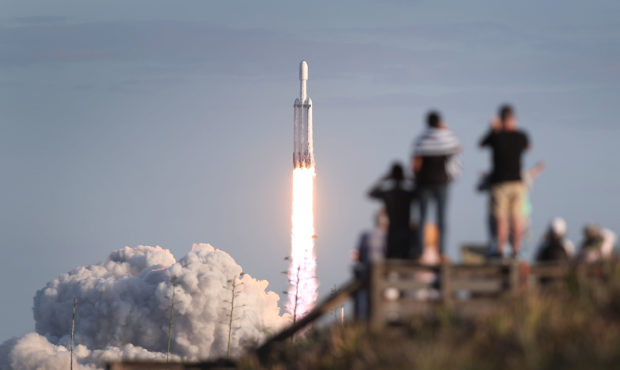
TITUSVILLE, FLORIDA - APRIL 11: People watch as the SpaceX Falcon Heavy rocket lifts off from launch pad 39A at NASA’s Kennedy Space Center on April 11, 2019 in Titusville, Florida. The rocket is carrying a communications satellite built by Lockheed Martin into orbit. (Photo by Joe Raedle/Getty Images)
(Photo by Joe Raedle/Getty Images)

(CNN) — SpaceX fired 60 small satellites into orbit last week, the first installment of an internet-beaming megaconstellation that the company hopes will grow to include thousands of satellites in just a few years.
Elon Musk’s space company is just one of several with its eyes on beaming broadband to Earth from space. Companies including Amazon and OneWeb also have similar plans. Looking ahead, a lot could go wrong for them — financially or technologically.
The most nightmarish calamity, however unlikely, wouldn’t just impact their businesses. It could set back all of human civilization.
Imagine this scenario: A single satellite loses power and smashes, uncontrolled, into another satellite. They explode, sending plumes of junk charging through space at 23 times the speed of sound.
A piece of that debris slams into another satellite, and it sets off a chain reaction that obliterates everything orbiting in nearby altitudes.
In low-Earth orbit, that could include multibillion-dollar networks like Starlink, the International Space Station, spy satellites and Earth-imaging technology.
Nothing would remain except an impenetrable graveyard of rubbish that could ground rocket launches for years, maybe even centuries.
In the rarest of situations, all satellite technology could be done for. GPS services would cut out; weather tracking technology would be lost, potentially grounding commercial flights worldwide; satellite television and phone service would be gone; the loss in bandwidth could clog ground-based systems and jam up internet and phone services. From there, economies could be crippled.
The odds of disaster
Such a scenario remains highly, highly unlikely. Space is huge and satellites are still far from “crowded” up there.
But the price of space travel is plummeting, meaning loads of new satellites are going up each year, while the risk of collisions climbs exponentially higher, explains Jonathan McDowell, an astronomer at the Harvard-Smithsonian Center for Astrophysics.
“If you put up 10 times the [current total] number of satellites, the risk isn’t just ten times as big — it’s 100 times bigger,” McDowell told CNN Business, describing the risk of a collision. While a single crash might not lead to a doomsday scenario, any incident can create problems.
Experts frequently liken the space debris issue to pollution and climate change: A devastating series of collisions may seem far-fetched until, suddenly, it’s a looming catastrophe.
T.S. Kelso, a senior researcher for satellite-tracking company Analytical Graphics Inc., said the issue should be approached with urgency no matter how remote the odds of disaster.
“We’ve got to figure out how to get a handle on this,” Kelso said. “The community needs to understand that it’s not about probability — it’s risk. It’s the consequences.”
There are already many millions of pieces of junk whirling around in orbit. They include spent rocket boosters, dead satellites and pieces of debris from an accidental collision in 2009 and military “anti-satellite” demonstrations. Most of the debris is too small to be tracked.
It’s the result of a half-century of space travel and few regulations to keep space clean.
Mitigating danger involves several things: One is finding a way to clean up some of the mess that’s already up there, though there’s no viable technology for that just yet. Another is ensuring that newly launched satellites don’t become drifting pieces of space garbage later on.
SpaceX, Starlink and the patrons of space
Musk, for his part, says SpaceX takes the problem very seriously: “We are taking great pains to make sure there’s not an orbital debris issue,” he told reporters during a recent conference call.
Each active Starlink satellite will be able to automatically dodge traceable pieces of debris headed their way, Musk said.
The satellites will also save enough fuel at the end of their lives so that they can intentionally plunge back toward Earth to get out of the way of new devices, SpaceX says. Even if a satellite unexpectedly dies, it’ll be in such a low altitude that gravity will naturally pull it out of orbit in one-to-five years, according to the company.
The Federal Communications Commission, which approves satellites for launch, approved of SpaceX’s designs and said its Starlink satellites have “zero, or near zero” risk of collision while operational.
The first 60 Starlink satellites have now been in orbit about a week, and everything seems to be going smoothly. No malfunctioning satellites or failed propulsion systems have been reported.
Still, nothing is foolproof.
“If there’s some subtle failure that only kicks in two years after launch … you could end up with a thousand dead satellites in the operational orbit,” said McDowell, the astronomer.
In other words, if all 60 of the satellites SpaceX just launched turn out to have some kind of design flaw that only becomes apparent somewhere down the line, and they all die in orbit, it could spell big trouble.
SpaceX is a well-respected company that has proven its technological chops time and time again, McDowell added. But the company took on a lot of risk launching this large batch of satellites, with an untested design, at the same time.
Averting disaster
SpaceX’s debris mitigation plan matches or exceeds expert guidelines on best practices. SpaceX competitor OneWeb also has plans to ensure its satellites don’t become spaceborne garbarge.
With spaceflight growing cheaper and more common, however, businesses with all types of goals (and little stake in whether or not space stays safe) can afford to send something into orbit.
Yet no formal international rules or punishments exist to hold satellite operators accountable for debris creation or general carelessness in space. Some countries, including the United States, are considering stricter regulations.
For now, companies and organizations mostly have to take it upon themselves to research and invest in being good patrons of space.
“It’s like any kind of environmental stewardship,” Kelso said. There isn’t always a business incentive to do the right thing, but “you don’t want to reach the point where you’re saying, ‘Gee, I wish we did this earlier.'”
The-CNN-Wire
™ & © 2019 Cable News Network, Inc., a Time Warner Company. All rights reserved.