
Global airlines reroute flights after Iran downs US drone
Jun 21, 2019, 5:32 AM
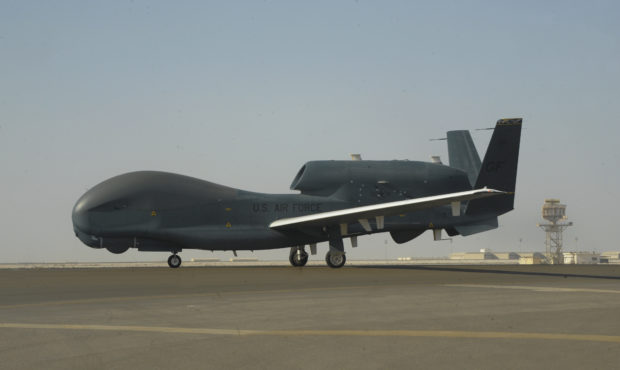
In this Feb. 13, 2018, photo released by the U.S. Air Force, an RQ-4 Global Hawk is seen on the tarmac of Al-Dhafra Air Base near Abu Dhabi, United Arab Emirates. Iran's Revolutionary Guard shot down a U.S. RQ-4 Global Hawk on Thursday, June 20, 2019, amid heightened tensions between Tehran and Washington over its collapsing nuclear deal with world powers, American and Iranian officials said, though they disputed the circumstances of the incident. (Airman 1st Class D. Blake Browning/U.S. Air Force via AP)
(Airman 1st Class D. Blake Browning/U.S. Air Force via AP)

DUBAI, United Arab Emirates (AP) — Major airlines from around the world on Friday began rerouting their flights to avoid areas around the Strait of Hormuz following Iran’s shooting down of a U.S. military surveillance drone there, as America warned commercial airliners could be mistakenly attacked.
The Federal Aviation Administration warned of a “potential for miscalculation or misidentification” in the region after an Iranian surface-to-air missile on Thursday brought down a U.S. Navy RQ-4A Global Hawk, an unmanned aircraft with a wingspan larger than a Boeing 737 jetliner and costing over $100 million. The U.S. said it made plans for limited strikes on Iran in response, but then called them off.
Australia’s Qantas, British Airways, Dutch carrier KLM and Germany’s Lufthansa said soon afterward that they will avoid the region as well.
The FAA previously warned of a risk in the region, but Friday’s warning threw into stark relief a danger that both the agency and analysts say is real after the shooting down of a Malaysian Airlines flight over Ukraine in 2014. That could further imperil the bottom lines of Gulf long-haul carriers, which already have faced challenges under the Trump administration.
“The threat of a civil aircraft shootdown in southern Iran is real,” warned OPSGROUP, a company that provides guidance to global airlines.
The FAA made a similar warning in May to commercial airliners of the possibility of Iranian anti-aircraft gunners mistaking them for military aircraft, something dismissed by Tehran some 30 years after the U.S. Navy shot down an Iranian passenger jet.
Iran had no immediate reaction to the U.S. announcement.
The FAA said its warning would affect the area of the Tehran Flight Information Region, without elaborating. The FAA’s operations center referred questions to its press office, which did not immediately respond to queries from The Associated Press. However, that likely only extends some 12 miles off of the Iranian coast, aviation experts said.
There are “heightened military activities and increased political tensions in the region, which present an inadvertent risk to U.S. civil aviation operations and potential for miscalculation or misidentification,” the FAA said. “The risk to U.S. civil aviation is demonstrated by the Iranian surface-to-air missile shoot-down of a U.S. unmanned aircraft system on 19 June 2019 while it was operating in the vicinity of civil air routes above the Gulf of Oman.”
Qantas said it would reroute its London flights to avoid the Strait of Hormuz and Gulf of Oman. Dutch carrier KLM and British Airways said their flights would avoid the strait. Lufthansa said it would avoid both the Strait of Hormuz and the Gulf of Oman, as well as nearby land. However, it said it would continue its flights to Tehran.
The Persian Gulf is home to some of the world’s top long-haul carriers, who already have been battered by Trump’s travel bans targeting a group of predominantly Muslim countries, as well as an earlier ban on laptops in airplane cabins for Mideast carriers. Etihad, the Abu Dhabi-based long-haul carrier, said it had “contingency plans” in place, without elaborating.
“We will decide what further action is required after carefully evaluating the FAA directive to U.S. carriers,” the carrier told The Associated Press.
The other major carriers, Emirates and Qatar Airways, as well as low-cost carriers, did not immediately respond to requests for comment.
Iran said the drone “violated” its territorial airspace, while the U.S. called the missile fire “an unprovoked attack” in international airspace over the Strait of Hormuz, the narrow mouth of the Persian Gulf. OPSGROUP said the Iranian weapons system that shot down the drone was comparable to the Russian Buk system used in 2014 Malaysian Airlines shootdown in Ukraine.
“Any error in that system could cause it to find another target nearby – another reason not to be anywhere near this part of the Straits of Hormuz,” OPSGROUP said.
President Donald Trump initially tweeted that “Iran made a very big mistake!” He later appeared to play down the incident, telling reporters in the Oval Office that he had a feeling “a general or somebody” being “loose and stupid” made a mistake in shooting down the drone.
A U.S. official said the military made preparations Thursday night for limited strikes on Iran in retaliation for the downing of a U.S. surveillance drone, but approval was abruptly withdrawn before the attacks were launched.
The official, who was not authorized to discuss the operation publicly and spoke on condition of anonymity, said the targets would have included radars and missile batteries.
The New York Times reported that President Donald Trump had approved the strikes, but then called them off. The newspaper cited anonymous senior administration officials.
The White House on Thursday night declined requests for information about whether Trump changed his mind.
The incident immediately heightened the crisis already gripping the wider region, which is rooted in Trump withdrawing the U.S. a year ago from Iran’s 2015 nuclear deal and imposing crippling new sanctions on Tehran. Recently, Iran quadrupled its production of low-enriched uranium to be on pace to break one of the deal’s terms by next week while threatening to raise enrichment closer to weapons-grade levels on July 7 if Europe doesn’t offer it a new deal.
Citing unspecified Iranian threats, the U.S. has sent an aircraft carrier to the Middle East and deployed additional troops alongside the tens of thousands already there. All this has raised fears that a miscalculation or further rise in tensions could push the U.S. and Iran into an open conflict, 40 years after Tehran’s Islamic Revolution.
“We do not have any intention for war with any country, but we are fully ready for war,” Revolutionary Guard commander Gen. Hossein Salami said in a televised address Thursday.
___
Associated Press writers Lolita C. Baldor and Deb Riechmann in Washington, David Rising in Berlin and Mike Corder in The Hague, Netherlands, contributed to this report.






