
Lost wallet? More cash means you’re likelier to get it back
Jun 21, 2019, 5:36 AM | Updated: 5:36 am
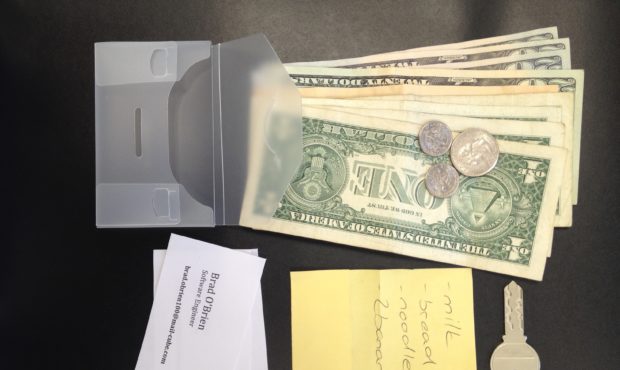
This undated photo provided by researchers in June 2019 shows an example of the contents of a transparent wallet used in an experiment to test how likely people are to return a lost wallet. "The evidence suggests that people tend to care about the welfare of others, and they have an aversion to seeing themselves as a thief," said Alain Cohn of the University of Michigan, one author who reported the results Thursday, June 20, 2019 in the journal Science. (Christian Zünd via AP)
(Christian Zünd via AP)

NEW YORK (AP) — People are more likely to return a lost wallet if it contains money — and the more cash, the better.
That’s the surprising conclusion from researchers who planted more than 17,000 “lost wallets” across 355 cities in 40 countries, and kept track of how often somebody contacted the supposed owners.
The presence of money — the equivalent of about $13 in local currency — boosted this response rate to about 51%, versus 40% for wallets with no cash. That trend showed up in virtually every nation, although the actual numbers varied.
Researchers raised the stakes in the U.S., the United Kingdom and Poland. The response jumped to 72% for wallets containing the equivalent of about $94, versus 61% for those containing $13. If no money was enclosed, the rate was 46%.
How can this be?
“The evidence suggests that people tend to care about the welfare of others, and they have an aversion to seeing themselves as a thief,” said Alain Cohn of the University of Michigan, one author who reported the results Thursday in the journal Science.
Another author, Christian Zuend of the University of Zurich, said “it suddenly feels like stealing” when there’s money in the wallet. “And it feels even more like stealing when the money in the wallet increases,” he added. That idea was supported by the results of polls the researchers did in the U.S., the U.K. and Poland, he told reporters.
The wallets in the study were actually transparent business card cases, chosen so that people could see money inside without opening them. A team of 13 research assistants posed as people who had just found the cases and turned them in at banks, theaters, museums or other cultural establishments, post offices, hotels and police stations or other public offices. The key question was whether the employee receiving each case would contact its supposed owner, whose name and email address were displayed on three identical business cards within.
The business cards were crafted to make the supposed owner appear to be a local person, as was a grocery list that was also enclosed. Some cases also contained a key, and they were more likely to get a response than cases without a key. That led the researchers to conclude that concern for others was playing a role, since — unlike money — a key is valuable to its owner but not a stranger.
The effect of enclosed money appeared in 38 of the 40 countries, with Mexico and Peru the exceptions. Nations varied widely in how often the wallet’s “owner” was contacted. In Switzerland the rate was 74% for wallets without money and 79% with it, while in China the rates were 7% and 22%. The U.S. figures were 39% and 57%.
The study measured how employees act when presented with a wallet at their workplaces. But would those same people act differently if they found a wallet on a sidewalk?
“We don’t know,” said Michel Marechal, an author from the University of Zurich. But he said other analyses suggest the new results reflect people’s overall degree of honesty.
Shaul Shalvi of the University of Amsterdam, who wrote a commentary that accompanied the study, told The Associated Press that he suspected the study does shed light on how people would act with a wallet found on the street.
He said the results “support the idea that people care about others as well as caring about being honest.”
Robert Feldman, psychology professor at the University of Massachusetts Amherst who didn’t participate in the work, said he suspected the experiment might have turned out differently if involved “everyday people” rather than employees acting in an official capacity.
But Feldman called the study impressive and said it seems like “a very real result.”
Dan Ariely, a psychology professor at Duke University who didn’t participate in the research, said the conclusions fit with research that indicates keeping a larger amount of money would be harder for a person to rationalize.
“It very much fits with the way social scientists think about dishonesty,” he said.
___
The Associated Press Health and Science Department receives support from the Howard Hughes Medical Institute’s Department of Science Education. The AP is solely responsible for all content.






