
Agency cites ‘staggering’ cost of reining in US wild horses
May 14, 2020, 7:07 AM | Updated: 7:07 am

FILE - In this Jan. 13, 2011, file photo, two young wild horses play while grazing in Reno, Nev. Federal land managers say it will take 20 years and cost more than $1 billion over the first six years alone to slash wild horse populations to sustainable levels necessary to protect U.S. range land. (Andy Barron/The Reno Gazette-Journal via AP, File)
(Andy Barron/The Reno Gazette-Journal via AP, File)

RENO, Nev. (AP) — Federal land managers say it will take two decades and cost more than $1 billion over the first six years alone to slash wild horse populations to sustainable levels necessary to protect U.S. rangeland.
The Bureau of Land Management’s latest plans envision capturing 200,000 mustangs over the next two decades. It also wants to build corrals to hold thousands more than current capacity and adopt regulations allowing the permanent sterilization of horses roaming federal lands for the first time.
“The overall funding requirements could be staggering,” the bureau acknowledged in a report to Congress this week.
The strategy underscores the volatility of the decades-long controversy pitting horse advocates against ranchers whose livestock compete for federally subsidized forage across 10 western states.
“The estimates in this analysis are intended to identify to committees the severity of program challenges,” the agency said.
The 25-page report repeats 10 separate times that the estimates “should not be construed to imply Administration support for particular levels of appropriations for this program beyond FY 2021.”
However, it also suggests Congress should put its money where its mouth is when it comes to managing mustangs, noting that language congressional conferees included in the Interior Department’s last appropriation bill states it is “incumbent upon the bureau to request the funding necessary to address this growing problem.”
The bureau says if nothing is done to curb annual growth rates of herds that naturally double every four or five years, the number of wild horses and burros on the range could exceed 2.8 million by 2040.
It stops short of repeating past requests to eliminate prohibitions on the resale of excess horses for slaughter.
But horse defenders said that’s clearly the intention of painting such a dire picture of the challenges. They argue horses grazing federal land are dramatically outnumbered by cattle that cause significantly more ecological damage.
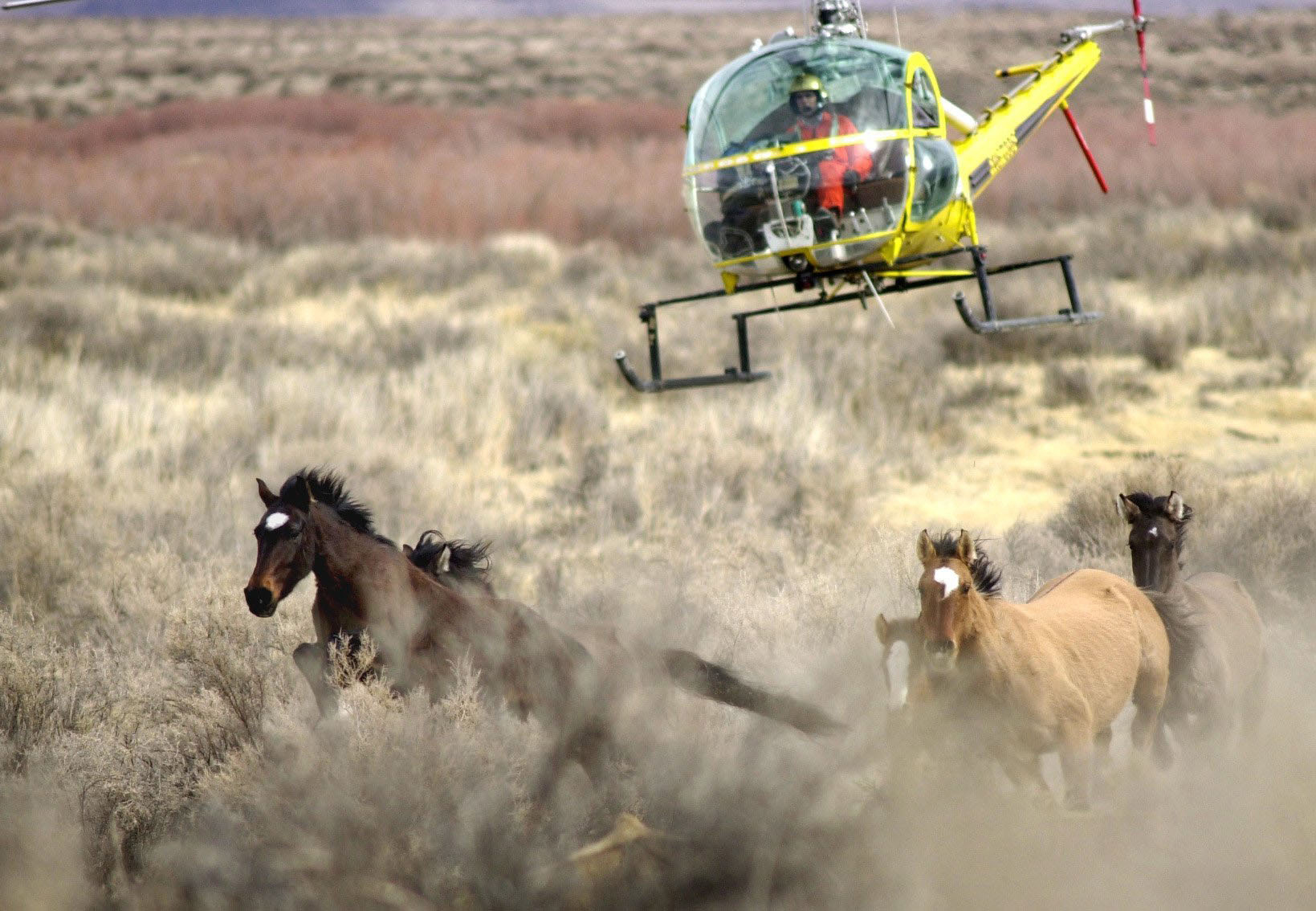
FILE – In this January 2004 file photo, the Bureau of Land Management uses a helicopter for gathering 251 wild horses from the Lahontan Herd Management Area in Nevada. Federal land managers say it will take 20 years and cost more than $1 billion over the first six years alone to slash wild horse populations to sustainable levels necessary to protect U.S. range land. (Lisa J. Tolda/The Reno Gazette-Journal via AP, File)
“By prioritizing the failed approach of mass roundup and warehousing of tens of thousands of wild horses in holding facilities, the agency is setting the stage for the ultimate slaughter of these American icons,” said Suzanne Roy, executive director of the American Wild Horse Campaign.
Rep. Raul Grijalva, D-Arizona, chairman of the House Natural Resources Committee, said a more sustainable path would require use of fertility controls, “not surgical sterilization or other inhumane methods.”
“This report envisions massive roundups without a viable plan for dealing with the horses once they’ve left the range,” he said. “It’s almost as if the BLM is setting itself up for failure.”
The bureau maintains the range can only support 27,000 horses — something horse advocates dispute.
The agency said it captured 80,000 horses and burros during the 1990s. By 2000, about 48,000 remained on the range, with 10,000 in holding facilities. Now, it estimates 88,000 roam the range, with 47,000 in government corrals and off-range pastures.
It plans more contraception research but warns “using only short-term fertility control vaccines at any scale” won’t significantly reduce on-range populations.
Kaitlynn Glover, executive director of the Public Lands Council and National Cattlemen Beef Association Natural Resources, said the report “provides clear and welcome recognition of the hard decisions that are necessary to protect our rangelands and the animals themselves.”
Nevada Farm Bureau Executive Vice President Doug Busselman said accelerated roundups and sterilizations are long overdue.
“The current condition of over-population is not acceptable,” he said.
Congress allocated $80 million annually for the efforts from 2011 to 2019. The bureau estimates it needs $900 million over the first five years to rein in herds — $116 million next year, growing to $238 million by year five.
“With potentially more than 250,000 animals being held in off-range pastures, a spike in daily feed rates could dramatically increase out-year funding needs,” it said.






