Reality bites for Putin’s much-hyped Covid-19 vaccine, as concerns over efficacy and safety linger
Oct 27, 2020, 8:02 AM
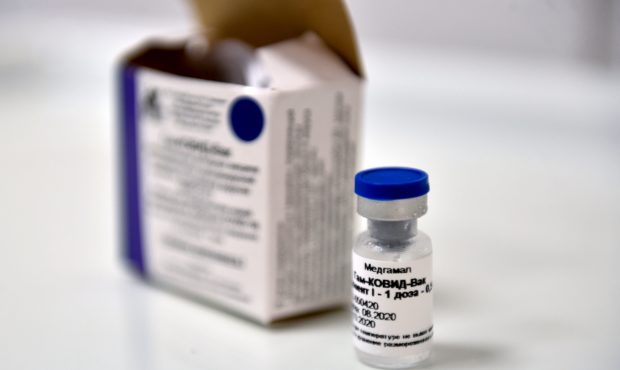
A vial with Russia's new coronavirus vaccine is seen prior to a vaccination of a volunteer in a post-registration trials, Moscow, September 10, 2020. - Russia announced last month that its vaccine, named "Sputnik V" after the Soviet-era satellite that was the first launched into space in 1957, had already received approval. The vaccine was developed by the Gamaleya research institute in Moscow in coordination with the Russian defence ministry. (Photo by Natalia KOLESNIKOVA / AFP) (Photo by NATALIA KOLESNIKOVA/AFP via Getty Images)
(Photo by NATALIA KOLESNIKOVA/AFP via Getty Images)

(CNN) — In August, Russian state media rolled out the red carpet for a bombshell announcement — President Vladimir Putin, from his residence outside Moscow, unveiled what he said was the world’s first registered coronavirus vaccine, meant to bring Russia closer to the end of a devastating pandemic.
Putin, who is famously secretive about his family, said one of his daughters had already been inoculated as part of the early-stage trials and felt “well,” to bulk up the vaccine’s safety claims.
Now, as the second wave of Covid-19 hits the country — with record numbers of new infections and deaths — the vaccine, named Sputnik V, is far from being widely available to the general public.
Russia has passed a grim milestone of 1.5 million cases and at least 26,269 deaths, although experts have previously cast doubts on Russia’s counting methods.
Lagging in trials
Russia approved the vaccine after trying it on several dozen subjects in a non-blind study and ahead of Phase 3 trials, which are key to establish its safety and efficacy, drawing skepticism from the international community and accusations it could have jumped the gun for political gains.
Alexander Gintsburg, head of the Gamaleya Institute which developed the vaccine, told CNN in an exclusive interview last week at Valdai Discussion Club, a Moscow-based think tank where Putin often makes an appearance, that 17,000 people took part in the Phase 3 trials but acknowledged that only 6,000 so far have received both doses necessary to complete the vaccination.
The vaccine is indicated for use in people age 18-60, according to its instructions, since no large-scale trials on other age groups have been conducted. But despite this, Gintsburg said people over 60 can still take it.
International virology experts cast doubt on Russia’s claims of proven safety. “People who were immunized with this vaccine won’t know whether they will be protected or develop a severe disease until they encounter the virus,” Konstantin Chumakov, a top virologist with the Global Virus Network, told CNN in an interview.
“And to do this, you need to immunize a whole lot of people and just wait until they will be infected and see whether they will have a lower incidence or they will have more severe disease. There is just nothing that can replace clinical trials.”
By comparison, as of October 26, BioNTech-Pfizer reported that it had enrolled 42,113 participants out of a prospective 44,000 in the Phase 3 trial in the United States for their vaccine candidate, with 35,771 people having received their second doses.
Moderna, the first company to start US Phase 3 clinical trials of a Covid-19 vaccine, said Thursday that 25,650 people have received their second shot out of around 30,000 enrolled participants.
The Russian vaccine “is probably two to three months behind,” Chumakov said. “Moderna and Pfizer basically finished enrolling the patients and now they’re in the observation phase looking at the incidence of disease in placebo and immunized individuals.”
The speedy development and approval of Sputnik V, the Gamaleya Institute explains, was possible as it is based on two of their previous developments, vaccines for Ebola and MERS, the Middle East Respiratory Syndrome. The Ebola vaccine, Gintsburg previously said, was approved for trials in Guinea on just 2,000 people.
Chumakov notes that neither of these vaccines has been fully authorized by international bodies or tested enough to say it is effective and safe, and the Russian Ebola vaccine was tried in Guinea only post-outbreak.
“This particular institute, they have developed several prototype vaccines, I wouldn’t call them vaccines,” Chumakov said. “I don’t think that this institute has developed a vaccine in the last, you know, 30 years. They are very good in developing prototypes … but I don’t believe they have any experience in bringing products to the market.”
Production challenges
Russia’s own estimates of their capability to mass-produce the vaccine vary greatly depending on whom you ask.
In July, the head of Russia Direct Investment Fund Kirill Dmitriev said the sovereign wealth fund plans to produce more than 30 million doses by end of 2020. But Russia’s trade and industry minister Denis Manturov said earlier this month these numbers are “impossible.”
“To have 30 million doses by year-end is impossible, it is nonsense,” Manturov said in an interview with Bloomberg TV.
The Ministry of Industry and Trade did not provide CNN with the exact figure of how many doses have been made so far but said the goal was to scale up production to 300,000 doses by the end of October and 2.3 million by the end of the year.
Gintsburg told CNN Russia could produce around 5 million a month by December, which he said would allow getting enough doses to vaccinate 70% of the Russian population in about a year.
But unless Russia ramps up the production significantly from 5 million doses a month, the country will be only able produce around 60 million doses in this time frame, meaning it would be able to effectively vaccinate about 30 million people with both doses — out of more than 146 million Russians.
Whether Russia will be able to scale up the production to meet the latest goals remains questionable, but more sites are preparing to go online to produce Sputnik V in the next weeks while Phase 3 trials are ongoing.
All Russian regions have received pilot batches of Sputnik V, the Ministry of Health said at the end of September. But at least 10 regions reported the first supply to be relatively small, between 42 and 44 doses, according to a CNN tally based on statements from health officials and media reports.
Authorities in the Yamal-Nenets region, which received 42 doses of the vaccine, said in a statement to TASS the delivery is complicated by “special temperature conditions during transportation and storage.”
Most coronavirus vaccine front-runners require storage at deep-freeze temperatures, imposing additional challenges on governments to set up functioning supply chains. The Pfizer vaccine must be stored at -70 °C (-94 °F), while Moderna vaccine requires storage at -20 °C (-4 °F) and Sputnik V at -18 °C (-0.4 °F).
“I have a whole lot of respect to them as scientists but unfortunately they probably don’t appreciate the scale of issues that they will be facing to bring this product to the market,” Chumakov said.
“There is a huge distance between the experimental sample that can be prepared in the lab and bringing it to the mass production and distribution,” he added. “I think that’s a very cavalier attitude that, OK, we’ve just synthesized it in two weeks and here we go, we have a vaccine. They have a prototype. And until it’s tested, it still remains a prototype.”
PR frenzy
What Sputnik V lacks in participants and data, it has compensated for in PR.
Despite Phase 3 trial being in early stages, high-ranking Russian officials made public announcements about their vaccination in meetings with Putin. State TV ran clips of Defense Minister Sergei Shoigu taking the shot in one of the clinics. In early October, Putin announced that dozens of his relatives and staffers working around him got vaccinated.
Putin did not specify which of his daughters took the vaccine as he rarely calls them by name, even referring to them as “these women” when asked last year about their businesses in Russia. Alexey Venediktov, a well-connected editor-in-chief of radio station Echo of Moscow, said Katerina Tikhonova, widely believed to be Putin’s youngest daughter, was the one who got the shot in early-stage trials.
Gintsburg previously told CNN the Gamaleya Institute did not receive any instructions and has no “links to the Kremlin,” dismissing a suggestion there was political pressure to speed the production of vaccine.
Tikhonova heads the organization Innopraktika, which says its mission is to bring scientific developments into the business world and boasts a long list of heads of Russia’s key state enterprises like Gazprom, Rosatom and Transneft as members of the board. RDIF’s Kirill Dmitriev is also a board member, and his wife, Natalia Popova, is the deputy director of Innopraktika.
Popova told state TV she was able to see “how the vaccine was born in closed labs of Gamaleya Institute” and was among the first people to receive Sputnik V, even ahead of her husband.
Russian officials and state media also promoted Sputnik V as superior to some other Western vaccines. RDIF repeatedly said its drug is “based on a well-studied human adenoviral vectors platform with proven safety and efficacy” unlike those based on mRNA and chimpanzee adenovirus, such as the UK’s AstraZeneca vaccine.
Earlier this month, British officials slammed Russia for what they believe is a disinformation campaign against the AstraZeneca vaccine, dubbed “monkey vaccine” by some Russians, following a flurry of social media posts with baseless memes suggesting the drug could turn people into monkeys.
Kremlin denied the allegations and RDIF said it condemns social media posts attacking the vaccine. RDIF’s portfolio company R-Pharm also signed a deal with AstraZeneca this summer to produce the British vaccine in Russia.
“I don’t think that this vaccine is any better or worse than other similar products because there are many adenovirus-based vaccines in development right now and they’re being tested. So this one is probably OK — but we need to have data and we don’t have it yet,” Chumakov said, adding that although some vaccines are close to obtaining a license, there is no fully authorized and widely used adenovirus vaccine to date.
Economic boost
Aside from scoring PR victories, Russia is aiming for economic gains.
Last week Putin told the leaders of the RSPP or the Russian Union of Industrialists and Entrepreneurs, Russia’s biggest business lobby, that Sputnik V was “good business and the humanitarian component is clear,” adding that it could earn $100 billion in revenue worldwide, state-run news agency RIA Novosti reported.
RDIF announced it had reached deals with several countries, including India, Brazil and Egypt, to supply millions of doses of Sputnik V. But the fund might face licensing difficulties in trying to expand Sputnik production globally due to different standards.
“I think that in the United States, in Europe, in countries that really adhere to the international rules of product development, testing and licensure, this would not fly, it’s definitely a gamble,” Chumakov said.
Nevertheless, the country’s officials say they plan to roll out mass vaccination in the coming months, even though state polls show the majority of Russians do not want to get the vaccine.
One Russian who isn’t taking the Sputnik V vaccine so far is the President, with his spokesman telling CNN that he is still thinking about it.
The-CNN-Wire
™ & © 2020 Cable News Network, Inc., a WarnerMedia Company. All rights reserved.