What judges have said about birthright citizenship and nationwide injunctions
May 15, 2025, 12:31 PM
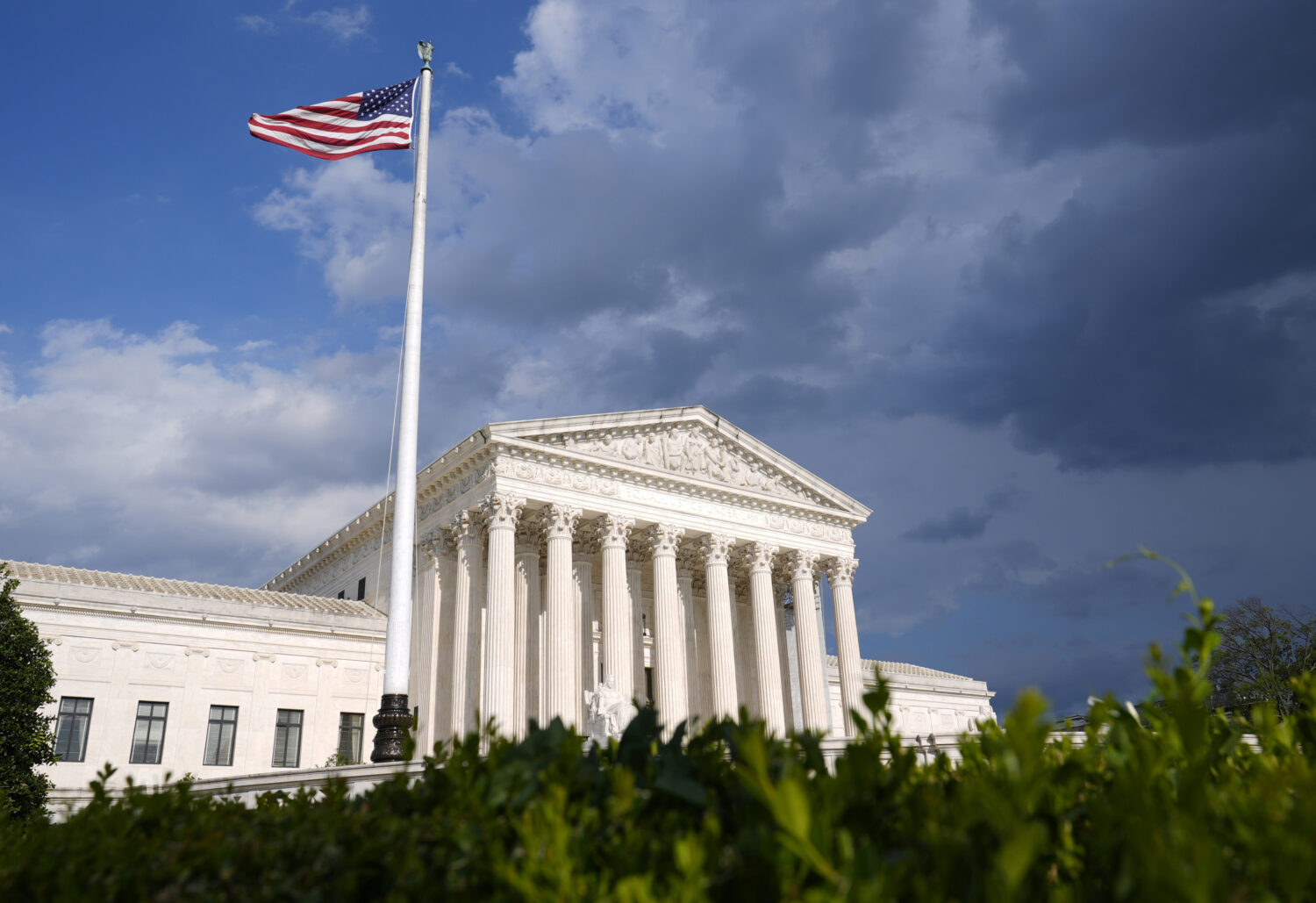
FILE - The Supreme Court in Washington, June 30, 2024. (AP Photo/Susan Walsh, File)
Credit: ASSOCIATED PRESS
(AP Photo/Susan Walsh, File)
WASHINGTON (AP) — Federal courts have uniformly blocked President Donald Trump’s order seeking to end birthright citizenship for children born in the United States to someone in the country illegally.
Tune in at 1:05 for the latest on Midday with Maria Shilaos.
The Supreme Court is hearing arguments Thursday in appeals of three of those orders that prevented the Trump administration’s citizenship restrictions from taking effect anywhere in the United States.
At issue are both the meaning of the Citizenship Clause of the 14th Amendment and the authority of individual judges to universally block policies rather than apply them just to the people and organizations that sued.
In dozens of pages of opinions, four federal judges have explained why they believe Trump’s birthright citizenship executive order, signed on his first day in office, is unconstitutional. Nine appellate judges also have weighed in over whether to narrow or pause those rulings while the administration appeals.
Here are excerpts from their opinions, as well as the 1898 Supreme Court case, United States v. Wong Kim Ark, that the judges have cited as the clearest precedent for their rulings:
Supreme Court ruled 127 years ago in favor of a child born in San Francisco to Chinese parents
Justice Horace Gray wrote the majority opinion in the 6-2 decision that Wong was a citizen by virtue of his birth on American soil.
“The real object of the Fourteenth Amendment of the Constitution, in qualifying the words ‘all persons born in the United States’ by the addition ‘and subject to the jurisdiction thereof,’ would appear to have been to exclude, by the fewest and fittest words (besides children of members of the Indian tribes, standing in a peculiar relation to the national government, unknown to the common law), the two classes of cases, — children born of alien enemies in hostile occupation, and children of diplomatic representatives of a foreign state.”
“… The fourteenth amendment affirms the ancient and fundamental rule of citizenship by birth within the territory, in the allegiance and under the protection of the country, including all children here born of resident aliens, with the exceptions or qualifications (as old as the rule itself) of children of foreign sovereigns or their ministers, or born on foreign public ships, or of enemies within and during a hostile occupation of part of our territory, and with the single additional exception of children of members of the Indian tribes owing direct allegiance to their several tribes.
“The amendment, in clear words and in manifest intent, includes the children born within the territory of the United States of all other persons, of whatever race or color, domiciled within the United States.
In dissent, Chief Justice Melville Fuller wrote that Wong could not be a citizen because his parents still owed their allegiance to the Chinese emperor and could not be fully “subject to the jurisdiction” of the United States. Justice John Marshall Harlan joined the dissent.
4 federal judges have said the changes likely violate the Constitution and 3 have blocked them nationally
“I’ve been on the bench for over four decades. I can’t remember another case where the question presented was as clear as this one is. This is a blatantly unconstitutional order,” U.S. District Judge John Coughenour said at a hearing in his Seattle courtroom.
In his written order, Coughenour said, “The plaintiffs are likely to succeed on their claim that the order violates the Citizenship Clause of the 14th Amendment … Indeed, the court need only look to its text. The Citizenship Clause is clear: ‘All persons born or naturalized in the United States, and subject to the jurisdiction thereof, are citizens of the United States and of the State wherein they reside.’ In other words, any individual who is born in the territorial United States or properly naturalized according to federal procedures is a citizen of this country.
“The government for its part relies on the provision of the Citizenship Clause that conditions citizenship upon being ‘subject to the jurisdiction’ of the United States. That is, the government argues that ‘children born in the United States of illegal aliens or temporary visitors’ are not ‘subject to the jurisdiction thereof’ and therefore cannot be considered birthright citizens … But the government accords more meaning to the phrase ‘subject to the jurisdiction’ than those words or precedent support.”
U.S. District Judge Leo Sorokin in Boston said the Wong Kim Ark decision resolved the current case. “The rule and reasoning from that decision were reiterated and applied in later decisions, adopted by Congress as a matter of federal statutory law in 1940, and followed consistently by the Executive Branch for the past 100 years, at least. A single district judge would be bound to apply that settled interpretation, even if a party were to present persuasive arguments that the long-established understanding is erroneous. The defendants, however, have offered no such arguments here. “The loss of birthright citizenship — even if temporary, and later restored at the conclusion of litigation — has cascading effects that would cut across a young child’s life (and the life of that child’s family), very likely leaving permanent scars. The record before the court establishes that children born without a recognized or lawful status face barriers to accessing critical healthcare, among other services, along with the threat of removal to countries they have never lived in and possible family separation. That is irreparable harm.”
In Greenbelt, Maryland, a Washington suburb, U.S. District Judge Deborah Boardman wrote that “the Supreme Court has resoundingly rejected and no court in the country has ever endorsed” Trump’s interpretation of birthright citizenship.
The children targeted by Trump’s order don’t fit into any of the exceptions the high court recognized in 1898, Indian tribes, foreign diplomats or occupying forces. “They are children whose citizenship by birth has been recognized in this country since the ratification of the Fourteenth Amendment. When the children described in the Executive Order are born, they will be United States citizens under the Fourteenth Amendment and long-standing Supreme Court precedent. The President does not have the authority to strip them of their constitutional right to citizenship by birth,” she wrote.
Boardman also explained why she issued a nationwide injunction. One of the groups that sued, ASAP, has more than 680,000 members. “Because ASAP’s members reside in every state and hundreds of them expect to give birth soon, a nationwide injunction is the only way ‘to provide complete relief’ to them,” she wrote. “It also is necessary because the policy concerns citizenship—a national concern that demands a uniform policy.”
In New Hampshire, U.S. District Judge Joseph Laplante blocked the citizenship order only in the state. “The court need not presume the Executive Order’s constitutionality. ‘A legislative enactment carries with it a presumption of constitutionality.’ The defense has not argued, or cited binding or persuasive authority, that executive orders enjoy a similar presumption, and the court does not know of any,” Laplante wrote.
3 federal appeals courts have refused to let the citizenship changes take effect while Trump appeals
In the 9th U.S. Circuit Court of Appeals, Judge Danielle Forrest, a Trump appointee, wrote to explain why she voted against an emergency stay of Coughenour’s ruling. “To constitute an emergency under our Rules, the Government must show that its inability to implement the specific policy at issue creates a serious risk of irreparable harm within 21 days,” Forrest wrote. “The Government has not made that showing here. Nor do the circumstances themselves demonstrate an obvious emergency where it appears that the exception to birthright citizenship urged by the Government has never been recognized by the judiciary and where executive-branch interpretations before the challenged executive order was issued were contrary.”
In the 1st U.S. Circuit Court of Appeals, Judge David Barron wrote for a unanimous panel. “The Government expressly declines to make any developed argument that it is likely to succeed on appeal in showing that the Executive Order is either constitutional or compliant with” federal law, Barron wrote.
The three-judge panel in the 4th U.S. Circuit Court of Appeals split 2-1 to deny the administration’s emergency appeal, focused on nationwide, or universal, injunctions. “We are of course aware of separate writings by Supreme Court Justices, emphasized by the government, that express concerns about the propriety of universal injunctions and an interest in taking up that question. But notwithstanding these reservations, the Supreme Court has allowed most universal injunctions to remain in effect during the course of litigation, even in cases in which the Court has ultimately reversed on the merits,” Judges Pam Harris and Roger Gregory wrote. “No decision of the Supreme Court has superseded our precedent in this area, and we have no reason to think the Court will soon announce a change in course.”
They also forecast “confusion and upheaval” if the restrictions were allowed to take effect. “Even for children born to two citizen parents, a standard birth certificate will no longer suffice to prove citizenship – not under the Executive Order, and not for any other purpose. Existing administrative systems will fail, states and localities will bear the costs of developing new systems for issuing birth certificates and verifying citizenship, and anxious parents-to-be will be caught in the middle.”
In dissent, Judge Paul Niemeyer wrote that administration “only seeks to stay the effort by the district court to impose its injunction nationwide to afford relief to persons beyond the District of Maryland.”
The legality of the Trump order was not before the court, Niemeyer wrote. “Rather, it is whether the court was entitled, in the circumstances of this case, to extend its injunction to apply ‘throughout these United States’ — to persons not before the court nor identified by the court. I would grant the government’s modest motion, which seeks only to cabin the order’s inappropriate reach,” he wrote.
Related reading: Trump’s birthright citizenship order is put on hold by a second federal judge