ELECTIONS, POLITICS, & GOVERNMENT
Supporters press for a DC memorial to Thomas Paine, whose writings helped fuel the Revolutionary War
Jan 10, 2026, 3:33 PM | Updated: 3:47 pm
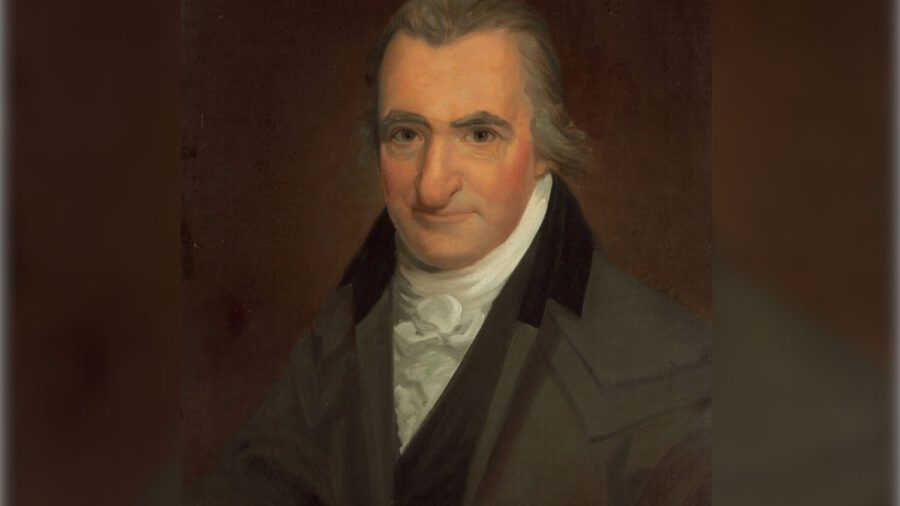
This image provided by the National Gallery of Art shows a painted portrait of American founding-father Thomas Paine by John Wesley Jarvis. (National Gallery of Art via AP)
(National Gallery of Art via AP)
NEW YORK (AP) — Some 250 years after “Common Sense” helped inspire the 13 colonies to declare independence, Thomas Paine might receive a long-anticipated tribute from his adopted country.
A Paine memorial in Washington, D.C., authorized by a 2022 law, awaits approval from the U.S. Department of Interior. It would be the first landmark in the nation’s capital to be dedicated to one of the American Revolution’s most stirring, popular and quotable advocates — who also was one of the most intensely debated men of his time.
“He was a critical and singular voice,” said U.S. Rep. Jamie Raskin, D-Md., a sponsor of the bill that backed the memorial. He said Paine has long been “underrecognized and overlooked.”
Saturday marks the 250th anniversary of the publication of Paine’s “Common Sense,” among the first major milestones of a yearlong commemoration of the country’s founding and the signing of the Declaration of Independence in 1776.
Paine supporters have waited decades for a memorial in the District of Columbia, and success is still not ensured: Federal memorials are initiated by Congress but usually built through private donations. In 1992, President George H.W. Bush signed bipartisan legislation for such a memorial, but the project was delayed, failed to attract adequate funding and was essentially forgotten by the mid-2000s.
The fate of the current legislation depends not just on financial support, but on President Donald Trump’s interior secretary, Doug Burgum.
In September 2024, the memorial was recommended by the National Capital Memorial Advisory Commission for placement on the National Mall. Burgum needs to endorse the plan, which would be sent back to Congress for final enactment. If approved, the memorial would have a 2030 deadline for completion.
A spokesperson for the department declined comment when asked about the timing for a decision.
“We are staying optimistic because we feel that Thomas Paine is such an important figure in the founding of the United States of America,” said Margaret Downey, president of the Thomas Paine Memorial Association, which has a mission to establish a memorial in Washington.
A contentious legacy
Scholars note that well into the 20th century, federal honors for Paine would have been nearly impossible. While Paine first made his name through “Common Sense,” the latter part of his life was defined by another pamphlet, “The Age of Reason.”
Published in installments starting in 1794, it was a fierce attack against organized religion. Paine believed in God and a divinely created universe but accepted no single faith. He scorned what he described as the Bible’s “paltry stories” and said Christianity was “too absurd for belief, too impossible to convince, and too inconsistent for practice.”
By the time of his death, in New York in 1809, he was estranged from friends and many of the surviving founders; only a handful of mourners attended his funeral. He has since been championed by everyone from labor leaders and communists to Thomas Edison, but presidents before Franklin Roosevelt in the 1930s rarely quoted him. Theodore Roosevelt referred to him as a “filthy little atheist.”
There are Paine landmarks around the country, including a monument and museum in New Rochelle, New York, and statue in Morristown, New Jersey. But other communities have resisted. In 1955, Mayor Walter H. Reynolds of Providence, Rhode Island, rejected a proposed Paine statue, saying “he was and remains so controversial a character.”
Harvey J. Kaye, author of “Thomas Paine and the Promise of America,” cites the election of Ronald Reagan as president in 1980 as a surprising turning point. Reagan’s victory was widely seen as a triumph for the modern conservative movement, but Reagan alarmed some Republicans and pleased Paine admirers during his acceptance speech at the Republican National Convention when he quoted Paine’s famous call to action: “We have it in our power to begin the world over again.”
Reagan helped make Paine palatable to both parties, Kaye said. When Congress approved a memorial in 1992, supporters ranged from a liberal giant, Democratic Sen. Ted Kennedy of Massachusetts, to a right-wing hero, Republican Sen. Jesse Helms of North Carolina.
“Reagan opened the door,” Kaye said.
An immigrant who stoked the fire of revolution
Paine’s story is very much American. He was a self-educated immigrant from Britain who departed for the colonies with little money but with hopes for a better life.
He was born Thomas Pain in Thetford in 1737, some 90 miles outside of London (he added the “e” to his last name after arriving in America). Paine was on the move for much of his early life. He spent just a few years in school before leaving at age 13 to work as an apprentice for his father, a corset maker. He would change jobs often, from teaching at a private academy to working as a government excise officer to running a tobacco shop.
By the time he sailed to the New World in 1774, he was struggling with debt, had been married twice and had failed or made himself unwelcome in virtually every profession he entered. But Paine also had absorbed enough of London’s intellectual life to form radical ideas about government and religion and to meet Benjamin Franklin, who provided him a letter of introduction that helped him find work in Philadelphia as a contributor to The Pennsylvania Magazine.
The Revolutionary War began in April 1775 and pamphlets helped frame the arguments, much as social media posts do today. The Philadelphia-based statesman and physician Benjamin Rush was impressed enough with Paine to suggest that he put forth his own thoughts. Paine had wanted to call his pamphlet “Plain Truth,” but agreed to Rush’s idea: “Common Sense.”
Paine’s brief tract was credited to “an Englishman” and released on Jan. 10, 1776. Later expanded to 47 pages, it was a popular sensation. Historians differ over how many copies were sold, but “Common Sense” was widely shared, talked about and read aloud.
Paine’s urgent, accessible prose was credited for helping to shift public opinion from simply opposing British aggression to calling for a full break. His vision was radical, even compared to some of his fellow revolutionaries. In taking on the British and King George III, he did not just attack the actions of an individual king, but the very idea of hereditary rule and monarchy. He denounced both as “evil” and “exceedingly ridiculous.”
“Of more worth is one honest man to society and in the sight of God, than all the crowned ruffians that ever lived,” he stated.
A message that continues to resonate
Historian Eric Foner would write that Paine’s appeal lasted through “his impatience with the past, his critical stance toward existing institutions, his belief that men can shape their own destiny.” But “Common Sense” was despised by British loyalists and challenged by some American leaders.
John Adams would refer to Paine as a “star of disaster,” while Franklin worried about his “rude way of writing.” Meanwhile, George Washington valued “Common Sense” for its “sound doctrine” and ”unanswerable reasoning,” and Thomas Jefferson, soon to be the principal author of the Declaration of Independence, befriended Paine and later invited him to the White House when he was president.
Paine’s message continues to be invoked by those on both sides of the political divide.
In his 2025 year-end report on the federal judiciary, Supreme Court Chief Justice John Roberts began by citing the anniversary of “Common Sense” and praising Paine for “shunning legalese” as he articulated that “government’s purpose is to serve the people.” Last year, passages from “Common Sense” appeared often during the nationwide “No Kings” rallies against Trump’s policies.
One demonstrator’s sign in Boston said, “No King! No Tyranny! It’s Common Sense.”
Read more: New coins will commemorate 250th anniversary of American independence. Here’s how they’ll look