
Deal sealed on federal budget ensures no shutdown, default
Jul 23, 2019, 6:04 AM
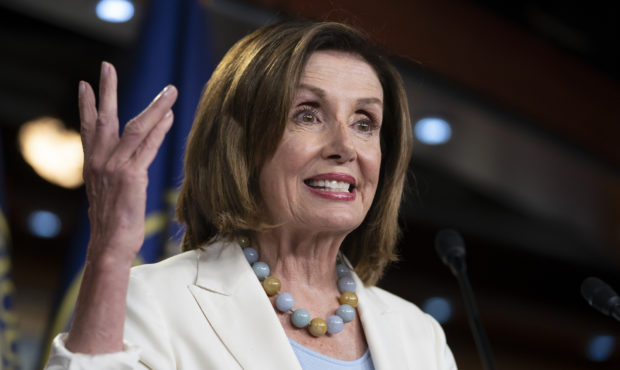
Speaker of the House Nancy Pelosi, D-Calif., holds a news conference on Capitol Hill in Washington, Wednesday, July 17, 2019. (AP Photo/J. Scott Applewhite)
(AP Photo/J. Scott Applewhite)

WASHINGTON (AP) — President Donald Trump and congressional leaders have announced a critical debt and budget agreement that’s an against-the-odds victory for Washington pragmatists seeking to avoid political and economic tumult over the possibility of a government shutdown or first federal default.
The deal, announced Monday by Trump on Twitter and in a statement by Democratic House Speaker Nancy Pelosi and Senate Democratic leader Chuck Schumer, will restore the government’s ability to borrow to pay its bills past next year’s elections and build upon recent large budget gains for both the Pentagon and domestic agencies.
“I am pleased to announce that a deal has been struck,” Trump tweeted, saying there will be no “poison pills” added to follow-up legislation. “This was a real compromise in order to give another big victory to our Great Military and Vets!”
The agreement is on a broad outline for $1.37 trillion in agency spending next year and slightly more in fiscal 2021. It would mean a win for lawmakers eager to return Washington to a more predictable path amid political turmoil and polarization, defense hawks determined to cement big military increases and Democrats seeking to protect domestic programs.
Nobody notched a big win, but both sides view it as better than a protracted battle this fall.
Pelosi and Schumer said the deal “will enhance our national security and invest in middle class priorities that advance the health, financial security and well-being of the American people.” Top congressional GOP leaders issued more restrained statements stressing that the deal is a flawed but achievable outcome of a government in which Pelosi wields considerable power.
“While this deal is not perfect, compromise is necessary in divided government,” said House Minority Leader Kevin McCarthy, R-Calif.
However, it also comes as budget deficits are rising to $1 trillion levels — requiring the government to borrow a quarter for every dollar the government spends — despite the thriving economy and three rounds of annual Trump budget proposals promising to crack down on the domestic programs that Pelosi is successfully defending now. It ignores warnings from deficit and debt scolds who say the nation’s fiscal future is unsustainable and will eventually drag down the economy.
“This agreement is a total abdication of fiscal responsibility by Congress and the president,” said Maya MacGuineas, president of the Committee for a Responsible Federal Budget, a Washington advocacy group. “It may end up being the worst budget agreement in our nation’s history, proposed at a time when our fiscal conditions are already precarious.”
A push by the White House and House GOP forces for new offsetting spending cuts was largely jettisoned, though Pelosi, D-Calif., gave assurances about not seeking to use the follow-up spending bills as vehicles for aggressively liberal policy initiatives.
The head of a large group of House GOP conservatives swung against the deal.
“No new controls are put in place to constrain runaway spending, and a two-year suspension on the debt limit simply adds fuel to the fire,” said Republican Study Committee Chairman Mike Johnson, R-La. “With more than $22 trillion in debt, we simply cannot afford deals like this one.”
Fights over Trump’s U.S.-Mexico border wall, other immigration-related issues and spending priorities will be rejoined on spending bills this fall that are likely to produce much the same result as current law. The House has passed most of its bills, using far higher levels for domestic spending. Senate measures will follow this fall, with levels reflecting the accord.
At issue are two separate but pressing items on Washington’s must-do agenda: increasing the debt limit to avert a first-ever default on U.S. payments and acting to set overall spending limits and prevent $125 billion in automatic spending cuts from hitting the Pentagon and domestic agencies with 10 percent cuts starting in January.
The threat of the automatic cuts represents the last gasp of a failed 2011 budget and debt pact between former President Barack Obama and then-Speaker John Boehner, R-Ohio, that promised future spending and deficit cuts to cover a $2 trillion increase in the debt. But a bipartisan deficit “supercommittee” failed to deliver, and lawmakers were unwilling to live with the follow-up cuts to defense and domestic accounts. This is the fourth deal since 2013 to reverse those cuts.
Prospects for an agreement, a months-long priority of top Senate Republican Mitch McConnell, R-Ky., became far brighter when Pelosi returned to Washington this month and aggressively pursued the pact with Treasury Secretary Steven Mnuchin , who was anointed lead negotiator instead of more conservative options like acting White House Chief of Staff Mick Mulvaney or hardline Budget Director Russell Vought.
Mnuchin was eager to avert a crisis over the government’s debt limit. There’s some risk of a first-ever U.S. default in September, and that added urgency to the negotiations.
The pact would defuse the debt limit issue for two years, meaning that Trump or his Democratic successor would not have to confront the politically difficult issue until well into 2021.
Washington’s arcane budget rules give each side a way to paint the numbers favorably. Generally speaking, the deal would lock in place big increases won by both sides in a 2018 pact driven by the demands of GOP defense hawks and award future increases consistent with low inflation.
Pelosi and Schumer claimed rough parity between increases for defense and nondefense programs, but the veteran negotiator retreated on her push for a special carve-out for a newly reauthorized program for veterans utilizing private sector health care providers. Instead non-defense spending increases would exceed increases for the military by $10 billion over the deal’s two-year duration.
In the end, non-defense appropriations would increase by $56.5 billion over two years, giving domestic programs 4% increases on average in the first year of the pact, with a big chunk of those gains eaten up by veterans increases and an unavoidable surge for the U.S. Census. Defense would increase by $46.5 billion over those two years, with the defense budget hitting $738 billion next year, a 3% hike, followed by only a further $2.5 billion increase in 2021.
Trump retains flexibility to transfer money between accounts, which raises the possibility of attempted transfers for building border barriers. That concession angered the Senate’s top Appropriations Committee Democrat, Patrick Leahy of Vermont, who said he has “many concerns” with a memorandum outlining the agreement that promised there will also be no “poison pills,” new policy “riders,” or bookkeeping tricks to add to the deal’s spending levels.
The results are likely to displease some on both sides, especially Washington’s weakening deficit hawks and liberals demanding greater spending for progressive priorities. But Pelosi and McConnell have longtime histories with the Capitol’s appropriations process and have forged a powerful alliance to deliver prior spending and debt deals.
The measure would first advance through the House this week and win the Senate’s endorsement next week before Congress takes its annual August recess. Legislation to prevent a government shutdown will follow in September.






