Here’s what happened when students went to school during the 1918 pandemic

Aug 19, 2020, 6:26 AM
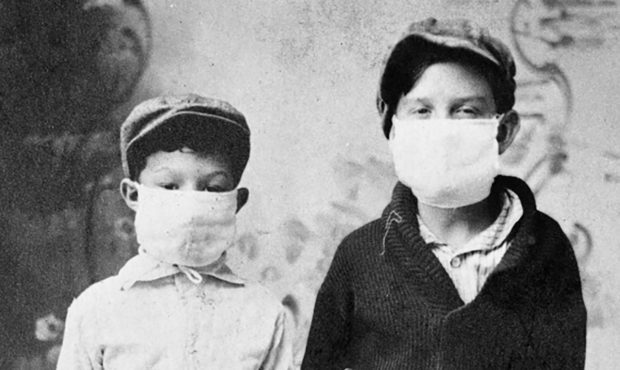
1918 school...

Don Hoover and Joe Sistrunk of Starke, Florida, ready for school during the 1918 Spanish flu epidemic.

    (CNN) — This isn’t the first time leaders have struggled with deciding whether to keep schools open in a pandemic.

During the influenza pandemic in 1918, even though the world was a very different place, the discussion was just as heated.

That pandemic killed an estimated 5 million people worldwide, including 675,000 Americans, before it was all over.

While the vast majority of cities closed their schools, three opted to keep them open — New York, Chicago and New Haven, according to historians.

The decisions of health officials in those cities was based largely on the hypothesis of public health officials that students were safer and better off at school. It was, after all, the height of the Progressive Era, with its emphasis on hygiene in schools and more nurses for each student than is thinkable now.

New York had almost 1 million school children in 1918 and about 75% of them lived in tenements, in crowded, often unsanitary conditions, according to a 2010 article in Public Health Reports, the official journal of the US Surgeon General and the US Public Health Service.

“For students from the tenement districts, school offered a clean, well-ventilated environment where teachers, nurses, and doctors already practiced — and documented — thorough, routine medical inspections,” according to the Public Health Reports article.

The city was one of the hardest and earliest hit by the flu, said Dr. Howard Markel, a medical historian and director of the Center for the History of Medicine at the University of Michigan. He was a co-author of the 2010 Public Health Reports article.

“(Children) leave their often unsanitary homes for large, clean, airy school buildings, where there is always a system of inspection and examination enforced,” New York’s health commissioner at the time, Dr. Royal S. Copeland, told the New York Times after the pandemic had peaked there.


Students weren’t allowed to gather outside school and had to report to their teacher immediately, according to Copeland. Teachers checked students for any signs of the flu, and students who had symptoms were isolated.

If students had a fever, someone from the health department would take them home, and the health official would judge whether the conditions were suitable for “isolation and care,” according to Public Health Reports. If not, they were sent to a hospital.

“The health department required families of the children recovering at home to either have a family physician or use the services of a public health doctor at no charge,” the Public Health Report article said.

The argument in Chicago for leaving schools open for its 500,000 students was the same: keeping schools open would keep the children off the streets and away from infected adults, the reasoning went.

If social distancing was helpful then, it would have been made easier by the fact that absenteeism in schools soared during the pandemic, perhaps because of what one Chicago public health official called “fluphobia” among parents.

“The absentee rate was so great, it really didn’t matter” that schools were open, Markel said.

Part of Chicago’s strategy was to ensure that fresh air was circulated. School rooms were overheated during the winter so that windows could remain open at all times, according to a 1918 paper by the Chicago Department of Health.

The paper concluded that an analysis of data showed that “the decision of keeping the schools of this city open during the recent influenza epidemic was justified.”

And in New York, then Health Commissioner Copeland told the New York Times: “How much better it has been to have the children under the constant observation of qualified persons than to close the schools.”

Markel, who with other researchers pored over data and historical records in looking at the response of 43 cities to the 1918 pandemic, isn’t as convinced.

New York “didn’t do the worst, but it didn’t do the best, either,” Markel said, adding Chicago was slightly better.

Research showed that cities who implemented quarantining and isolation, school closures and bans on public gatherings fared the best, he said.

“The cities that did more than one” of these measures “did better. School closures were part of that contribution,” Markel said.

Public health experts, including Markel, are quick to point out that Covid-19 is not influenza, which was a well-known disease in 1918. There is still a lot to learn about the novel coronavirus and the disease it causes, Covid-19.

The right decision today, Markel said, is school closure.

“It’s better,” he said, “to be safe than sorry.”

The-CNN-Wire
™ & © 2020 Cable News Network, Inc., a WarnerMedia Company. All rights reserved.

We want to hear from you.

Have a story idea or tip? Send it to the KSL NewsRadio team here.

Flood waters surround homes in Beaver, Utah, on Monday, July 20, 2026. Residents have been under a ...

Becky Bruce

Beaver City boil water order partially lifted

Some residents of Beaver City are no longer under a boil water order, though they still should take precautions before drinking or using the water.

2 days ago

The KSL forecast for Saturday, July 25, 2026, shows highs above 75 degrees every day for a week, as...

Becky Bruce

Heat advisory in effect through Monday night for northern Utah

The National Weather Service issued a heat advisory for multiple days, saying the lows at night would not offer much relief from triple-digit daytime highs.

2 days ago

FILE: A sign is posted in front of the 23andMe headquarters on February 01, 2024 in Sunnyvale, Cali...

Logan Stefanich, KSL

Utah, 40 other states reach $18M settlement with 23andMe after data breach, bankruptcy

Utah and over 40 other states on Wednesday announced a $18 million settlement agreement with genetic information company 23andMe after the company filed for bankruptcy in March 2025.

2 days ago

Sen John Curtis, R-Utah, walks through the Capitol during votes in Washington, July 16. A journey t...

Cami Mondeaux, Deseret News

From Salt Lake City to the Senate: Curtis leads tribute honoring Pioneer Day

In the US Senate on Thursday, Sen. John Curtis led a resolution honoring the Utah pioneers for exhibiting a spirit that he says still shapes the country today.

2 days ago

Mateus Rangel, of Provo, plays hymns with his children. He spoke about how he uses songs for "Hymns...

Emily Ashcraft, KSL

Church of Jesus Christ announces 10 hymns to be included in ‘Hymns for Home and Church’

The Church of Jesus Christ of Latter-day Saints released 10 new hymns that will be included in its new hymnbook on Thursday as part of a phased rollout of "Hymns for Home and Church."

2 days ago

Taylor Farms Mexico's facilities in Doctor Mora, Guanajuato state, Mexico, Monday. The facility was...

Siddhi Mahatole, Reuters

Taylor Farms temporarily shuts Mexico facility as US cyclosporiasis cases rise, source says

Taylor Farms on Thursday temporarily closed its Mexico facility linked to cyclosporiasis cases. The CDC has reported 4,173 cases across 41 states.

2 days ago

Sponsored Articles

...

Bear Lake

Road trip ready: How Bear Lake became the go-to destination for Western U.S. travelers

Whether you are chasing pristine beaches, fresh raspberry shakes, or endless water sports, this sponsored guide—brought to you in partnership with Bear Lake —uncovers everything you need to plan the ultimate getaway.   There’s nothing quite like the thrill of hopping in the car with your favorite snacks in tow and heading out for a […]

...

Harper Clinic

A new standard of care: How Harper Clinic’s IOP is changing the face of mental health treatment in Utah

This article is sponsored by Harper Clinic, a Utah-based clinic offering FDA-approved TMS therapy for treatment-resistant depression.    Utah’s mental health crisis is leaving many residents caught in an uncomfortable middle ground: struggling too much for weekly therapy alone, but unable to step away from work, parenting or daily life for inpatient treatment. As demand […]

...

Harper Clinic

Breaking free from depression: How Harper Clinic’s TMS Therapy can help

This article is sponsored by Harper Clinic, a Utah-based clinic offering FDA-approved TMS therapy for treatment-resistant depression.    The weight of depression is real. Many people spend years fighting it, adjusting medications, managing side effects and wondering if this is simply how life is going to feel.   According to the World Health Organization, depression affects […]

mental health...

Andrew Adams, KSL

Library discussions bring men’s mental health to the surface

Therapists say it’s common for men to repress things like trauma, grief, stress and anxiety. Now, a new weekly series of discussions aims to help men bring it all to the surface.

...

Bear Lake Convention & Visitors Bureau

Cozy up in Bear Lake: Discover the magic of a winter getaway

SALT LAKE CITY – The holiday season shines brightest when time slows down and loved ones gather. Gifts, decorations and festive music come and go, but shared experiences tend to last much longer. Research supports that idea. Dr. Theresa E. DiDonato told Psychology Today that vacations can strengthen relationships by creating meaningful time away from daily […]

...

Harper Clinic

Rewriting the path to healing: Inside Harper Clinic’s whole-person mental health model

OREM — A few decades ago, you’d have had a hard time finding a doctor to treat both your mind and body; And a century ago, you’d have been hard-pressed to find a doctor to treat your mind at all. Today, medical professionals are understanding more and more the undeniable connection between the body and […]

Here’s what happened when students went to school during the 1918 pandemic