Humans have been living on the space station for 20 years
Nov 2, 2020, 6:37 AM | Updated: 7:13 am
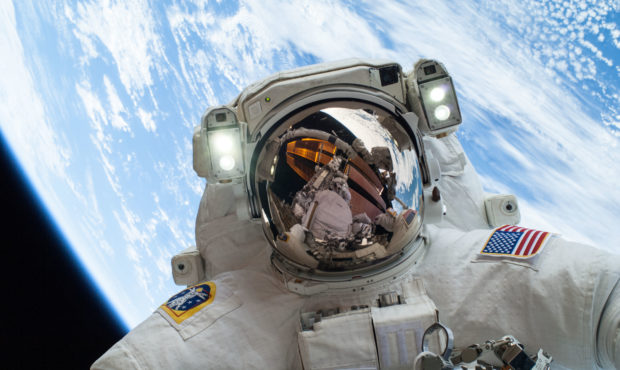
On Dec. 24, 2013, NASA astronaut Mike Hopkins, Expedition 38 flight engineer, participated in the second of two spacewalks, on the exterior of the International Space Station. Credit: NASA

(CNN) — When NASA astronaut William Shepherd and Russian cosmonauts Yuri Gidzenko and Sergei Krikalev entered the International Space Station on November 2, 2000, they became the first of many to live in the orbiting laboratory 227 nautical miles above Earth.
Since that initial 136-day stay for Expedition 1, the space station has served as a hub for continuous human occupation, scientific research and a proving ground for future space exploration for 20 years. It has hosted 241 individuals from 19 countries and required the cooperation and collaboration of 15 nations to build the space station.
Crews have conducted more than 227 spacewalks to build and maintain the space station — including the first all-female spacewalk in 2019 by NASA astronauts Christina Koch and Jessica Meir.
When Expedition 1 arrived, the space station was “very new, very clean, much emptier than it is now,” Krikalev said during a press conference Thursday. As the first crew, they started with the basics: turning on the lights and preparing something hot to drink after spending two days in the Russian Soyuz capsule before arrival.
Although it may sound mundane, they never had an average day during their stay, Shepherd said during a press conference Thursday. Each day presented a new set of challenges, and they worked through endless checklists to set up and prepare the space station for future crews.
But they began a tradition that has continued for 20 years of sitting down around a table three times a day for communal meals.
Utah’s lone moon tree faces an uncertain future
And this mealtime tradition, which has helped the expedition crews to bond and observe normalcy as their football field-size home orbits Earth at 17,500 miles per hour, is exactly how the current crew will celebrate the anniversary.
“It’s an incredible honor for us to be up here on the 20th anniversary,” said Kate Rubins during a press conference Friday from the space station. “We all feel very lucky. We’ll have a simple dinner celebration. On the ISS, we really enjoy getting together and having dinners. And the three of us will take a nice long view out of cupola to appreciate both Earth and the space station.”
The cupola is the space station’s seven-window observatory. There, the crew can witness the 16 sunrises and 16 sunsets the space station experiences each day.
Rubins, along with Russian cosmonauts Sergey Ryzhikov and Sergey Kud-Sverchkov, arrived at the space station on October 14. It’s the second expedition for both Rubins and Ryzhikov.
“Since the anniversary is on a Monday, we’ll be celebrating through hard work,” Kud-Sverchkov said. “And we will be remembering those who have been flying here for 20 years and all the 63 expeditions here before us. We really appreciate them.”
An orbiting laboratory
Since her first stay on the space station in 2016, Rubins said that not much has changed — except there is now more scientific equipment for new types of experiments.
Early in the space station program, the main focus was on assembling and building the space station. After that was completed in 2011, the focus has shifted to science.
More than 3,000 scientific investigations from researchers living in 108 different countries and territories have been conducted on the space station. This research has spanned a multitude of disciplines including space science, biology, human physiology, physical sciences, material science, educational activities and technology demonstrations that benefit from the absence of gravity.
Students from elementary school to college have been able to participate in conversations with astronauts on the station, send up experiments and learn about the impact of microgravity.
The millions of photos astronauts have taken from the station’s cupola support disaster response and studies of Earth and its changing climate.
While the research conducted on the space station sheds light on how a range of things, including the human body, react to the lack of gravity, it has also been used to improve our lives on Earth.
Through experiments on the station, we’ve learned better ways to purify air and water in our homes, developed advancements in telemedicine, discovered less invasive testing methods, improved wound treatment with cold plasmas and found better treatments for diseases like cancer through protein-crystal-growth studies.
New phenomena have also been discovered on the station, like how fluids react in space and steadily burning cool flames, which burn at temperatures cooler than a candle and could be used to reduce engine emissions on Earth.
Firsts and breakthroughs
The space station has been home to many scientific firsts. The first item to be 3D-printed on the space station occurred in 2014. Rubins sequenced DNA in space for the first time in 2016. And the fifth state of matter, called a Bose-Einstein condensate, was produced in space by NASA’s Cold Atom Lab on the station in 2018.
“It’s really phenomenal up here,” Rubins said. “It’s been completely outfitted for science, like taking a world class university and shrinking it down to the size of the space station.”
Astronauts have learned how to grow lettuces and leafy greens in space. The first space-grown salad was sampled by astronauts in 2015. Now, they’re even growing radishes on the station. This could be used to one day help astronauts grow their own food on deep space missions.
Astronauts have also studied their own health in space. In the absence of gravity, the human body can experience changes in vision, cognition and fine motor skills as well as muscle and bone loss. Crews on the space station work out twice a day to mitigate bone and muscle loss and regularly collect data about themselves to better understand changes they experience.
This includes the groundbreaking Twins Study, where NASA astronaut Scott Kelly spent 340 consecutive days on the space station. Everything from the most superficial changes down to shifts in gene expression were compared with his identical twin brother, Mark Kelly, who served as a control in the experiment on Earth. Mark Kelly was also a NASA astronaut and is now running for the US Senate from Arizona.
The study results suggested that human health can be “mostly sustained” for a year in space. But it also revealed areas that may require countermeasures or safeguards when preparing for longer space missions or missions to deep space, like Mars.
This will help NASA and other space agencies as they plan future human missions in deep space.
Looking ahead
NASA has certified the space station through 2024 and its hardware through 2028, and they expect it to be around for years to come as the home of a multitude of exciting scientific results, Rubins said.
It’s not all about the science experiments, though. The crew also spend their time performing routine maintenance each week, replacing parts and fixing the toilet. (There’s finally one designed with women in mind.)
The current crew said if anything, they would love to see an upgrade to the volume of the space station with more modules. Russia will launch its habitable Multipurpose Laboratory Module Nauka, which means “science” in Russian, in April. And the US has plans to install commercial modules on the space station going forward.
“We welcome any and all modules, especially if they have stowage space,” Rubins said.
The crew is also preparing to welcome the NASA SpaceX Crew-1 flight when it launches on November 14, which will bring the total astronauts on the station to seven.
Crew-1 will carry four more astronauts to the space station through the agency’s Commercial Crew program: NASA astronauts Victor Glover Jr., Michael Hopkins, Shannon Walker and Japan’s Soichi Noguchi.
NASA’s Commercial Crew program can expand the amount of astronauts on the space station — which means that more science, and even new types of experiments, can happen in the unique microgravity environment.
The space station is also being used as a proving ground as NASA prepares to return humans to the moon by 2024 through its Artemis program, as well as a future human mission to Mars.
“We’re using the ISS right now for Mars preparation,” said Michelle Rucker, lead for NASA’s Mars Architecture team, in September. “The long transit to Mars and back is not unlike being in microgravity on the ISS.”
In addition to the isolation and exposure space station crews face, the space station has also provided long-duration equipment experience when planning out concepts for what will be required for a Mars trip.
And if anything, the space station has shown what happens when countries cooperate to explore and learn in space.
“I think people maybe have not experienced or don’t remember what a technical and programmatic and possibly just diplomatic challenge the space station really was,” Shepherd said in NASA’s “Houston, We Have a Podcast” on Friday. “We’ve had, what, 63 expeditions on there that have all been very successful. We have multiple ways to get to the station now.”
Going forward, Shepherd believes that a trip to Mars or other locations in the solar system will require large vehicles that will require assembly in orbit, using spacewalks and robotics. It will also require the work, expense and cooperation of multiple countries.
“If you look at the International Space Station, it’s really a blueprint for how to do this.”
The-CNN-Wire
™ & © 2020 Cable News Network, Inc., a WarnerMedia Company. All rights reserved.