Moscow court orders Kremlin foe Navalny to prison
Feb 3, 2021, 5:34 AM | Updated: 5:38 am
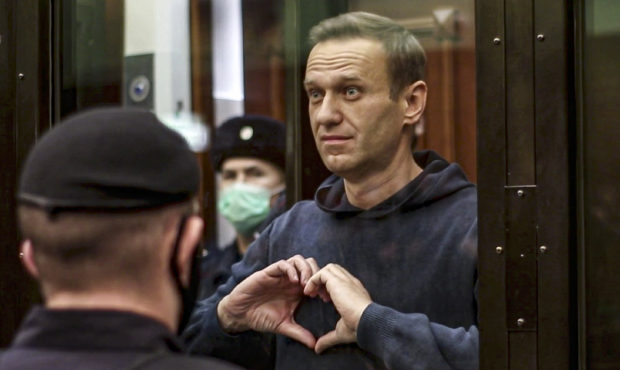
In this handout photo taken from a footage provided by Moscow City Court, Russian opposition leader Alexei Navalny shows a heard symbol standing in the cage during a hearing to a motion from the Russian prison service to convert the suspended sentence of Navalny from the 2014 criminal conviction into a real prison term in the Moscow City Court in Moscow, Russia, Tuesday, Feb. 2, 2021. A Moscow court has ordered Russian opposition leader Alexei Navalny to prison for more than 2 1/2 years for violating the terms of his probation while he was recuperating in Germany from nerve-agent poisoning. Navalny, who is the most prominent critic of President Vladimir Putin, had earlier denounced the proceedings as a vain attempt by the Kremlin to scare millions of Russians into submission. (Moscow City Court via AP)
(Moscow City Court via AP)

MOSCOW (AP) — A Moscow court on Tuesday ordered Russian opposition leader Alexei Navalny to prison for more than 2 1/2 years, finding that he violated the terms of his probation while recuperating in Germany from nerve-agent poisoning. The ruling ignited protests in Moscow and St. Petersburg.
Navalny, who is the most prominent critic of President Vladimir Putin, had denounced the proceedings as a vain attempt by the Kremlin to scare millions of Russians into submission.
After the verdict that was announced about 8 p.m., protesters converged on areas of central Moscow and gathered on St. Petersburg’s main avenue, Nevsky Prospekt.
Helmeted riot police grabbed demonstrators without obvious provocation and put them in police vehicles. The Meduza website showed video of police roughly pulling a passenger and driver out of a taxi.
The ruling came despite massive protests across Russia over the past two weekends and Western calls to free the 44-year-old anti-corruption campaigner.
Alexey Navalny makes a heart gesture as his wife and supporters look on while a Russian court orders the opposition leader to more than two years in a prison camp. https://t.co/fyxIyFPIj8 pic.twitter.com/CPIeMhSxRs
— ABC News (@ABC) February 3, 2021
“We reiterate our call for the Russian government to immediately and unconditionally release Mr. Navalny, as well as the hundreds of other Russian citizens wrongfully detained in recent weeks for exercising their rights, including the rights to freedom of expression and of peaceful assembly,” U.S. Secretary of State Antony Blinken said after the ruling.
The protests lasted until about 1 a.m. About 650 people were arrested, according to OVD-Info, a group that monitors political arrests.
The prison sentence stems from a 2014 embezzlement conviction that Navalny has rejected as fabricated and politically motivated.
Navalny was arrested Jan. 17 upon returning from his five-month convalescence in Germany from the attack, which he has blamed on the Kremlin. Russian authorities deny any involvement. Despite tests by several European labs, Russian authorities said they have no proof he was poisoned.
As the order was read, Navalny smiled and pointed to his wife Yulia in the courtroom and traced the outline of a heart on the glass cage where he was being held. “Everything will be fine,” he told her as guards led him away.
Earlier in the proceedings, Navalny attributed his arrest to Putin’s “fear and hatred,” saying the Russian leader will go down in history as a “poisoner.”
“I have deeply offended him simply by surviving the assassination attempt that he ordered,” he said.
“The aim of this hearing is to scare a great number of people,” Navalny added. “You can’t jail the entire country.”
Russia’s penitentiary service said Navalny violated the probation conditions of his suspended sentence from the 2014 conviction. It asked the court to turn his 3 1/2-year suspended sentence into one that he must serve in prison, although about a year he spent under house arrest will be counted as time served.
Navalny emphasized that the European Court of Human Rights ruled that his 2014 conviction was unlawful and Russia paid him compensation in line with the ruling.
Navalny and his lawyers have argued that while he was recovering in Germany from the poisoning, he couldn’t register with Russian authorities in person as required by his probation. He also insisted that his due process rights were crudely violated during his arrest and described his jailing as a travesty of justice.
“I came back to Moscow after I completed the course of treatment,” Navalny said during Tuesday’s hearing. “What else could I have done?”
Tens of thousands of people took to the streets the past two weekends to demand Navalny’s release and chant slogans against Putin. On Sunday, police detained more than 5,750 people nationwide, which was the biggest one-day total in Russia since Soviet times. Most were released after being handed a court summons, and they face fines or jail terms of seven to 15 days, although several face criminal charges of violence against police.
“I am fighting and will keep doing it even though I am now in the hands of people who love to put chemical weapons everywhere and no one would give three kopecks for my life,” Navalny said.
Navalny’s team called for a demonstration Tuesday outside the Moscow courthouse, but police were out in force, cordoning off nearby streets and making random arrests. More than 320 people were detained, according to OVD-Info.
Some Navalny supporters still managed to approach the building. A young woman climbed a pile of snow across the street and held up a poster saying “Freedom to Navalny.” Less than a minute later, a police officer took her away.
Before the ruling, authorities also cordoned off Red Square and other parts of central Moscow, as well as Palace Square in St. Petersburg, anticipating protests. Police flooded the centers of both cities.
In court, Navalny thanked protesters for their courage and urged other Russians not to fear repression.
“Millions can’t be jailed,” he said. “You have stolen people’s future and you are now trying to scare them. I’m urging all not to be afraid.”
Observers noted that authorities want Navalny in prison, fearing he could run an efficient campaign against the main Kremlin party, United Russia, in September’s parliamentary election. “If Navalny remains free, he is absolutely capable of burying the Kremlin’s plans regarding the outcome of the Duma election,” said political analyst Abbas Gallyamov.
After his arrest, Navalny’s team released a two-hour YouTube video about an opulent Black Sea residence allegedly built for Putin. It has been viewed over 100 million times, fueling discontent as ordinary Russians struggle with an economic downturn, the coronavirus and widespread corruption during Putin’s years in office.
Putin insisted that neither he nor his relatives own any of the properties mentioned in the video, and his longtime confidant, construction magnate Arkady Rotenberg, claimed that he owns it.
As part of efforts to squelch the protests, authorities have targeted Navalny’s associates and activists across the country. His brother Oleg, top ally Lyubov Sobol and several others were put under house arrest for two months and face criminal charges of violating coronavirus restrictions.
The jailing of Navalny and the crackdown on protests have stoked international outrage.
British Foreign Secretary Dominic Raab said the “perverse ruling, targeting the victim of a poisoning rather than those responsible, shows Russia is failing to meet the most basic commitments expected of any responsible member of the international community.”
Russia has dismissed the criticism as meddling in its domestic affairs and said Navalny’s current situation is a procedural matter for the court, not an issue for the government.
“A Russian citizen sentenced by Russian court in accordance with Russian laws. Who gave US the right to judge if it was wrongful or not? Wouldn’t you mind your own business, gentlemen? Recent events show that there are a lot of things for you to mend!,” Russia’s deputy U.N. ambassador, Dmitry Polyansky, said on Twitter.
More than a dozen Western diplomats attended the hearing. Foreign Ministry spokeswoman Maria Zakharova said their presence was part of efforts by the West to contain Russia, adding that it could be an attempt to exert “psychological pressure” on the judge.
Kremlin spokesman Dmitry Peskov said Russia is ready for dialogue about Navalny, but sternly warned it wouldn’t take Western criticism into account.
“We are ready to patiently explain everything, but we aren’t going to react to mentor-style statements or take them into account,” Peskov told reporters.
___
Jim Heintz in Moscow and Jill Lawless in London contributed.