
NASA Artemis program hopes to learn how to live, work on moon
Feb 3, 2020, 1:31 PM
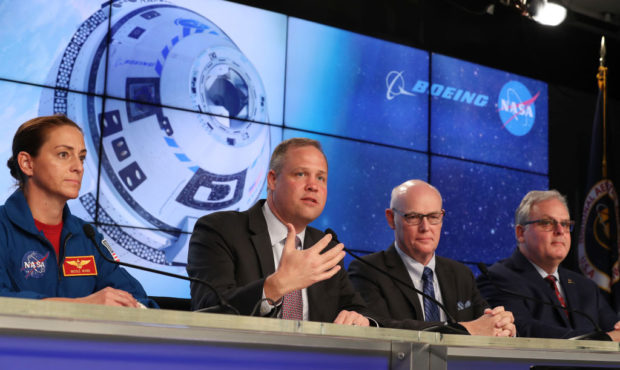
CAPE CANAVERAL, FLORIDA - DECEMBER 20: (L-R) Nicole Mann, NASA astronaut, Jim Bridenstine, NASA Administrator, Tory Bruno, President and CEO, United Launch Alliance,Jim Chilton, Boeing senior vice president, Space and Launch Division, speak to the media after the United Launch Alliance Atlas V rocket, topped by a Boeing CST-100 Starliner spacecraft, had an incident after lifting off from Space Launch Complex pad 41 on December 20, 2019 in Cape Canaveral, Florida. The launch was part of NASA’s Commercial Crew Program that aims to return human spaceflight launches to the space station from American soil on America spacecraft and rockets. (Photo by Joe Raedle/Getty Images)
(Photo by Joe Raedle/Getty Images)

NASA is working to complete its Artemis program, among others, that will allow the U.S. to learn how to live and work sustainably on the moon for an extended period of time.
Inside Sources host Boyd Matheson spoke with the administrator of NASA Jim Bridenstine to discuss what these programs look like.
“There have been some pretty dark days back at NASA, going back about a decade,” Bridenstine said. “We had a moment there where we retired the space shuttle and then we cancelled the replacement to the space shuttle, the consolation program. There was just a lot of concern about, ‘What is the agency going to do?'”
Bridenstine is the 13th administrator of NASA, confirmed by the U.S. Senate in 2018 by the Trump Administration. He has a deep government background, with experience with Congress and the military.
The administrator stepped into NASA when national interest was waning, and several U.S. citizens wondered what the program’s role was. Often, they complained that it failed to capture people’s imagination.
But now, Bridenstine said NASA is bringing several programs back, that are near to completion, that will strengthen the country’s economy and future.
The NASA Artemis program
Through the NASA Artemis program, Bridenstine said its main agenda is to return to the moon. But, it won’t end there.
“I like to say we’re going to go forward to the moon,” he said. “I say forward because we’re going in a way that’s never been done before.”
This time, the administration plans to go sustainably and stay there. Once there, astronauts will learn how to live and work for a longer period of time, using the resources of the moon.
Bridenstine said there are several resources on the moon the U.S. hasn’t tapped into yet, like water ice, that are huge advantages.
“When you think about the water ice, water ice represents water you drink,” he said. “It also represents air to breathe, and hydrogen and oxygen — that’s rocket fuel.”
It’s the same rocket fuel that powers the space shuttle, he said. The moon holds millions of tons of this water ice on the south side of the moon, which was discovered by the U.S. in 2009.
That should’ve changed the space program, Bridentine said. He said he thinks NASA should have been working on these current programs in the wake of that discovery 11 years ago.
The Artemis program doesn’t end with the moon, however.
“We’re going to take that knowledge to Mars,” he said. “That’s really what the Artemis program is all about. It’s about a sustainable return to the moon and then we’re going to take that knowledge to Mars.”
Moving forward from Apollo days
In Greek mythology, Artemis is the twin sister of Apollo. The Greeks believed Artemis was the goddess of the moon.
However, Bridenstine said the Artemis program will be a step ahead from Apollo. While NASA loves the Apollo days, Bridenstine said, Artemis will bring more opportunities.
“We’re going to go to the moon sustainably with this diverse astronaut corp,” Bridenstine said.
Bridenstine said the Apollo days didn’t provide any opportunities for women, but now the program has grown to reflect a more highly-qualified corporation that includes women.
Bridenstine said it reflects a changing America, and is a story that the U.S. should be proud of.
The path to Mars
The Artemis program wouldn’t stop at the moon — it would lead the way to Mars.
“The challenge with Mars is that Mars and Earth are on the same side of the sun once every 26 months,” Bridenstine said. “So when you go to Mars you have to be willing to stay for a couple of years.”
Going to the moon to learn how to live sustainably there would be the first step toward living on Mars. The moon offers a more accessible journey to learn how to use foreign planet resources to live and work in space for an extended period of time.
For example, if there was an issue on Mars and the crew had to come home it would take longer than if the mission was on the moon.
“We have to use the resources of Mars to live and work for long periods of time,” he said. “The glory of the moon is always three day journey home.”
Bridenstine said the moon is a valuable place to learn how to use resources sustainably. If NASA were to learn everything on Mars, Bridenstine said the probability of success would go down.
“The moon really represents the best course for us to learn what is necessary to go to Mars.”
How NASA Artemis program would help the U.S. economy
Bridenstine said that when NASA goes to the moon this time, it will be completely different.
NASA plans to have a gateway in orbit around the moon, which is already under contract to be built. With this gateway, NASA can explore more areas of the moon to discover more resources that have possibly gone unnoticed before, much like the ice water that went unnoticed during previous Apollo missions.
The gateway will allow the U.S. to go to all orbits of the moon, as well as give access to the north and south pole. This will give NASA more capability and flexibility.
The plan to accomplish this is to commercialize the process of going to space. NASA no longer purchases, owns and operates its own hardware — rather it acts as a customer to other customers.
This creates a competitive marketplace that drives down costs, making it more accessible to go to space.
For the first time, Bridenstine said NASA will launch American ships with American astronauts from American soil. This will help to reach the goal of increasing the number of humans in space, which give several advantages for those still on Earth.
Space allows for more life-saving discoveries
Bridenstine said space allows for many opportunities that several Americans aren’t aware of. The zero-gravity environment in space allows for more inventions and creations that aren’t possible on Earth.
For example, astronauts are able to create pharmaceuticals and immunizations that can’t be created on Earth. It’s also possible to 3-D print human organs using adult stem cells in space, which can’t be done with Earth’s gravity.
They can also create artificial retinas so those with macular degeneration don’t have to lose their eyesight. That’s because of the advanced materials found in space that can’t be created down below.
The technology available in space can provide breakthrough capabilities that will drive investments and capital into the space market, Bridenstine said.






