
NASA’s Mars helicopter takes flight, 1st for another planet
Apr 19, 2021, 6:43 AM
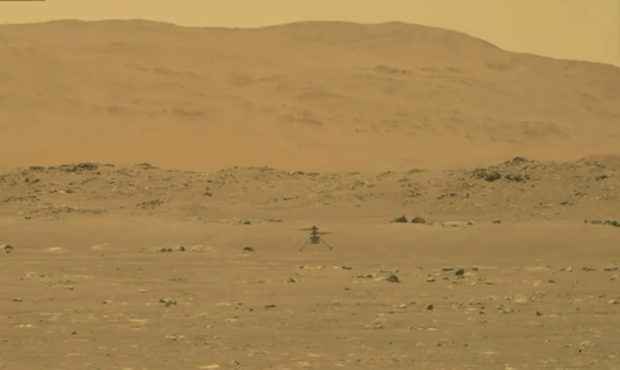
In this image from NASA, NASA's experimental Mars helicopter Ingenuity lands on the surface of Mars Monday, April 19, 2021. The little 4-pound helicopter rose from the dusty red surface into the thin Martian air Monday, achieving the first powered, controlled flight on another planet. (NASA via AP)
(NASA via AP)

CAPE CANAVERAL, Fla. (AP) — NASA’s experimental helicopter Ingenuity rose into the thin air above the dusty red surface of Mars on Monday, achieving the first powered flight by an aircraft on another planet.
The triumph was hailed as a Wright Brothers moment. The mini 4-pound (1.8-kilogram) copter even carried a bit of wing fabric from the 1903 Wright Flyer, which made similar history at Kitty Hawk, North Carolina.
You wouldn’t believe what I just saw.
More images and video to come…#MarsHelicopterhttps://t.co/PLapgbHeZU pic.twitter.com/mbiOGx4tJZ
— NASA’s Perseverance Mars Rover (@NASAPersevere) April 19, 2021
“Altimeter data confirms that Ingenuity has performed its first flight, the first flight of a powered aircraft on another planet,” said the helicopter’s chief pilot back on Earth, Havard Grip, his voice breaking as his teammates erupted in applause.
It was a brief hop — just 39 seconds — but accomplished all the major milestones.
Project manager MiMi Aung was jubilant as she ripped up the papers holding the plan in case the flight had failed. “We’ve been talking so long about our Wright Brothers moment, and here it is,” she said.
Flight controllers at NASA’s Jet Propulsion Laboratory in California declared success after receiving the data and images via the Perseverance rover, which stood watch more than 200 feet (65 meters) away. Ingenuity hitched a ride to Mars on Perseverance, clinging to the rover’s belly upon their arrival in an ancient river delta in February.
The $85 million helicopter demo was considered high risk, yet high reward. “Each world gets only one first flight,” Aung observed earlier this month.
Scientists cheered the news from around the world, and even from space: “The shadow of greatness, #MarsHelicopter first flight on another world complete!” NASA astronaut Victor Glover tweeted from the International Space Station.
“A whole new way to explore the alien terrain in our solar system is now at our disposal,” said Nottingham Trent University astronomer Daniel Brown.
This first test flight — with more to come by Ingenuity — holds great promise, Brown noted. Future helicopters could serve as otherworldly scouts for rovers and, eventually, astronauts in difficult, dangerous locales.
Ground controllers had to wait more than three excruciating hours before learning whether the pre-programmed flight had succeeded more than 170 million miles (287 million kilometers) away. Adding to their anxiety: A software error prevented the helicopter from lifting off a week earlier and had engineers scrambling to come up with a fix.
When the news finally came, the operations center filled with applause, cheers and laughter. More followed when the first black and white photo from Ingenuity appeared on the Mission Control screens, showing the helicopter’s shadow as it hovered above the surface of Mars. Next came the stunning color images of the copter descending back to the surface, taken by Perseverance, “the best host little Ingenuity could ever hope for,” Aung said in thanking everyone.
The helicopter achieved its planned altitude of 10 feet (3 meters), according to the altimeter data, and hovered for a full 30 seconds, appearing stable. The touchdown looked just as clean. More details were expected in the coming hours and days.
To accomplish all this, the helicopter’s twin, counter-rotating rotor blades needed to spin at 2,500 revolutions per minute — five times faster than on Earth. With an atmosphere just 1 percent the thickness of Earth’s, engineers had to build a helicopter light enough — with blades spinning fast enough — to generate this otherworldy lift. At the same time, it had to be sturdy enough to withstand the Martian wind and extreme cold.
More than six years in the making, Ingenuity is a barebones 19 inches (49 centimeters) tall, a spindly four-legged chopper. Its fuselage, containing all the batteries, heaters and sensors, is the size of a tissue box. The carbon-fiber, foam-filled rotors are the biggest pieces: Each pair stretches 4 feet (1.2 meters) tip to tip.
The helicopter is topped with a solar panel for recharging the batteries, crucial for its survival during the minus-130 degree Fahrenheit (minus-90 degree-Celsius) Martian nights.
NASA chose a flat, relatively rock-free patch for Ingenuity’s airfield, measuring 33 feet by 33 feet (10 meters by 10 meters). It turned out to be less than 100 feet (30 meters) from the original landing site in Jezero Crater. The helicopter was released from the rover onto the airfield on April 3. Flight commands were sent Sunday, after controllers sent up a software correction for the rotor blade spin-up.
Following Monday’s success, NASA named the Martian airfield “Wright Brothers Field.”
“While these two iconic moments in aviation history may be separated by time and 173 million miles of space, they now will forever be linked,” NASA’s science missions chief Thomas Zurbuchen announced.
The little chopper with a giant job attracted attention from around the world, from the moment it launched with Perseverance last July. Even Arnold Schwarzenegger joined in the fun, rooting for Ingenuity over the weekend via Twitter. “Get to the chopper!” he shouted, re-enacting a line from his 1987 sci-fi film “Predator.”
Up to five helicopter flights are planned, each one increasingly ambitious. If successful, the demo could lead the way to a fleet of Martian drones in decades to come, providing aerial views, transporting packages and serving as lookouts for human crews. On Earth, the technology could enable helicopters to reach new heights, doing things like more easily navigating the Himalayas.
“This gives us amazing hope for all of humanity,” Zurbuchen tweeted. Indeed, JPL’s mantra, “Dare Mighty Things,” was printed on a wall of the control room.
Ingenuity’s team has until the beginning of May to complete the test flights. That’s because the rover needs to get on with its main mission: collecting rock samples that could hold evidence of past Martian life, for return to Earth a decade from now.
Until then, Perseverance will keep watch over Ingenuity. Flight engineers affectionately call them Percy and Ginny. “Big sister’s watching,” said Malin Space Science Systems’ Elsa Jensen, the rover’s lead camera operator.
___
The Associated Press Health and Science Department receives support from the Howard Hughes Medical Institute’s Department of Science Education. The AP is solely responsible for all content.






