
These feces-finding Fidos help save orcas and other endangered wildlife
Dec 10, 2020, 5:54 AM
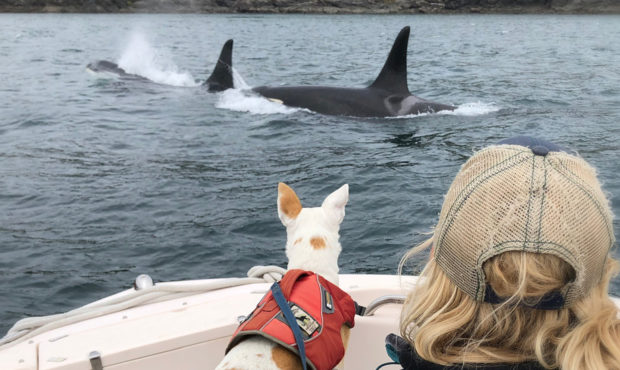
Thanks to expertly trained dogs like Eba and their handlers, researchers can collect and analyze the poop of Southern Resident orcas to understand why populations are declining. Credit: Center for Conservation Biology

(CNN) — Barrel-chested, with the pointy ears of a much larger pooch swiveling above her mellow gaze, Eba is more than just the Very Good Dog she appears to be. She’s a professional, working the prow of a moving speedboat, carefully tracking the very particular scent of killer whale poop floating in Puget Sound. But she doesn’t work alone.
“It’s a three-being team,” said Deborah Giles, a dog handler with Conservation Canines and a biologist at the University of Washington in Seattle.
“It’s a coordinated dance between the dog reacting to a scent, the handler being able to interpret that change in body behavior of the dog, and then the boat driver really being in tune with not only the dog and the handler, but also all of the other things associated with being on the water.”
The canine program, which is part of the university’s Center for Conservation Biology, trains the dogs in what might seem at first to be unusual detective work: tracking wild animal scat. To non-scientists, that’s poop — and it didn’t start with orcas.
It’s a technique pioneered by Conservation Canines’ founder, Samuel Wasser, in the 1990s. He first worked with Barb Davenport, a lead trainer at the Washington State Department of Corrections, to train dogs using some of the department’s narcotics-tracking techniques.
Davenport and her team “really helped us perfect this technology,” said Wasser, who is also a professor and director of UW’s Center for Conservation Biology.
What poop can reveal
That scat tells researchers incredibly valuable things about the animals: Levels of reproductive and stress hormones, nutrition profiles, toxin loads, microbiome details, pregnancy, loss of pregnancy and more are revealed once the scat is analyzed.
“I can take an individual sample and use it the same way that a doctor uses your blood samples when you go in for a physical,” Wasser said.
Over time, that information can paint a valuable and detailed picture of a species’ health. “You have the ability to look at how environmental pressures are changing over space and time and closely track it with the physiological changes that the animal is going through,” Wasser said.
And since DNA can also be extracted from the scat, individual animals can be tracked — which is especially important for endangered species.
Conservation Canines has tracked a huge variety of animals, including wolves, bobcats, coyote, grizzly and black bears, and cougars. “We’ve tracked tigers in Cambodia; and cheetah, wild dogs and lions in southern Mozambique,” Wasser said.
The dogs track the scat of smaller animals like spotted owls and New Mexico mountain salamanders, too.
“We did a study in Southern California at the Camp Pendleton naval base, looking for the scat of one of the smallest species of mouse, the Pacific pocket mouse,” said Julianne Ubigau, a research scientist and senior handler with Conservation Canines. “We were training dogs to find something that was smaller than a sesame seed. In a sandy environment. That was a really fun challenge.”
Dogs with the right stuff
The dogs can even transfer their skills to non-scat jobs, too: They tracked an invasive plant in Portland, Oregon, and environmental chemicals in Seattle.
It takes a special dog to excel at this work. Wasser described looking for dogs that have a “extreme” drive to play with a ball — to the extent they will ignore food or treats. (The dogs are trained using reward-based training, and the ball is the ultimate reward.) The CK9 team finds these dogs at animal shelters where they might be scheduled for euthanasia.
“Often they don’t make good pets. They’re too hyper and too focused,” Giles said. “We take those dogs’ natural drive and put it to work to save endangered species.”
The critically endangered orcas that live along the US Pacific Coast, also known as Southern Resident killer whales, are one of those species. And while it’s a fast-moving and complex feat to track and collect orca poop, the dogs do it, for hours at a stretch — with a little help from a team of humans.
The boat zigzags along to follow the scent as the dog tracks it. The orca poop is “only going to pop up and float for a few minutes before it’s gone,” but the information gleaned from the samples are key to helping the orcas survive.
Solving a conservation mystery
Wasser and his team’s work using dogs to track the orca poop, and subsequently analyze it in the lab, was about solving a mystery: Why were the Southern Resident killer whales struggling, losing 69% of their calves in miscarriage?
Theories included causes as varied as the stress of boat traffic, a lack of fish to eat or toxins in the water. By looking at hundreds of samples over several years and typing the DNA to identify individual whales, then examining stress and pregnancy hormones, as well as nutrition details and toxin loads, they had an answer:
“What we found was that the ones that lost their calves were significantly nutritionally compromised, compared to the ones that had a successful birth. So that showed that nutrition was driving this whole thing,” Wasser said.
But that wasn’t the whole story: “Very seldomly does one stress occur in isolation — there’s often many,” and Wasser found that compromised nutrition was just part of it.
Persistent organic pollutants like polychlorinated biphenyls (PCBs), polybrominated diphenyl ethers (PBDEs), dichlorodiphenyltrichloroethane (DDT) and dioxins bioaccumulated in the fat of the killer whales throughout their lifetime.
“When it’s sequestered in the fat, these toxins don’t appear to do much damage, but when they start to starve, they metabolize their fat. And when they metabolize the fat, they dump the toxins into circulation, where it can do the most damage,” like leading to pregnancy loss, Wasser said. So the data suggest it’s an interactive combination of lack of food and toxins that was causing the orcas’ decline.
This isn’t the first time Wasser has figured out an animal conservation mystery. When the Alberta, Canada, government had planned on shooting up to 80% of the wolves in the oil fields there to save caribou populations, Wasser studied the dog-tracked scat from caribou, wolves and moose. He proved that the wolves were eating deer and moose, not caribou. “People have been trying to stop the wolf killing there for years. And it took us one season to stop it,” with scat science, Wasser said.
That’s the point of all this work: to do science that can help save species. “Our center is, first and foremost, a conservation biology center. We try to pick projects, philosophically, that are going to affect wildlife conservation, and especially wildlife policy.”
It’s the dogs like Casey, Davy, Jasper and Eba — and their human handlers — who find the samples to make that science happen. They do it with those superior sniffers that canines are famous for. Each dog’s nose has 50 times more olfactory receptors than a human does — along with a brain area dedicated to processing those scents that’s 40 times bigger than ours.
It’s no wonder Ubigau said of working with her dog: “It feels like you’re exploring the world using a borrowed superpower.”
The-CNN-Wire
™ & © 2020 Cable News Network, Inc., a WarnerMedia Company. All rights reserved.






