
Trump plan would shift immigration focus to ‘merit’
May 17, 2019, 6:07 AM
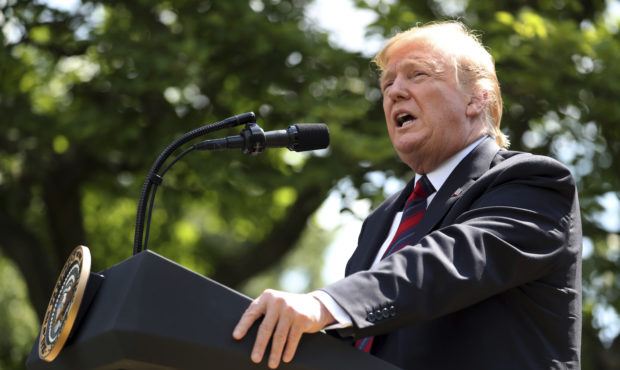
President Donald Trump speaks on immigration in the Rose Garden at the White House, Thursday, May 16, 2019, in Washington. (AP Photo/Andrew Harnik)
(AP Photo/Andrew Harnik)

WASHINGTON (AP) — Unveiling a new immigration plan, President Donald Trump said he wanted to provide a sharp contrast with Democrats, and he did — aiming to upend decades of family-based immigration policy with a new approach that favors younger, “totally brilliant,” high-skilled workers he says won’t compete for American jobs.
Trump’s sweeping immigration plan is more a campaign document than anything else. It’s a White House attempt to stretch beyond the “build-the-wall” rhetoric that swept the president to office but may not be enough to deliver him a second term. As Trump heads into reelection season, his campaign sees the plan as a way to help him look more reasonable on a signature issue than he often seems — and to cast Democrats as blocking him.
“Will the Democrats give our Country a badly needed immigration win before the election? Good chance!” Trump said in a tweet Friday.
In a Rose Garden speech attended by Republican lawmakers and members of his Cabinet, Trump insisted Thursday that his administration wants immigrants to come to the United States. “We cherish the open door,” he said.
Trump said his new system, with points given for those with advanced degrees, job offers and other attributes, will make it exactly “clear what standards we ask you to achieve.”
Nowadays, “we discriminate against genius,” he said, using a softer tone than his usual fiery campaign rallies. “We discriminate against brilliance. We won’t anymore once we get this passed.”
Even before the speech, Democrats, whose votes would be needed for any bill to be approved by the divided Congress, panned the effort and questioned the Republican Party’s commitment to families.
“Are they saying family is without merit?” asked House Speaker Nancy Pelosi. “Are they saying most of the people who’ve come to the United States in the history of our country are without merit because they don’t have an engineering degree?”
Pelosi continued: “Certainly we want to attract the best to our country.” But she said “merit” is a “condescending” word that means “merit in the eyes of Donald Trump.”
Trump’s new plan has been months in the making, a project of his son-in-law, Jared Kushner, who has been meeting privately with business groups, religious leaders and conservatives to find common ground among Republicans on an issue that has long divided the party.
Kushner has long complained that many advocates on the immigration issue are very clear about what they’re against, but have much more trouble articulating what they’re “for.” Kushner set out to create a proposal that Republicans might be able to rally around, his mission to give the president and his party a clear platform heading into the 2020 elections.
Trump didn’t mention his son-in-law’s work during the address but noted that the proposal wasn’t written by politicians. Instead, the president said it had input from law enforcement personnel. It also had echoes of White House senior adviser Stephen Miller, who wants to push down the country’s immigration levels and has driven much of the administration’s policy.
With a humanitarian crisis at the border — officials said this week that a fourth child, a 2-year-old Guatemalan migrant, died in U.S. custody — Trump promised to halt illegal border crossings with the “most complete and effective border security package ever assembled.” He did not mention the child’s death.
As part of the plan, officials want to shore up ports of entry to ensure all vehicles and people are screened and to create a self-sustaining fund, paid for with increased fees, to modernize ports of entry.
The plan also calls for building border wall in targeted locations and continues to push for an overhaul to the U.S. asylum system, with the goal of processing fewer applications and more quickly removing people who don’t qualify.
In addition, the plan includes a proposal to allow public donations to pay for the president’s long-promised border wall.
The plan does not address what to do about the millions of immigrants already living in the country illegally, including hundreds of thousands of young “Dreamers” brought to the U.S. as children — a top priority for Democrats. Nor does it reduce overall rates of immigration, as Miller and many conservative Republicans would like.
Republicans in Congress who were briefed on the plan by Kushner and Miller earlier this week welcomed, but did not fully embrace, the approach. Some of those up for reelection, including Sen. Susan Collins of Maine, objected to its failure to account for the young Dreamers. In Colorado, a Democrat running against GOP Sen. Cory Gardner blasted it as part of Trump’s “hateful” immigration agenda that would do nothing but “build Trump’s wall and keep families apart.”
“It’s obviously just a start,” said Texas GOP Sen. John Cornyn, who will be among those running for reelection in 2020. “It’s a clear statement of what our immigration policy should be. … We’re not eliminating family connections, it’s just adding an emphasis on merit.”
At its core, the proposal would fundamentally overhaul how the country for decades has approached immigration. The country has long placed a preference on providing green cards to family members of immigrants.
Under the Trump plan, the country would award the same number of green card as it now does, about 1 million annually. But far more would go to exceptional students, professionals and people with high-level and vocational degrees. Factors such as age, English language ability and employment offers would also be considered.
Far fewer green cards would be given to people with relatives already in the U.S. They would be reserved just for immediate family members — Trump mentioned spouses and children — rather than parents and adult siblings. Fifty-seven percent would be awarded on merit as opposed to the current 12%.
While Trump is seeking to put a softer facade on the top issue from his first campaign, he also is making a direct appeal to his supporters. He says his plan means fewer low-skilled immigrants will compete for low-paying American jobs.
“Our plan is pro-American, pro-immigrant and pro-worker,” Trump said, saying it contrasts with what he called Democrats’ support of “chaos.”
Efforts to overhaul the immigration system have gone nowhere for three decades, and prospects for an agreement seem especially bleak as the 2020 elections approach.
Lisa Koop, director of legal services at the National Immigrant Justice Center, called Trump’s plan “a political stunt intended to posture rather than problem-solve.”
Mark Krikorian, executive director of the Center for Immigration Studies, which advocates for lower immigration rates, welcomed a “very positive effort” that was “undermined by the embrace of the current very high level of immigration.”
___
Associated Press writers Kevin Freking and Colleen Long in Washington and Nicholas Riccardi in Denver contributed to this report.
___
Follow Colvin, Miller and Mascaro on Twitter at https://twitter.com/colvinj and https://twitter.com/zekejmiller and twitter.com/lisamascaro
___
This story has been corrected to show Trump unveiled his immigration plan on Thursday, not Tuesday.






