
Very different, symbolic hajj in Saudi Arabia amid virus
Jul 29, 2020, 8:02 AM
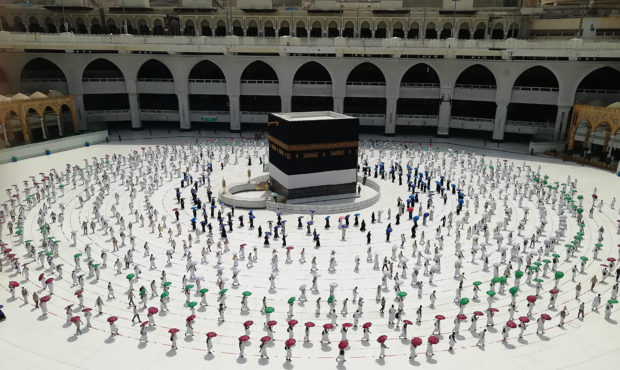
Hundreds of Muslim pilgrims circle the Kaaba, the cubic building at the Grand Mosque, as they keep social destination to protect themselves against the coronavirus ahead of the Hajj pilgrimage in the Muslim holy city of Mecca, Saudi Arabia, Wednesday, July 29, 2020. During the first rites of hajj, Muslims circle the Kaaba counter-clockwise seven times while reciting supplications to God, then walk between two hills where Ibrahim's wife, Hagar, is believed to have run as she searched for water for her dying son before God brought forth a well that runs to this day. (AP Photo)
(AP Photo)

DUBAI, United Arab Emirates (AP) — Muslim pilgrims, donning face masks and moving in small groups after days in isolation, began arriving at Islam’s holiest site in Mecca on Wednesday for the start of a historically unique and scaled-down hajj experience reshaped by the coronavirus pandemic.
The hajj is one of Islam’s most important requirements, performed once in a lifetime. It follows a route the Prophet Muhammad walked nearly 1,400 years ago and is believed to ultimately trace the footsteps of the prophets Ibrahim and Ismail, or Abraham and Ishmael as they are named in the Bible.
The hajj, both physically and spiritually demanding, is intended to bring about greater humility and unity among Muslims.
Rather than standing and praying shoulder-to-shoulder in a sea of people from different walks of life, pilgrims this year are social distancing — standing apart and moving in small groups of 20 to limit exposure and the potential transmission of the coronavirus.
The pilgrimage is a journey that Muslims traditionally experience with relatives. In past years, it was common to see men pushing their elderly parents around on wheelchairs in order to help them complete the hajj, and parents carrying children on their backs. The communal feeling of more than 2.5 million people from around the world — Shiite, Sunni and other Muslim sects — praying together, eating together and repenting together has long been part of what makes hajj both a challenging and rewarding experience like none other.
This year, however, pilgrims are eating prepackaged meals alone in their hotel rooms and praying at a distance from one another. The Saudi government is covering all the pilgrims’ expenses of travel, accommodation, meals and healthcare.
While the experience is starkly different, it remains an opportunity for pilgrims to wipe clean past sins and deepen their faith.
Ammar Khaled, a 29-year-old Indian pilgrim who was born and raised in Saudi Arabia, said although he’s alone on the hajj, he’s praying for those he loves.
“Words aren’t enough to explain how blessed I feel and how amazing the arrangements have been,” Khaled said. “They have taken every possible precaution.”
For the first time in Saudi history, the government barred Muslims from entering the kingdom from abroad to perform the hajj in order to limit exposure of the coronavirus.
Instead, as few as 1,000 people already residing in Saudi Arabia were selected to take part in the hajj this year. Two-thirds are foreign residents from among the 160 different nationalities that would have normally been represented at the hajj. One-third are Saudi security personnel and medical staff.
The pilgrims, who were selected after applying through an online portal, were required to be between the ages of 20 and 50, with no terminal illnesses and showing no symptoms of the virus. Preference was given to those who have not performed the hajj before.
Pilgrims were tested for the coronavirus, given wristbands that connect to their phones and monitor their movement and were required to quarantine at home and in their hotel rooms in Mecca ahead of Wednesday’s start of the hajj. They will also be required to quarantine for a week after the hajj concludes on Sunday.
Mecca was sealed off for months ahead of the hajj, and the smaller year-round Umrah pilgrimage was suspended earlier this year, with pilgrims already in the city at that time flown back home.
International media were not permitted to cover the hajj from Mecca this year. Instead, Saudi government broadcast live footage from the Grand Mosque on Wednesday showing limited numbers of pilgrims, moving several feet apart, circling the cube-shaped Kaaba in the first rituals of the hajj.
The Kaaba represents the metaphorical house of God and the oneness of God in Islam. Observant Muslims around the world face toward the Kaaba during their five daily prayers.
During the hajj, women forgo makeup and perfume and wear loose-fitting clothing and a head covering in order to focus inwardly. Men dress in seamless, white terrycloth garments meant to emphasize the equality of all Muslims and prevent wealthier pilgrims from differentiating themselves with more elaborate garments.
During the first rites of hajj, Muslims circle the Kaaba counter-clockwise seven times while reciting supplications to God, then walk between two hills where Ibrahim’s wife, Hagar, is believed to have run as she searched for water for her dying son before God brought forth a well that runs to this day.
This year, pilgrims will only be able to drink water from this Zamzam well that is packaged in plastic bottles. Pebbles for casting away evil that are usually picked up by pilgrims along hajj routes will be sterilized and bagged ahead of time.
Pilgrims have also been given their own prayer rugs and special attire to wear during the hajj laced with silver nano technology that Saudi authorities say helps kill bacteria and makes clothes water resistant. They were also provided with umbrellas to shield them from the sun, towels, soaps, sanitizers and other essentials, as well as online sessions in different language about what to expect on the hajj and the regulations in place.
“The kingdom of Saudi Arabia needs to put these measures in place so we can learn from this experience,” said Saudi infectious disease expert and World Health Organization official, Dr. Hanan Balkhy.
“The kingdom and the world will learn together what are the best ways to mitigate transmission during these types of events,” said Balkhy, assistant director-general for the antimicrobial resistance division at WHO’s headquarters in Geneva who has worked on past hajj missions.




