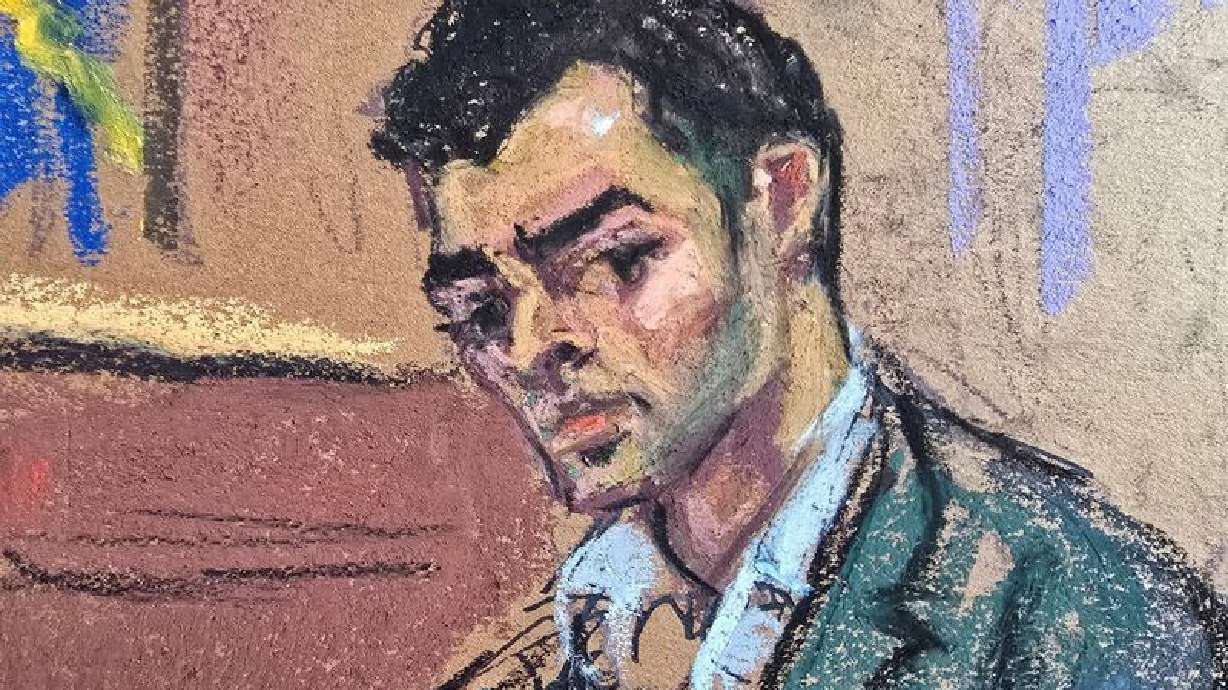
Man accused of killing Charlie Kirk requests street clothes and no shackles during hearings
Oct 10, 2025, 7:38 AM | Updated: 5:39 pm

Defense attorneys Richard G. Novak, left, Michael N. Burt, and Kathryn Nester who are representing Tyler Robinson, the man accused of killing Charlie Kirk at Utah Valley University, appear at a waiver hearing in Utah County Court in Provo, Utah, on Monday, Sept. 29, 2025. (Laura Seitz/Deseret News)
(Laura Seitz/Deseret News)
PROVO — Attorneys for the man accused of killing Charlie Kirk would like their client to appear at all upcoming hearings in regular clothes and without shackles.





A judge approved the attorney’s motion Friday afternoon, granting Robinson permission to wear regular clothes without restraints while appearing in court.
“Indeed, given the pervasive media coverage in this case, the repeated and ubiquitous display of Mr. Robinson in jail garb, shackles, and a suicide vest will undoubtedly be viewed by prospective jurors and will inevitably lead to prospective juror perception that he is guilty and deserving of death,” attorneys for Tyler James Robinson argue in their motion filed Thursday in 4th District Court.
Robinson, 22, of Washington, Washington County, is charged with aggravated murder, a capital offense, and facies a potential death sentence if convicted of shooting and killing Kirk on the campus of Utah Valley University on Sept. 10. Kirk, 31 — a political activist and co-founder of Turning Point USA — was sitting under a tent of an outdoor amphitheater-courtyard area at UVU, speaking in front of approximately 3,000 people, when he was shot in the neck by a gunman on the roof of the nearby Losee Center building.
Robinson’s next court hearing is scheduled for Oct. 30. During his initial hearing, he appeared via livestream from the Utah County Jail where he was seen wearing a “safety smock” or “turtle suit,” a one-piece, tear-resistant garment worn by incarcerated or detained individuals to prevent them from committing suicide by forming a noose. At his second hearing on Sept. 29, he again was at the jail, but his video was blacked out at his attorneys’ request.

Defense attorneys Michael N. Burt and Kathryn Nester confer during a waiver hearing for Tyler Robinson, the man accused of killing Charlie Kirk at Utah Valley University, in Utah County Court in Provo, Utah, on Monday, Sept. 29, 2025. (Laura Seitz/Deseret News)
During his next hearing, however, his attorneys say he will be present in the courtroom.
But according to a motion filed Thursday, his defense team wants their client to appear in “civilian attire” and without “physical restraints.”
“These requests are necessary to maintain the presumption of innocence, to protect Mr. Robinson’s rights to a fair and impartial trial, and to maintain courtroom decorum and dignity,” the motion states.
While a defendant is innocent until proven guilty, “the psychological reality is that the human beings who serve on the bench are likewise not immune to such subconscious and subliminal influence from seeing a human being in chains to protect others from him,” according to the motion.
His attorneys say “reliable decision-making” in death penalty cases must be “grounded in admissible evidence, not on innuendo derived from a defendant’s custodial status.”
Robinson’s motion points to his initial hearing on Sept. 16 as an example, stating that media outlets from all over the world covered it.

Tyler Robinson, 22, the suspect in the shooting death of Charlie Kirk, appears by camera before 4th District Court Judge Tony Graf on Tuesday, Sept. 16, 2025, for his initial court appearance in Provo, Utah. (Scott G Winterton/Deseret News)
“Mr. Robinson’s physical appearance alone was and is subject to endless scrutiny and speculation. One article described Mr. Robinson during his initial appearance as ’emotionless’ and ‘star(ing) blankly ahead’ and ‘sporting slightly mussed locks, several days’ worth of facial hair’ and wearing ‘a green ‘suicide smock,'” the motion says.
“With each development in the case generating thousands of articles and comments online, the likelihood of potential jurors seeing and drawing conclusions regarding Mr. Robinson’s guilt and or deserved punishment from obvious signs of pretrial incarceration will only increase,” the motion continues. “In the face of worldwide scrutiny, permitting Mr. Robinson to wear civilian clothing for court appearances is a minor inconvenience compared to the already present concerns with securing a fair trial before an impartial jury.”
His attorneys argue that “the world is watching Mr. Robinson and these proceedings,” and because of that, “additional care must be taken to preserve the presumption of innocence and to prevent tainting the pool of jurors that will ultimately decide Mr. Robinson’s guilt or innocence, and if guilty, if Mr. Robinson should receive the death penalty.”
Robinson’s defense team is asking for a temporary order to allow their client to appear at the next court hearing in civilian clothes and without restraints. At that time, a date can be scheduled for a closed hearing to discuss the full motion.
Attorneys are asking for a hearing closed to the public, presumably so more sensitive evidence such as security can be discussed. The motion notes that a similar order was granted in the high profile case of Bryan Kohberger, convicted of killing four college students in Idaho.
If you or someone you know is experiencing suicidal thoughts or exhibiting warning signs, call, text, or chat the 988 Suicide and Crisis Lifeline at 988 which is answered 24/7/365 by crisis counselors at the Huntsman Mental Health Institute. All calls to legacy crisis hotlines, including the old National Suicide Prevention hotline, 1-800-273-8255, will also connect to a crisis care worker at the Huntsman Mental Health Institute as well.
Additional resources
- SafeUT: Parents, students, and educators can connect with a licensed crisis counselor through chat by downloading the SafeUT app or by calling 833-3SAFEUT (833-372-3388)
- SafeUT Frontline: First responders, including firefighters, law enforcement, EMS, and healthcare professionals can chat with a licensed crisis counselor at no cost 24/7/365 by downloading the SafeUT Frontline app.
- SafeUTNG: Members of the National Guard can chat with a licensed crisis counselor at no cost 24/7/365 by downloading the SafeUTNG app.
- Utah Warm Line: For non-crisis situations, when you need a listening ear as you heal and recover from a personal struggle, call 1-833 SPEAKUT 8:00 a.m.-11:00 p.m., 7 days a week, 365 days a year.
- The Huntsman Mental Health Institute offers a wide variety of programs and services including suicide prevention and crisis services, hospital treatment, therapy & medication management, substance Use & addiction recovery, child & teen programs, and maternal mental health services including birth trauma, pregnancy loss, infertility, and perinatal mood and anxiety disorders.
- LiveOnUtah.org is a statewide effort to prevent suicide by promoting education, providing resources, and changing Utah’s culture around suicide and mental health. They offer resources for faith based groups, LGBTQ+, youth, employers, firearm suicide prevention, and crisis and treatment options.
Counties in Utah provide services for mental health and substance use disorders. Centers are run by the thirteen Local Mental Health and Substance Use Authorities all across the state and offer therapy, substance use disorder treatment, support groups, mobile services, youth treatment, and more.
These resources and more information can be found here: https://www.uacnet.org/behavioralhealth.
Other community-based resources
- NAMI Utah provides education, support and advocacy for individuals and families impacted by mental illness.
- American Foundation for Suicide Prevention offers prevention programs, public education, support for loss survivors, and fundraising for research.
- Encircle Utah: LGBTQ+ family and youth resource center.
- Utah Pride Center empowers Utah’s diverse LGBTQ+ community.
- The Trevor Project: LGBTQ teen resource center.
- U.S. Department of Veterans Affairs Mental Health
- Latino Behavioral Health Services
Center for Workplace Mental Health offers suicide prevention and response for employers.