EDUCATION + SCHOOLS

Audit: Utah’s K-12 and higher education systems could improve cybersecurity practices

Sep 26, 2025, 8:00 AM

A legislative audit released Thursday took a deeper look into Utah's cybersecurity practices for bo...

A legislative audit released Thursday took a deeper look into Utah's cybersecurity practices for both public and higher education, finding room for improvement in both areas. (Jeffrey D. Allred, Deseret News)

(Jeffrey D. Allred, Deseret News)

SALT LAKE CITY — Cybersecurity has been a topic of conversation among Utah lawmakers for some time now, especially following a data breach that impacted all current and former Granite School District students — about 450,000 — in December 2024.

A legislative audit released Thursday took a deeper look into Utah’s cybersecurity practices for both public and higher education, finding room for improvement in both areas.


K-12 public education


When looking at the K-12 realm, the audit found that local education agencies can be more aggressive in meeting baseline cybersecurity best practices, especially amid increasing attacks on public education.

“Successful Utah attacks have cost districts financially and in staff time and impacted hundreds of thousands of students and employees. Cyber attacks have also significantly impacted school districts in other states,” according to the audit.

Cybersecurity threats, the audit says, can include ransomware, data breaches, and corporate email fraud that can lead to significant financial losses, loss of trust and a disruption of education.

Due to the evolving landscape of cybersecurity threats, addressing them can prove difficult. But U.S. Department of Homeland Security’s Cybersecurity and Infrastructure Security Agency has developed cybersecurity best practices for public education entities, both big and small, that include:


  1. Multifactor authentication: Controls in this area help ensure that users are required to provide multiple forms of verification before accessing systems, reducing the risk of unauthorized access.
  2. Patch management: These controls focus on keeping software and systems up to date by promptly applying security patches to fix unknown vulnerabilities.
  3. Backups: These controls emphasize creating and securely storing regular system and data backups to ensure recovery in case of data loss or ransomware attacks.
  4. Exposure to the internet: These controls focus on ensuring that IT assets accessible via the internet do not expose frequently exploited services.
  5. Incident response plan: This category includes developing, maintaining and testing an incident response plan to handle cybersecurity events effectively.
  6. Training: These controls promote user awareness by requiring regular cybersecurity training to help staff recognize threats like phishing and social engineering.


The audit used these practices to guide testing on a sample of local education agencies, alongside statewide survey data gathered at the direction of the Utah Education and Telehealth Network.

“Both the testing conducted by the state of Utah’s Division of Technology Services and (Utah Education and Telehealth Network’s) survey data point out gaps in the use of baseline cybersecurity controls. It also appears that large school districts have more robust cybersecurity protection than small school districts,” the audit says.
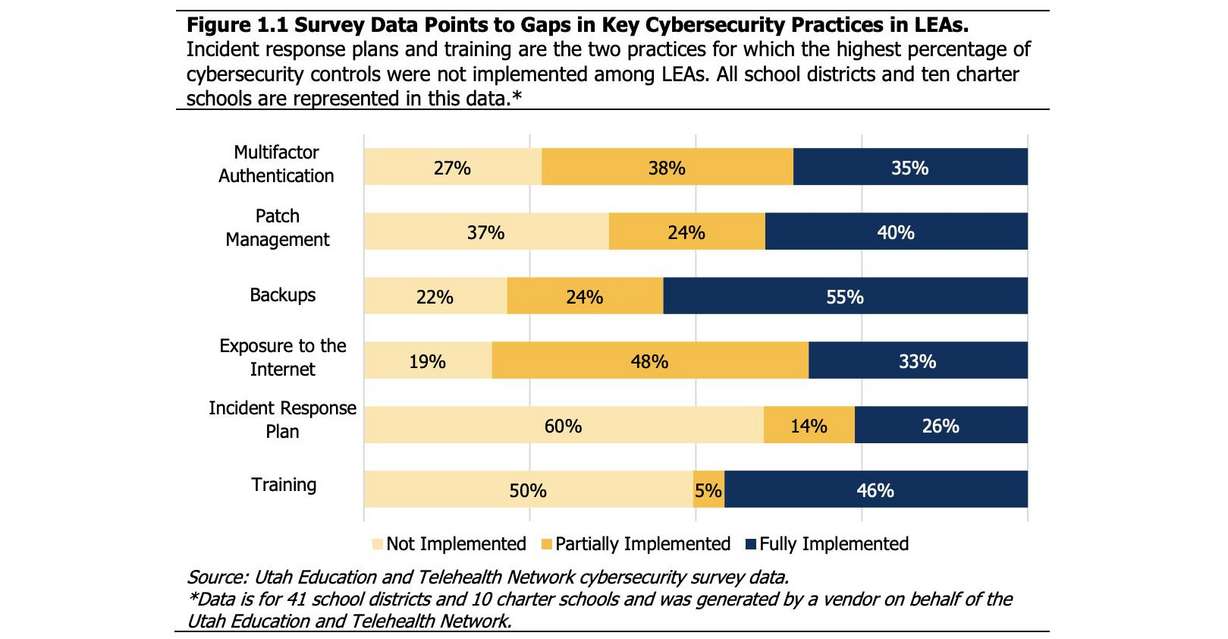
A graph shows the implementation status for all local education agencies surveyed for relevant cybersecurity controls.
A graph shows the implementation status for all local education agencies surveyed for relevant cybersecurity controls. (Photo: Utah Education and Telehealth Network cybersecurity survey data)

The biggest barriers districts face in implementing cybersecurity controls include insufficient staffing (55%), insufficient statewide cooperative contracts (33%) and insufficient training for IT or cybersecurity staff (29%), among others.

The audit recommends that the Legislature consider studying minimum cybersecurity standards for local education agencies.

“These minimum standards could follow the principles behind high-priority practices outlined by the Cybersecurity and Infrastructure Security Agency, that are attainable by local education agencies, regardless of size, and proven to reduce risk,” said the audit.

It also recommends that the Legislature consider studying solutions to challenges Utah’s local education agencies face, like insufficient prioritization of cybersecurity, staffing, training and recruiting and retaining skilled personnel while considering the differences between large and small districts in implementing cybersecurity controls.


Higher education


Like K-12 education, the audit says Utah’s higher education institutions can do more to improve both cybersecurity controls and governance.

“Utah’s colleges and universities face a broad spectrum of cyber threats, including ransomware, business email fraud, and data breaches. However, these risks are elevated by more complex IT systems and additional sensitive data,” according to the audit.

The University of Utah in 2020 was the victim of a ransomware attack, which the school ultimately resolved by paying the hackers nearly half a million dollars, though most of that was reimbursed by the U.’s insurance provider.

The Cybersecurity and Infrastructure Security Agency’s cybersecurity best practices for public education entities are also being implemented by Utah System of Higher Education institutions, but the audit found that there are areas for improvement.
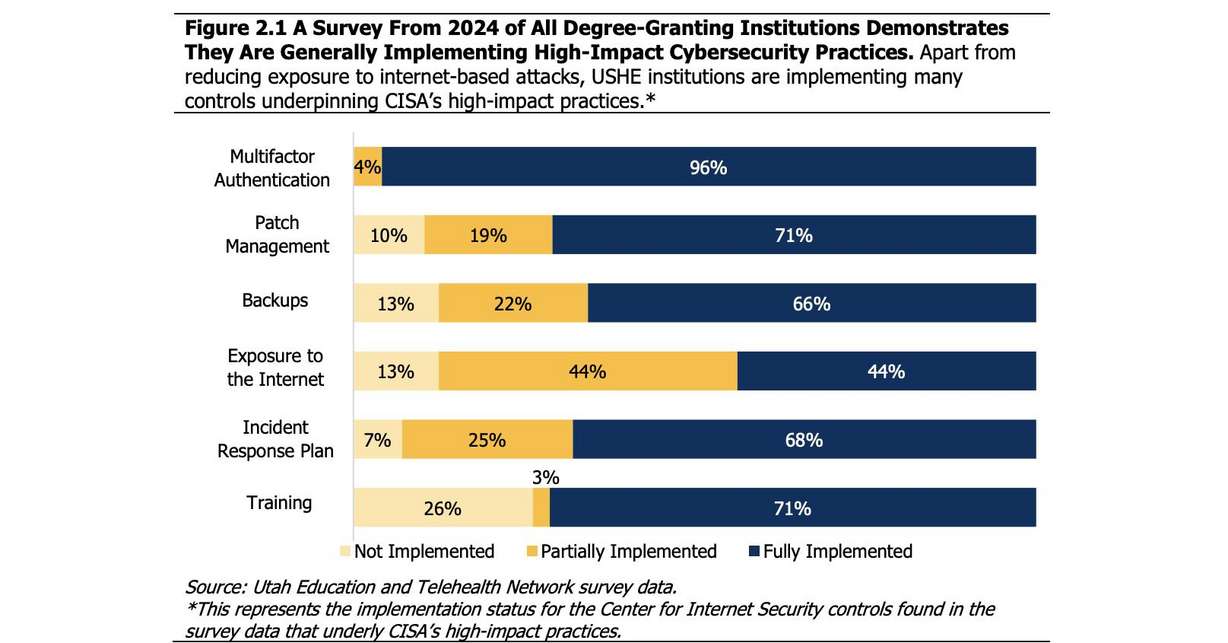
This chart shows the implementation status for the Cybersecurity and Infrastructure Security Agency's six practices at all Utah System of Higher Education institutions using survey data commissioned by the Utah Education and Telehealth Network.
This chart shows the implementation status for the Cybersecurity and Infrastructure Security Agency’s six practices at all Utah System of Higher Education institutions using survey data commissioned by the Utah Education and Telehealth Network. (Photo: Utah Education and Telehealth Network survey data)

“We are encouraged by the recurring cybersecurity assessments (Utah System of Higher Education) institutions have been doing on each other for over a decade. Cybersecurity personnel from (Utah System of Higher Education) institutions test the defenses of other institutions regularly. This shows good leadership and collaboration,” says the audit.

Still, the audit recommends that the Utah Board of Higher Education clarify roles, including accountability for compliance, for the Utah System of Higher Education and its member institutions in the cybersecurity policy.

“The policy should define the purpose of the policy and how information security plans and programs are to be used. The purpose of these changes is to ensure decisions are made according to sound information and institutions are held accountable for cybersecurity,” said the audit.


We want to hear from you.

Have a story idea or tip? Send it to the KSL NewsRadio team here.

Education + Schools

Jon Anderson speaks after being named as Utah Valley University's next president on Friday. The Uta...

Logan Stefanich, KSL

‘Best days at UVU are ahead’: Jon Anderson appointed president at Utah Valley University

The Utah Board of Higher Education on Friday voted unanimously to appoint Jon Anderson as the next Utah Valley University president.

9 hours ago

Rebecca Fontes works in a geography class at the Beehive Science and Technology Academy in Sandy on...

Logan Stefanich, KSL

12 Utah charter school hopefuls submit bids for approval

Twelve charter schools could soon join the Beehive State's existing network after submitting proposals for formal consideration last week.

4 days ago

FILE: University of Utah student Olive Nelson, 20, studies at the J. Willard Marriott Library in Sa...

Bryanna Willis

To help students and to save money, Utah’s public colleges, universities now in regional groups

The Utah Board of Education has restructured Utah's 16 public institutes of higher education to more easily transfer credits and to increase access across rural communities.

4 days ago

FILE: Students work on a computerize map at Hillsdale Elementary. There is intense interest in the ...

Becky Bruce

State audit finds ‘wasteful’ purchases with Utah Fits All scholarship money

A new limited audit of the Utah Fits All scholarship program showed most of the scholarship money went toward legitimate education expenses, but also that some of the money was spent in a "wasteful and extravagant" manner.

10 days ago

(Wesley Barton, KSL)...

Andrew Adams, KSL

East High coach hopes to boost nonprofit through new clothing line

A high school basketball coach with a nonprofit that helps financially challenged students said a new clothing line he started aims to help bolster the program and support more kids.

15 days ago

FILE - The U.S. Department of Education building is seen in Washington, Nov. 18, 2024. Changes to f...

Adriana Morga, Associated Press

Changes to student loans are taking effect July 1. Here’s what to know

Changes to federal student loans expected to affect millions of borrowers are taking effect July 1.

16 days ago

Sponsored Articles

...

Bear Lake

Road trip ready: How Bear Lake became the go-to destination for Western U.S. travelers

Whether you are chasing pristine beaches, fresh raspberry shakes, or endless water sports, this sponsored guide—brought to you in partnership with Bear Lake —uncovers everything you need to plan the ultimate getaway.   There’s nothing quite like the thrill of hopping in the car with your favorite snacks in tow and heading out for a […]

...

Harper Clinic

A new standard of care: How Harper Clinic’s IOP is changing the face of mental health treatment in Utah

This article is sponsored by Harper Clinic, a Utah-based clinic offering FDA-approved TMS therapy for treatment-resistant depression.    Utah’s mental health crisis is leaving many residents caught in an uncomfortable middle ground: struggling too much for weekly therapy alone, but unable to step away from work, parenting or daily life for inpatient treatment. As demand […]

...

Harper Clinic

Breaking free from depression: How Harper Clinic’s TMS Therapy can help

This article is sponsored by Harper Clinic, a Utah-based clinic offering FDA-approved TMS therapy for treatment-resistant depression.    The weight of depression is real. Many people spend years fighting it, adjusting medications, managing side effects and wondering if this is simply how life is going to feel.   According to the World Health Organization, depression affects […]

mental health...

Andrew Adams, KSL

Library discussions bring men’s mental health to the surface

Therapists say it’s common for men to repress things like trauma, grief, stress and anxiety. Now, a new weekly series of discussions aims to help men bring it all to the surface.

...

Bear Lake Convention & Visitors Bureau

Cozy up in Bear Lake: Discover the magic of a winter getaway

SALT LAKE CITY – The holiday season shines brightest when time slows down and loved ones gather. Gifts, decorations and festive music come and go, but shared experiences tend to last much longer. Research supports that idea. Dr. Theresa E. DiDonato told Psychology Today that vacations can strengthen relationships by creating meaningful time away from daily […]

...

Harper Clinic

Rewriting the path to healing: Inside Harper Clinic’s whole-person mental health model

OREM — A few decades ago, you’d have had a hard time finding a doctor to treat both your mind and body; And a century ago, you’d have been hard-pressed to find a doctor to treat your mind at all. Today, medical professionals are understanding more and more the undeniable connection between the body and […]

Audit: Utah’s K-12 and higher education systems could improve cybersecurity practices