ELECTIONS, POLITICS, & GOVERNMENT
After Voting Rights Act case arguments, concerns over diminished minority representation rise
Oct 18, 2025, 3:13 PM | Updated: 3:17 pm
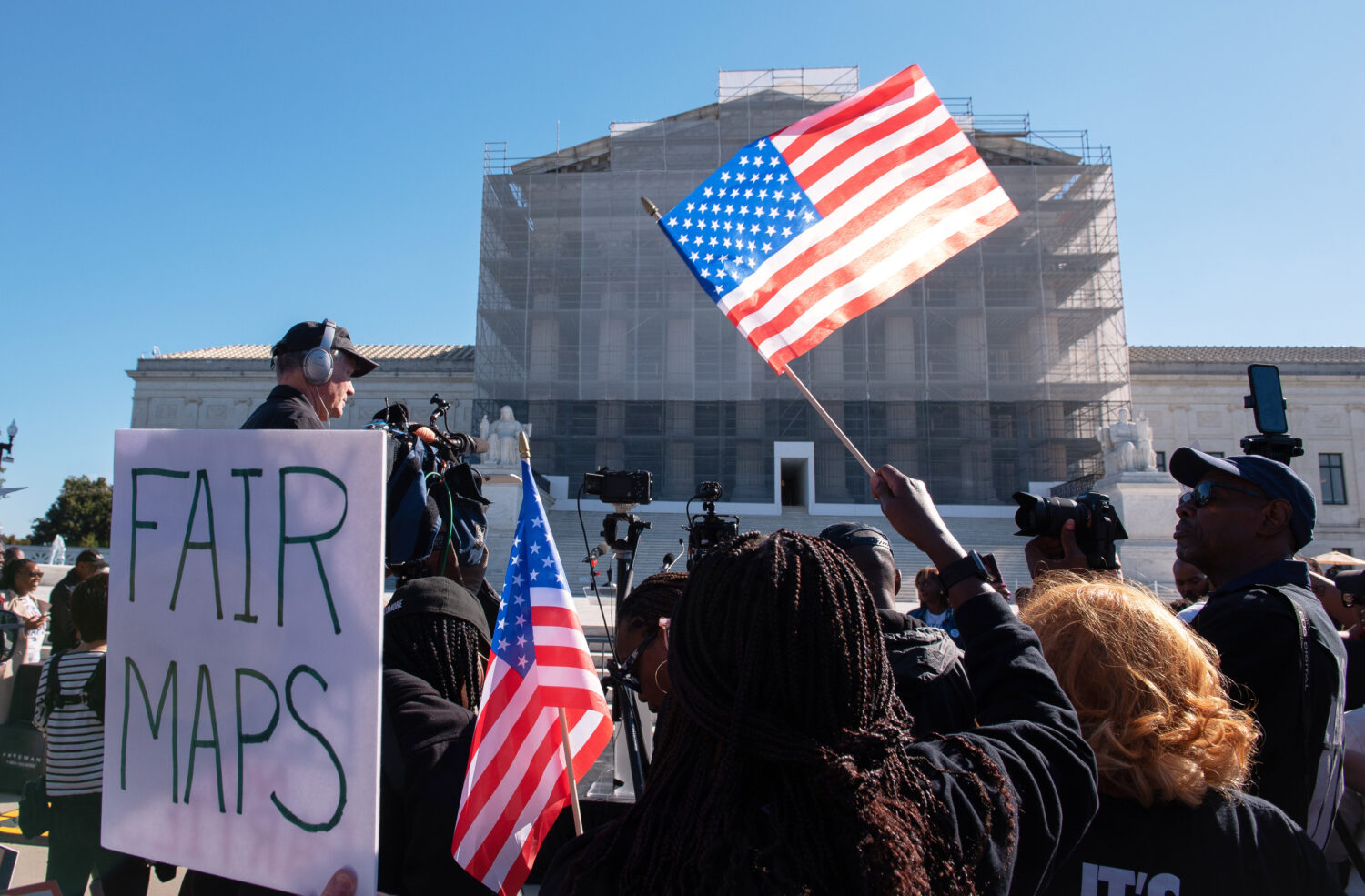
Voting rights activists gather outside the Supreme Court in Washington, early Wednesday, Oct. 15, 2025, as the justices prepare to take up a major Republican-led challenge to the Voting Rights Act, the centerpiece legislation of the Civil Rights Movement. (AP Photo/Cliff Owen)
Credit: ASSOCIATED PRESS
(AP Photo/Cliff Owen)
WASHINGTON (AP) — For decades, the faces of American politics have grown more diverse by nearly every measure, especially as racial minority communities gained political representation after longtime legal disenfranchisement and violent discrimination.
But after some Supreme Court justices expressed skepticism about a key provision of the Voting Rights Act of 1965, a landmark law that civil rights leaders credit with enabling pluralistic democracy in the U.S., Black lawmakers, civic leaders and organizers fear that the faces of the nation’s elected representatives may soon return to a time before hard-fought civil rights gains.
Justices on Wednesday heard oral arguments in Louisiana v. Callais, a case that scrutinizes whether Section 2, a part of the Voting Rights Act that bars discrimination in voting systems, is constitutional.
Rep. Cleo Fields, who represents the Louisiana congressional district at the heart of the case, sat in the courtroom as the justices questioned attorneys on both sides of the case. He said he hopes the scope of the ruling’s impact would give justices pause about whether to gut the law.
“If they do away with Section 2, they know the ripple effect that’s going to have all over this nation. It’s not just Congress,” Fields said in an interview with The Associated Press. He added that it was “hard to judge” what the justices are thinking, “but I am cautiously optimistic. I really think all of the justices know what’s at stake.”
Voting Rights Act has broad impacts for communities of color
Since the passage of the Voting Rights Act, which bans a range of discriminatory voting practices by state and local governments and individuals, communities of color have turned longtime movements into direct political representation — and power.
State legislatures in the Deep South, once uniformly committed to white supremacy, now feature sizable minorities of Black, Asian and Latino lawmakers. The act was amended a decade after its passage to protect the rights of “ language minorities,” increasing protections for Asian American, Native American and Latino communities across the country.
Lawmakers elected as a direct result of Voting Rights Act-enabled legislative districts have often served as a voice in state legislatures and Congress for once-overlooked interests. The Congressional Black Caucus, for instance, has for decades served as a hub for Black political power and organizing in the country. Lawmakers in VRA districts have become political icons and overseen political machines that drive national politics.
Minority communities in states and districts once subject to VRA review have successfully elected mayors, police commissioners, judges and county commissioners to lead some of the nation’s largest cities and municipalities.
Black residents of communities in VRA districts gathered in front of the Supreme Court to rally during oral arguments Wednesday.
Khadidah Stone, a plaintiff in a 2023 case brought by Black Louisianans that created Fields’ district and another majority-minority district in Alabama, connected the current lawsuit to President Donald Trump’s calls for states to redraw congressional maps ahead of next year’s midterm elections.
“We’re back because it’s very evident what the current administration is trying to do when it comes to dismantling what we currently know as democracy,” Stone told The Associated Press. “That entails destroying things like the Voting Rights Act because it doesn’t align with their ideals of what America should be.”
Some lawmakers worry that progress will be reversed if the law’s protections are removed.
“There’s a certain level of anxiety as we look at the mid-decade gerrymandering that’s taking place,” Rep. Yvette Clarke, chair of the Congressional Black Caucus, told the AP.
Clarke called GOP-led redistricting efforts in states like Texas “blatant targeting” of Black lawmakers and said the case now before the court “could have an impact for generations to come.”
Rep. Troy Carter, a Louisiana Democrat, said the U.S. would become “a very weakened democracy” if the court made a sweeping decision.
“A representative form of government means it should look like its people. If you take away the elements that create the opportunity for it to look like its people, it won’t be a democracy as we hoped it would be,” Carter warned. “It will be a much weaker one, and ultimately on the road to an oligarchy.”
Supreme Court arguments show Civil Rights movement’s legacy in question
The Voting Rights Act of 1965 is considered to be a crowning achievement of the Civil Rights movement. The law bans discriminatory voting practices like poll taxes and literacy tests. It reaffirms the constitutional right of all citizens to vote. And it established processes by which federal authorities could review how states and localities enacted policies or legislative maps that may disenfranchise voters.
Some of those provisions have been struck down or restricted by Supreme Court rulings, like the 2013 case of Shelby v. Holder. Voting rights advocates argue that discriminatory actions by states and localities have increased since then. If Section 2 meets a similar fate, they warn, Black political representation could be sent back several generations.
Justices on the high court’s conservative majority questioned the long-term effect of requiring that governments remedy violations of Section 2 — which the law would consider proven claims of discrimination — with race-conscious solutions.
“It’s the particular application of the statute that entails the intentional, deliberate use of race to sort people into different districts,” Justice Brett Kavanaugh said to lawyers speaking in defense of Section 2 during oral arguments. “I’m asking what you think the time limit on that should be, or maybe you really shouldn’t think there should be a time limit?”
The court’s liberals countered that Section 2 is a tool and only requires districts to be drawn with race in mind if racial discrimination was the issue at hand. If proven cases of discrimination ended, the law would not be used, they reasoned.
“Section 2 itself is just the measure by which we determine that a remedy is required, so that’s why it doesn’t need a time limit, because it is just pointing us to the direction of where we might need to do something,” said Justice Ketanji Brown Jackson.
Congresswoman in Alabama ‘Bloody Sunday’ district readies for new rights battle
“Sitting there listening to the oral argument in person, it was very clear to me that the conservative justices have an end result they’d like and that they were justifying it through their questioning,” said Rep. Terri Sewell, an Alabama Democrat.
Sewell had the strong feeling that “old battles have become new again” as she left the court after oral arguments to return to Capitol Hill. She represents a majority-Black Alabama district where, 60 years ago, voting rights marchers were brutally beaten by state and local police officers while crossing a bridge in Selma to demand the right to vote. The Voting Rights Act mandates her district, which could be redrawn should the law be weakened.
But she left the chamber also undeterred and ready to respond, she said.
“Progress is elusive. The pendulum swings, and it doesn’t swing on its own,” Sewell said. “This is a continuous struggle, and we pass the baton on to the next generations. And while the baton is in our hand, I think we have to do everything in our power to maintain the representative democracy that we have and to make sure that this democracy is healthy and strong for the next generation.”