Smoke from climate-fueled wildfires contributed to thousands of US deaths over 15 years, study says
May 8, 2025, 6:00 AM
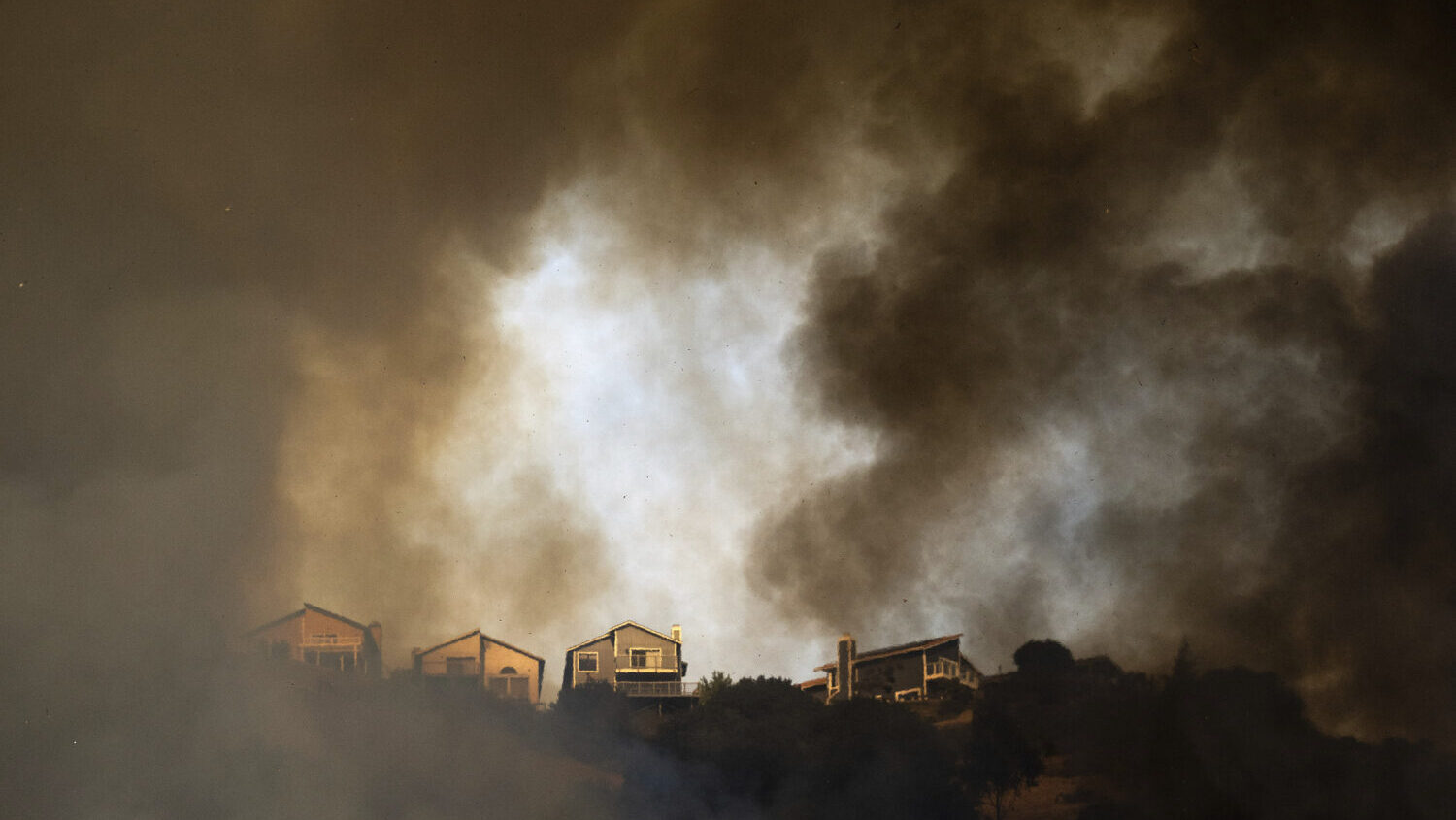
FILE - Smoke rises above homes as a grass fire burns near Interstate 580 in Oakland, Calif., Friday, Oct. 18, 2024. (Noah Berger, Associated Press)
(Noah Berger, Associated Press)
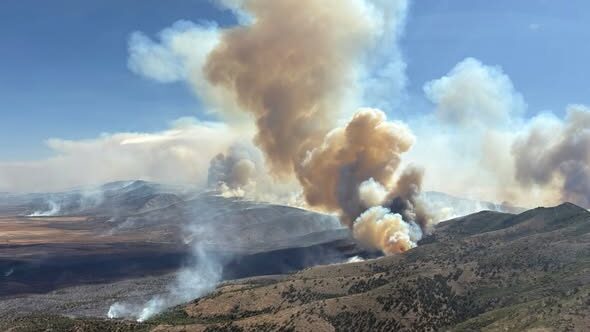
Wildfires driven by climate change contribute to as many as thousands of annual deaths and billions of dollars in economic costs from wildfire smoke in the United States, according to a new study.
The paper, published Friday in the journal Nature Communications Earth & Environment, found that from 2006 to 2020, climate change contributed to about 15,000 deaths from exposure to small particulate matter from wildfires and cost about $160 billion. The annual range of deaths was 130 to 5,100, the study showed, with the highest in states such as Oregon and California.
“We’re seeing a lot more of these wildfire smoke events,” said Nicholas Nassikas, a study author and a physician and professor of medicine at Harvard Medical School. So he and multidisciplinary team of researchers wanted to know: “What does it really mean in a changing environment for things like mortality, which is kind of the worst possible health outcome?”
Read more: Southern Utah could see more wildfires this year
Lisa Thompson, a professor at Emory University who studies air pollution and climate change and was not involved in the paper, said it is one of the first studies she has seen to isolate the effect of climate change on mortality. Looking at the impacts across time and space also made it unique, she said.
The paper’s researchers focused on deaths linked to exposure to fine particulate matter, or PM2.5 — the main concern from wildfire smoke.
These particles can lodge deep into lungs and trigger coughing and itchy eyes with short-term exposure. But longer term they can make existing health problems worse and lead to a range of chronic and deadly health issues. Children, pregnant people, the elderly and outdoor workers are among the most vulnerable. The Health Effects Institute estimated the pollutant caused 4 million deaths worldwide.
Evidence is emerging that PM2.5 from wildfire smoke is more toxic than other pollution sources. When wildfires encroach into cities, burning cars and other toxics-containing materials, it adds to the danger.
Numerous studies have tied human-caused climate change — caused by the burning of coal, oil and gas — to a growth in fires in North America. Global warming is increasing drought, especially in the West, and other extreme weather. Drier conditions suck moisture from plants, which act as fuel for fires. When drier vegetation and seasons are mixed with hotter temperatures, that increases the frequency, extent and severity of wildfires and the smoke they spew.
Findings dismaying but not surprising, scholar says
Jacob Bendix, professor emeritus of geography and environment at Syracuse University, said he was “dismayed” by the findings but not surprised.
“(T) hese numbers are really significant. I think there’s a tendency for people outside of the areas actually burning to see increasing fires as a distant inconvenience … This study drives home how far-reaching the impacts are,” said Bendix in an email. He wasn’t involved in the study.
The study’s authors drew on modeled and existing data to reach their findings. First, they sought to understand how much area burned by wildfires was attributable to climate change. They did that by analyzing the real climate conditions — heat and rain, for instance — when wildfires erupted from 2006 to 2020, and compared that to a scenario where weather measurements would be different without climate change.
From there, they estimated the levels of PM2.5 from wildfire smoke tied to climate change using the same approach. Lastly, integrating the current understanding of how particulate matter affects mortality based on published research, they quantified the number of deaths related to PM2.5 from wildfires and calculated their economic impact.
This framework showed that of 164,000 deaths related to wildfire-PM2.5 exposure from 2006 to 2020, 10% were attributable to climate change. The mortalities were 30% to 50% higher in some western states and counties.
Questions about the study’s conclusions
Marshall Burke, global environmental policy professor at Stanford University, said the evidence linking climate change to burned areas was “rock solid,” but the subsequent steps were harder.
“Linking burned area to smoke is trickier because you never know exactly which way the wind’s going to blow,” he said, and he wondered how the death estimates compared to fatalities tied to general air pollution.
Still, their approach was sensible and reasonable, Burke said.
Johns Hopkins University lecturer in climate and energy policy Patrick Brown said he had some concerns about the study. One was conceptual. The study acknowledges the power non-climate drivers have on wildfires, but it doesn’t give them proper weight, he said in an email.
Brown, who was not involved in the study, worries decision-makers could wrongly conclude that mitigating planet-warming carbon emissions is the only solution. “Yet in many regions, the more immediate life‑saving action may be fuel breaks, prescribed burns, ignition‑source regulation, public health efforts, etc.,” he said.
Land management practices such as prescribed burns can reduce wildfire fuel, Nassikas said. But ultimately, the study notes, the problem of deaths from wildfire smoke will only get worse without the reduction of greenhouse gas emissions.
“Part of the study is raising awareness,” he said. “And then once we kind of understand that … now what are the interventions that we can deploy at a personal level, at a community level, and then obviously at a larger level across the country and across the world?”
———
The Associated Press receives support from the Walton Family Foundation for coverage of water and environmental policy. The AP is solely responsible for all content. For all of AP’s environmental coverage, visit apnews.com/hub/climate-and-environment.