How Alta’s ‘dirtiest’ snow year ended its 2022 snowmelt process 2 weeks early
Jun 16, 2023, 6:31 AM | Updated: Oct 23, 2023, 2:27 pm
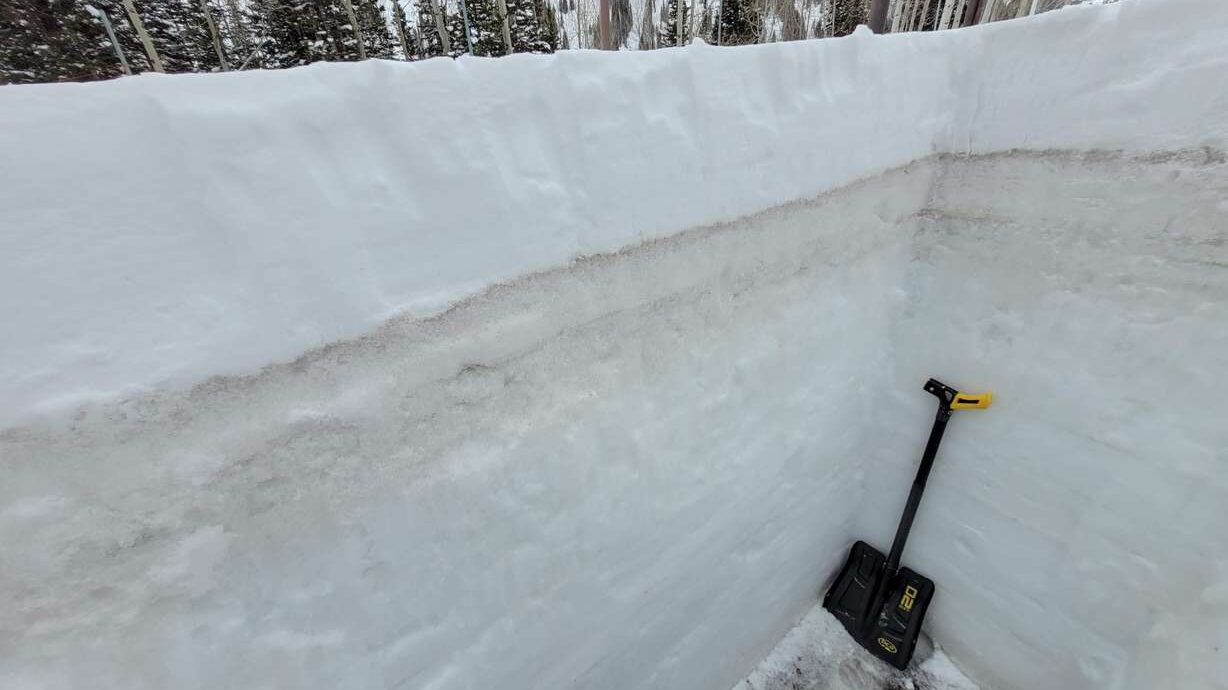
A ring of dust is visible from a snow pit at the Alta Atwater SNOTEL site on May 10, 2022. More than a dozen dust events were recorded last spring. (Photo: Otto Lang via University of Utah)
(Photo: Otto Lang via University of Utah)
This article is published through the Great Salt Lake Collaborative, a solutions journalism initiative that partners news, education and media organizations to help inform people about the plight of the Great Salt Lake — and what can be done to make a difference before it is too late.
SALT LAKE CITY — McKenzie Skiles and other Utah researchers had already shed light on the relationship between dust and mountain snowmelt before a series of storms in early 2022 began to pelt the Wasatch region with lots of dust.
“We saw dust event after dust event after dust event,” said Skiles, an assistant professor in the University of Utah’s geography department.
These storms sparked a new idea. They decided to turn their attention to these storms and where all the dust was coming from, so they could see how it factors in the snowpack runoff process for an entire season.
The team of researchers, led by Skiles, determined all the accumulating dust resulted in the snowpack at a research site in Alta melting 17 days faster than it would have otherwise in 2022.
While nearly half of the dust came from the West Desert, she points out that the Great Salt Lake was the “most efficient dust contributor by source area,” accounting for nearly a quarter of the dust they found.
Their results were published in Environmental Research Letters on Thursday.
The relationship between dust and snowpack
Snowpack — a calculation of all the water contained in mountain snow — is a vital resource in the West. Utah and federal water managers say the snowpack collection and spring snowmelt runoff process accounts for about 95% of the state’s water supply.
The spring runoff is a delicate process that requires the right conditions and timing, too. For example, if it’s too hot and it melts right away, you get flooding. If it’s too dry before the snowpack collection season, the water may not flow into the reservoirs and the runoff isn’t as efficient.
Here’s where dust comes into the equation.
Skiles, who has researched the impacts of dust on mountain snowpacks in Colorado and Utah for about a decade now, helped lead previous studies that show how dust can speed up the snowpack melting process. Snow melts faster when there’s dust and dirt on it because it’s darker and absorbs more sunlight, thus making it warmer and easier to melt than the typically white snow.
She and her team also conducted research in 2018 that found how one particular storm that dumped dust from the Great Salt Lake contributed to snowpack melting five days quicker than it normally would have, too.
A dusty spring runoff
Thursday’s report is the broadest look at the relationship between dust and Utah’s snowpack to date, reviewing an entire snowmelt season at a Natural Resources Conservation Center SNOTEL site in Alta.
Researchers analyzed the impact of 16 dust storms recorded between March and May 2022, in what the University of Utah says was the “dirtiest” year since the university began collecting data on dust events and snowpack dust concentrations in 2009.
Skilies explains that a pair of weather and climate factors are to blame for how dusty it got. First, Utah became even drier after the Great Salt Lake study came out.
Severe and exceptional drought conditions emerged in Utah beginning in 2020, the state’s driest calendar year since at least 1895. These conditions didn’t improve that much in 2021, setting up for more surface soils to become available to be picked up in the wind.
The Great Salt Lake was one of the hardest hit by the condition, which had tacked onto impacts from previous droughts and water projects that diverted water from flowing into the lake. It dropped to its lowest point on record in 2021 and to an even lower point after Skiles’ team collected data last year.
Second, the first half of 2022 was abnormally windy. By July, there had already been 49 days of at least one five-second wind gust of 35 mph or greater, the National Weather Service told the Deseret News. It bested the previous record of 44 days in the same span of time set in 2011.
These windy days essentially carried good portions of the newly available dust.
“We got many storms, and ahead of those storms in the spring were high wind speeds, so we had a dust event basically every time there was a storm and high prefrontal winds,” Skiles said. “That was picking up all that dust and depositing it into the mountains.”
From there, the team used the dust concentration data and other variables to determine that it sped up the entire snowmelt process by 17 days at the Alta site.
Where is the dust coming from?
Knowing how much dust affected a spring runoff only answered half of what the team sought to discover. After every new dust storm, the researchers went back and reviewed weather models to help determine where any of the dust could be coming from based on the origin of the air mass.
They found that 45% of the dust came from the West Desert, while the Great Salt Lake’s exposed lakebed accounted for 23% and the Sevier and Tule dried lakebeds accounted for another 17%, combined.
Derek Mallia, an assistant professor within the University of Utah’s department of atmospheric sciences, and a co-author of the study, said the team expected the West Desert would be a “major source of dust,” but they were “somewhat surprised” with how much came from the Great Salt Lake.
It’s why researchers say it’s very important that the lake is able to be refilled, so there aren’t more dust events in the future.
“While the lake’s dust sources are much smaller than the West Desert in terms of area, the exposed dry lakebeds are much closer to the Wasatch Mountains,” Mallia said, in a statement. “These results suggest that the Great Salt Lake is an important factor when it comes to accelerating snowmelt across the Wasatch Front and will become a bigger player if it continues to shrink.”
Plans for more research
This winter produced Utah’s largest snowpack on record, greatly reducing the severity of the drought in the Wasatch region and across the state.
That said, there was still quite a lot of dust observed at the Alta research site this year. Skiles said it seems to indicate that some surface soils became so dry that even a prolific winter couldn’t stop them from blowing in the wind.
“Anecdotally, there was probably as much dust this year as last year, if not more,” she said. “The snow was quite dusty this year, again. That did surprise us a little bit because it was such a wet winter.”
Her team is collecting and reviewing similar data from this year’s snowpack runoff, which is almost over.
Skiles explained that it’s likely the dust is speeding up this year’s snowpack in some form; however, this spring’s cloudy and rainy conditions have helped reduce the impact of the dust because it’s blocking the sunlight that’s needed to accelerate the snowmelt.
She’d also like to expand research beyond the site in Alta, providing research that may help better understand the snowpack runoff process every spring across the entire Wasatch Mountain region in the future. The research could be implemented in future snowmelt models, helping water managers better predict how much water to expect every spring.
“The plan is to keep doing it every year and also broaden it out,” she said. “We’ll be combining this with remote sensing in the future to study impacts over the whole Wasatch and not just focus on that one study area. We want to be able to understand the full impact of the headwaters of the Great Salt Lake.”
Related: