
Study: Warming makes US West megadrought worst in modern age
Apr 17, 2020, 4:33 PM
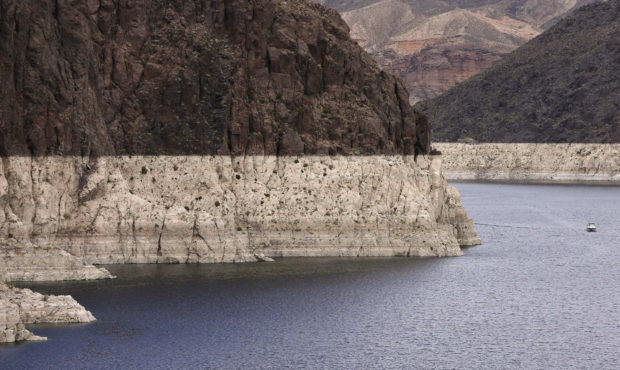
FILE - This Tuesday, April 16, 2013 file photo shows a bathtub ring marking the high water line as a recreational boat approaches Hoover Dam along Black Canyon on Lake Mead near Boulder City, Nev. A two-decade-long dry spell that has parched much of the western United States is turning into one of the deepest megadroughts in the region in more than 1,200 years, and about half of this historic drought can be blamed on man-made global warming, according to a study released Thursday, April 16, 2020 in the journal Science. (AP Photo/Julie Jacobson)
(AP Photo/Julie Jacobson)
KENSINGTON, Maryland (AP) — A two-decade-long dry spell that has parched much of the western United States is turning into one of the deepest megadroughts in the region in more than 1,200 years, a new study found.
And about half of this historic drought can be blamed on man-made global warming, according to a study in Thursday’s journal Science.
Scientists looked at a nine-state area from Oregon and Wyoming down through California and New Mexico, plus a sliver of southwestern Montana and parts of northern Mexico. They used thousands of tree rings to compare a drought that started in 2000 and is still going — despite a wet 2019 — to four past megadroughts since the year 800.
With soil moisture as the key measurement, they found only one other drought that was as big and was likely slightly bigger. That one started in 1575, just 10 years after St. Augustine, the first European city in the United States, was founded, and that drought ended before the Pilgrims landed on Plymouth Rock in 1620.
What’s happening now is “a drought bigger than what modern society has seen,” said study lead author A. Park Williams, a bioclimatologist at Columbia University.
Daniel Swain, a UCLA climate scientist who wasn’t part of the study, called the research important because it provides evidence “that human-caused climate change transformed what might have otherwise been a moderate long-term drought into a severe event comparable to the ‘megadroughts’ of centuries past.”
What’s happening is that a natural but moderate drought is being worsened by temperatures that are 2.9 degrees Fahrenheit (1.6 degrees Celsius) hotter than the past and that suck moisture out of the ground, Williams said. It’s much like how clothes and plants dry faster in the warmth of indoors than they do outside, he said.
To quantify the role of global warming, researchers used 31 computer models to compare what’s happening now to what would happen in a mythical world without the burning of fossil fuels that spews billions of tons of heat-trapping gases. They found on average that 47% of the drought could be blamed on human-caused climate change.
“We’ve been increasingly drifting into a world that’s getting dryer,” Williams said.
There’s debate among scientists over whether this current drought warrants the title “megadrought” because so far it has only lasted two decades and others are at least 28 years long.
Climate scientist Clara Deser at the National Center for Atmospheric Research, who wasn’t part of the study, said while the research is good, she thinks the deep drought has to last another decade or so to qualify as a “megadrought.” Williams said he understands the concern and that’s why the study calls it “an emerging megadrought.”
“It’s still going on and it’s 21 years long,” Williams said. “This drought looks like one of the worst ones of the last millennium except for the fact that it hasn’t lasted as long.”
University of Michigan environment dean Jonathan Overpeck, who studies southwestern climate and was not part of the study, calls it “the first observed multidecadal megadrought in recorded U.S. history.”
Although last year was wet, past megadroughts have had wet years and the recent rain and snow was not nearly enough to make up for the deep drought years before, Williams said.
The U.S. drought monitor puts much of Oregon, California, Colorado, Utah and Nevada and good chunks of New Mexico, Arizona and Idaho in abnormally dry, moderate or severe drought conditions. Wyoming is the only state Williams studied that doesn’t have large areas of drought.
This week, water managers warned that the Rio Grande is forecast to have water flows less than half of normal, while New Mexico’s largest reservoir is expected to top out at about one-third of its 30-year average.
This is “what we can expect going forward in a world with continued global warming,” said Stanford University climate scientist Noah Diffenbaugh, who wasn’t part of the study.
Read more stories on climate issues by The Associated Press at h ttps://www.apnews.com/Climate
___
Follow Seth Borenstein on Twitter at @borenbears .
___
The Associated Press Health and Science Department receives support from the Howard Hughes Medical Institute’s Department of Science Education. The AP is solely responsible for all content.






