Blaming mass shootings on mental illness is ‘inaccurate’ and ‘stigmatizing,’ experts say
Aug 5, 2019, 3:12 PM
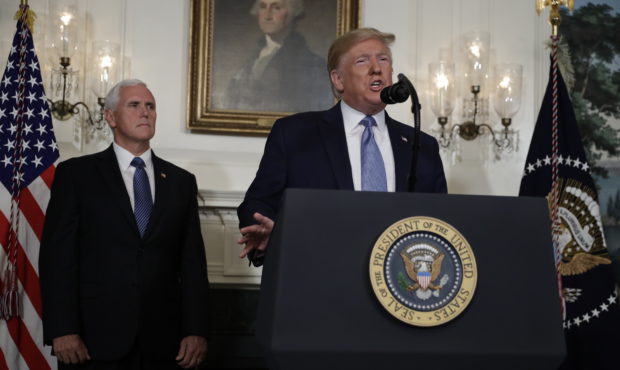
President Donald Trump speaks about the mass shootings in El Paso, Texas and Dayton, Ohio, in the Diplomatic Reception Room of the White House, Monday, Aug. 5, 2019, in Washington. (AP Photo/Evan Vucci)
(AP Photo/Evan Vucci)
(CNN) — President Donald Trump described a weekend of two mass shootings — one in El Paso, Texas, and the other in Dayton, Ohio — as a “mental illness problem.”
“We must reform our mental health laws to better identify mentally disturbed individuals who may commit acts of violence and make sure those people not only get treatment but when necessary involuntary confinement,” Trump said during a public address on Monday.
“Mental illness and hatred pulls the trigger, not the gun.”
Yet mental health experts, including representatives from the American Psychological Association, have called it “unfounded” to blame mass shootings on mental illness in place of considering other possible factors, such as hate, bigotry and access to assault weapons.
Calling every mass shooting a mental health problem is “inaccurate and it’s stigmatizing,” said Arthur Evans, chief executive officer of the American Psychological Association.
Mental illness affects millions of adults across the country. About 1 in 5 adults in the United States, or 46.6 million, experience mental illness in a given year, according to the National Alliance on Mental Illness.
“The reality is that there are a variety of reasons that mass shootings happen,” Evans said. “If this were a mental health issue and this was the only issue involved here, what you would see is roughly the same number of mass shootings around the world and we’re not seeing that.”
Framing mass shootings as a “mental health issue” certainly could lead to policies aimed at improving mental health, but “that won’t prevent the next shooter,” said Lori Ann Post, a professor of emergency medicine and medical social sciences at Northwestern University’s Feinberg School of Medicine, who studies violence and policy.
It’s estimated that less than 5% of shootings are committed by people with a diagnosable mental illness, Post said.
What makes a mass shooter
Based on the current body of research, mass shootings tend to fall within specific categories, most of which do not explicitly involve mental illness, according to Post, who has been tracking these “typologies” of massacres.
“One of them is hate crime,” Post said, referring to the El Paso, Texas, shooter and the previous mass shootings at a Charleston, South Carolina, church in 2015 and the 2016 Pulse nightclub shooting in Orlando, Florida.
“We also see revenge killing,” she said, referring to some workplace shootings. “Then we also have some people whose motives are mostly just to kill as many people as possible” or some are “mission oriented.”
“Another typology is domestic violence on steroids,” Post said, referring to when a violent spouse might kill an entire family. Most mass shootings fall within the categories of domestic violence, hate crimes or retribution killing, she added.
While these scenarios are important to research, Post said that mass shootings overall are rare occurrences.
“Mass shootings make up a half percent of the total deaths in America,” Post said.
“Mental health definitely has a role in gun shootings and that’s mostly people who are depressed and kill themselves — however, not mass shootings,” she said.
Nearly 40,000 people in the United States died by guns in the year 2017, marking the highest number of gun deaths in decades, according to an analysis of data from the Centers for Disease Control and Prevention’s WONDER database.
That analysis, conducted by CNN last year, showed that, within the total number of deaths, 23,854 people died from suicide by guns in 2017, the highest number in 18 years. That’s a difference of more than 7,000 deaths compared with 16,599 suicide deaths by guns in 1999.
The age-adjusted rate of suicide deaths by firearm rose from 6.0 in 1999 to 6.9 in 2017.
Although they seem like they happen all the time, public mass shootings are rare events and tend to have different motivations, said Jeffrey Swanson, a professor in psychiatry and behavioral sciences at Duke University, who specializes in gun violence and mental illness.
“They range from this extreme anger and hate, to rare manifestations of acute psychopathology,” he said. “The risk factors for this kind of violence are non-specific.”
He added that the risk factors require more study beyond just mental health research.
“Other countries have the same prevalence of mental illness as we do. They don’t have this problem with mass shootings,” Swanson said.
“If you look at our violent crime rate in the United States, it’s about average compared to countries in Western Europe, the UK, Canada, and Australia,” he said. “Our homicide rate is several times higher. One reason is that we have far easier access to guns.”
Various epidemiological studies over the past three decades suggest that the vast majority of people with serious mental illnesses, like schizophrenia, bipolar disorder or severe depression, are not violent, Swanson added.
Rather, people with severe mental illnesses are more than 10 times more likely to be victims of violent crime than the general population. Only about 3% to 5% of violent acts can be attributed to serious mental illness, according to the US Department of Health and Human Services, in reference to a study by Swanson and his colleagues.
More ‘complicated’ than just a mental health issue
Instead of policies that restrict gun access based solely on mental illness diagnoses or because a person has made contact with the judicial system or health care agencies due to mental illness, the American Psychological Association, the National Alliance on Mental Illness and other advocacy groups have called for gun access criteria based on more direct indicators of potentially dangerous behavior.
The American Psychological Association recommends prohibiting firearms for high-risk groups, like domestic violence offenders or persons convicted of violent misdemeanor crimes.
“What happened over the weekend shows how complicated the issue of gun violence is. Most people who commit gun violence are not committing mass shootings. Unfortunately, what’s happening in cities around the country every day, the majority of people who die by shooting are people who die by suicide,” said Evans of the APA.
“We need the research funding so that we can get a better handle on this in the country and secondly our political leaders need to understand the complexity.”
Stigma can be a harmful result of routinely blaming mass shootings on mental illness, Rosie Phillips Davis, president of the American Psychological Association, said in a written statement after the shootings.
Especially when “research has shown that only a very small percentage of violent acts are committed by people who are diagnosed with, or in treatment for, mental illness,” she said in the statement.
Rather, “as our nation tries to process the unthinkable yet again, it is clearer than ever that we are facing a public health crisis of gun violence fueled by racism, bigotry and hatred. The combination of easy access to assault weapons and hateful rhetoric is toxic.”
The-CNN-Wire
™ & © 2019 Cable News Network, Inc., a Time Warner Company. All rights reserved.