When bad news gets to be too much for you
Aug 7, 2019, 12:46 PM
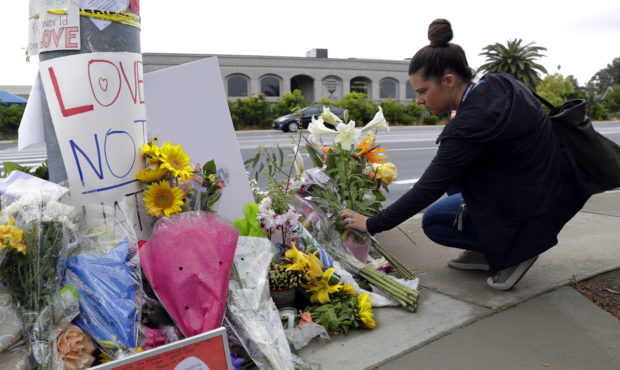
A woman leaves flowers on a growing memorial across the street from the Chabad of Poway synagogue in Poway, Calif., on Monday, April 29, 2019. A gunman opened fire on Saturday, April 27 as dozens of people were worshiping exactly six months after a mass shooting in a Pittsburgh synagogue. (AP Photo/Greg Bull)
(AP Photo/Greg Bull)
(CNN) — Maybe the bad news slump happened for you after the Parkland or San Bernardino shootings. Or when attacks in France, Brussels, New Zealand and other faraway regions came in such quick succession there wasn’t time for mourners of one trauma to disperse before the next took its place. Maybe it was earlier — after Sandy Hook or maybe even Columbine.
Maybe it’s happening for you now after the Gilroy, El Paso and Dayton shootings.
No matter when it happened, what you felt is how sadness and prayer can harden into palpable exhaustion.
This constant churn of harrowing news is physically and psychologically unhealthy, and you don’t need to be directly involved in a tragedy to feel its effects. To any concerned viewer, this pain can feel unavoidable or even necessary. It might be a little bit of both. The truth is, in an age of unfettered access to the worst of humanity, we have to act as our own gatekeepers if we want to stay sane.
Yes, you can experience vicarious trauma
Pick a tragedy, any that occurred in the last few months. Chances are there are images you can’t unsee, or a video you watched even once — and later regretted when you found the memory pulling you away from happier thoughts. This is a type of trauma, and though experts disagree on its severity (it may never be on par with the experiences of those at the scene), it can be damaging nonetheless.
Dr. Pam Ramsden, a lecturer in psychology at the University of Bradford in the UK, has studied the psychological effects of consuming negative news from social media. She says this vicarious trauma affects a portion of the viewing public and though it is not a specific diagnosis, she has seen patterns similar to those that plague first responders — nurses, doctors, emergency medical technicians and the like.
“Some individuals are left with post-traumatic stress and must be professionally treated, others are affected a short time with acute stress disorder,” Ramsden said.
People who are affected may engage in obsessive consumption, such as watching and re-watching a traumatic video long after its message has been absorbed. While prescriptions of resilience often dominate a post-trauma narrative, those who are especially affected may isolate themselves, change their routines, make decisions based out of fear — essentially all of the things we are taught not to do when dealing with terrorism and other threats.
Those are difficult rules to abide when all you can think about is the latest catastrophe. From this, guilt can emerge as well. After all, so many have it so much worse, any secondhand struggles may not seem worth the mention.
“With some of these individuals requiring professional help, I doubt they will get it,” Ramsden said. “Because how do you go to a mental health provider and tell them that YouTube videos have left you traumatized so that you can’t sleep and have nightmares?”
Turn it off and stop watching
Ali Dixon, a counselor who practices at the Anxiety & Stress Management Institute in Atlanta, says she has had several clients express increased anxiety and concern because of recent news events. She says the best way to cope with this anxiety is to pull away.
“When clients express these kind of concerns, we discuss ways to limit their exposure to media coverage,” she said. “This has become increasingly complicated as media coverage is so readily accessible on our phones, social media accounts and even on television at the gas station.”
Realistically, it comes down to a game of averages. Like food, news is a necessity. You can binge, you can starve, or you can regulate your intake.
“People should watch their own reactions to the news so they know when it’s too much,” says Elana Newman, a professor of psychology at the University of Tulsa.
It’s especially critical because the days of prepackaged, curated news are long gone.
“Social media is a whole other aspect of this because the news used to guide how the public learned about news,” Newman says. “Now there’s much more bad stuff to go through, it may not be metabolized. It isn’t broken down.”
Ramsden recalls in 2013 when Lee Rigby, a British army soldier, was hacked to death on a London street in broad daylight.
“Although the news media blurred the events, it was easy to find them and watch them in graphic detail,” she says. “So while there was an effort to protect the public from that, it wouldn’t be useful because the people who are traumatizing themselves would be the very people who would search online to watch the footage of the carnage.”
Carve out your own comfort
In the summer of 2016, when the Pokémon Go phenomenon spread across the globe, it seemed so incongruous against a backdrop of terror and instability. How could anyone run around chasing fake monsters when there were so many real ones to fear? It created dissonance for those who felt both the need to mourn and the need to escape.
Those needs, though, don’t need to be mutually exclusive.
“One of the things about trauma is it makes people think in terms of extremes,” Newman says. “They either go running toward it or they shut it off. They either watch a lot or don’t watch at all, when really it’s OK to have fun and recharge and also deal with difficult issues.”
If you think the idea of self-care sounds too squishy and sensitive for such trying times, consider it a force for change. There’s a reason people flock to blood banks and share that Mr. Rogers quote — the one about looking for all the helpers — every time the world is upended.
“It’s common to feel guilty when our lives are going well, and we see so much devastation around us,” Dixon says. “One reason this occurs is because we feel out of control and wish we could help. If we can continue to engage in activities that create positive energy for us, we can in turn give that positive energy back to the world around us.”
Newman says viewers crave instruction to quell their feelings of hopelessness.
“Journalists can provide information to people on what to do to support the causes they feel strongly about. Racism, what can you do about that? You can attend a meeting. You can find resources in your community. Are you concerned about terrorism? You can research a plan. You can talk to someone.”
Allow yourself to feel bad and grow from it
No matter how you deal with traumatic news, it doesn’t change the fact that it happens and it’s important — and maybe you should spend some time with your difficult thoughts.
“Being upset is not a bad thing. It shows compassion,” Newman says. “Some of these events that are in the news are causing us to confront deep, painful important issues.”
Mass shootings. Terrorism. Race relations. Mental health. The ongoing litany is hard to address in times of relative peace, let alone in the wake of whatever tragedy brings it to the forefront. Still, Newman says, if you can bear it, you shouldn’t look away.
“People need to grapple with guilt-inducing issues. They need to confront distressing and uncomfortable topics, and feeling bad about it isn’t necessarily a bad thing.”
The-CNN-Wire
™ & © 2019 Cable News Network, Inc., a Time Warner Company. All rights reserved.