Record low Colorado mountain snow won’t bode well for water in the drought-stricken US West
Mar 31, 2026, 11:20 PM | Updated: 11:23 pm
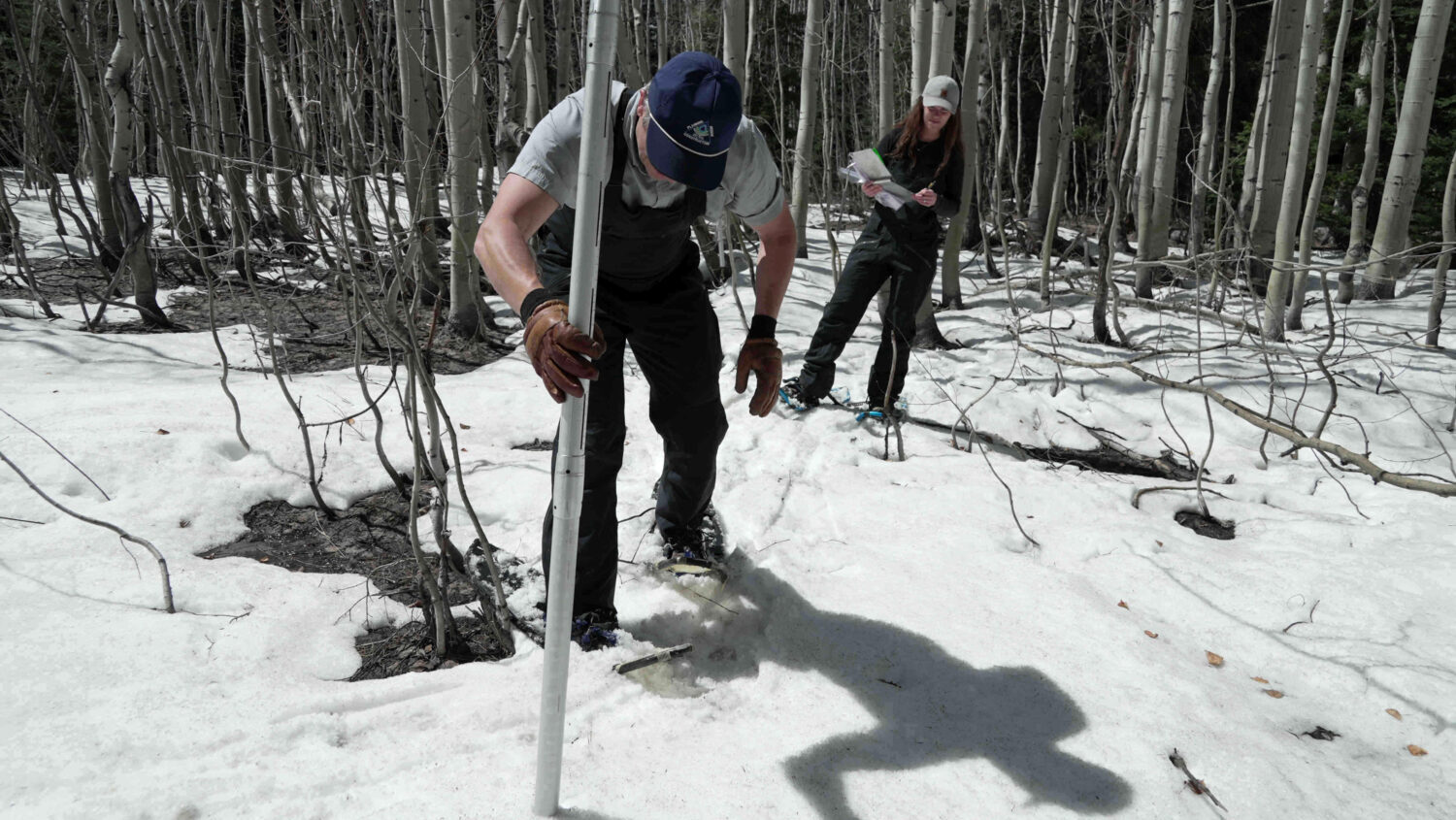
Clinton Whitten and hydrologist Maureen Gutsch, back, measure snow, Monday, March 30, 2026, in Kremmling, Colo. (Brittany Peterson, Associated Press)
(Brittany Peterson, Associated Press)
WALDEN, Colo. (AP) — Hydrologist Maureen Gutsch trudged through the mud and slush to confirm a grim picture: Colorado just had its worst snowpack since statewide record keeping began in 1941.
Even more troubling, mountain snow accumulations peaked a month early and contained just half the average moisture.
As a warm winter with poor skiing conditions gave way to early springtime record heat, snow is vanishing from all but the highest elevations in the West. It’s a clear sign that water shortages could worsen the ongoing significant drought, barring an unexpected deluge.
Gutsch struggled to match the mood of the sunny, 56-degree (13.3 degrees Celsius) weather as she stood in a section of the Rocky Mountains that’s considered the headwaters of the Colorado River.
“We love being out here. We love being in the snow, taking these measurements. This year, it’s kind of hard to enjoy it because it’s slightly depressing with the conditions that we’ve seen,” said Gutsch, who is with the U.S. Department of Agriculture’s Natural Resources Conservation Service.
Department hydrologists told The Associated Press of the dismal, record-low snowpack after concluding their field assessments late Tuesday.
Cities in the region are imposing water-use restrictions, and ranchers are wondering how they will feed and water their cattle. Meanwhile, the threat of devastating wildfires looms.
High (country) and dry
Ranchers in Colorado’s scenic mountain valleys near the Continental Divide are, in a sense, among the first in the region affected by drought, being nearest to the melting mountain snowpack.
They hardly need Gutsch to tell them how parched this winter and spring have been. They remember past droughts — bad ones in 2002, 1981, 1977 — and wonder just what this dry winter will mean for their operations.
“I’ve never seen it so warm so early and no snow all winter long,” said Philip Anderson, a retired teacher who also has ranched most of his life in Colorado’s North Park valley.
The heaviest snows in the Rockies fall in late winter and early spring, including now. Snowfall isn’t unusual in the highest regions even into June.
Anderson’s place is at about 8,100 feet (2,500 meters) in elevation. There, in a typical year, a foot (30 centimeters) or more of snow will linger on his pastures until springtime, helping the grass to green up and stock water ponds to refill.
But without snow on the land, his cows are grazing his grass before it can grow high, and several of his ponds are dry. The ditch that would usually move water from the nearby Illinois River to his property is also dry — tapped already by neighbors with more senior water rights than his.
“A lot of the people which are closer to the mountains have to let the water go by and let those folks with the senior water rights have it,” Anderson said.
The last time Anderson had to haul water in his truck from a nearby wildlife refuge was in 2002. That same year, he had to sell off his herd.
North Park — about 100 miles (161 kilometers) from the South Park valley that inspired the cartoon TV show — is a headwaters of the eastward-flowing Platte River system. Thirty-five miles (56 kilometers) to the west of Anderson’s place, across the Continental Divide, is the Stanko Ranch on the Yampa River.
Jo Stanko dreads low flows because they allow her cattle to wade across the Colorado River tributary. Then they need to be rounded up and brought back home.
This year, Stanko has been watering her parched meadow earlier than ever in her 50 years of ranching. She plans to cut hay before June and is considering buying hay soon to feed her 70 cows afterward.
“Hay’s always a good investment, you know, because it might be really expensive,” she said.
Go with the flow? Not when low
An old saying in the West is that whiskey’s for drinking and water’s for fighting over. It applies all the more when water becomes scarce amid a decades-long drought driven in part by human-caused climate change.
Meanwhile, the river’s Upper Basin states of Colorado, New Mexico, Utah and Wyoming remain at an impasse in negotiations with the Lower Basin states of Arizona, California and Nevada to create new rules for managing the water during shortages.
Like the water itself, time is running short — the current rules expire in September.
A recent federal plan would conserve river water “completely on Arizona’s back,” Democratic Gov. Katie Hobbs told a U.S. Chamber of Commerce meeting in March.
Upper Basin states say their cities, farmers and ranchers already use far less water than they are entitled to under the existing agreements. That’s because they honor senior water rights — some of which date to the 1880s — before those who own newer rights during droughts, Becky Mitchell, the Colorado River negotiator for Colorado, recently told other Upper Basin representatives.
“When there is less, we use less. This is not voluntary and no one gets paid as a result,” Mitchell said.
After missing multiple deadlines set by federal officials in recent months to, at least, create outlines of an agreement, the two sides are hiring more lawyers in case the dispute goes to court.
Cities cut back
After the driest and warmest winter on record, Salt Lake City announced a 10% daily cut in water use.
Reductions will be voluntary for residents, but the biggest nonresidential water users will have to consume no more than 200,000 gallons (2.6 million liters) per day.
On the other side of the Rockies, Denver Water approved limits to watering lawns and other restrictions, with hopes of achieving a 20% cut.
Water officials urged even less watering. Lawns in the Front Range region are just beginning to green up and don’t need watering twice a week until at least mid-May, they pointed out.
The city gets much of its water from mountain snow that accumulates east of the Continental Divide and on the western side. Tunnels under the mountains divert half the city’s water from snow-fed streams on the western side.
“We’re 7 to 8 feet (2 to 2.4 meters) of snow short of where we need to be,” Nathan Elder, water supply manager for Denver Water, said in a statement. “It would take a tremendous amount of snow to recover at this point, so it’s time to turn our attention to preserving what we have.”
Wildfire risk looms large
On the same day Denver approved the water restrictions, the city set a new high temperature record for March: 87 degrees (30 Celsius).
The previous record of 85 degrees (29 Celsius) was set just a week earlier.
Drought was bearing down west of the Rockies, too. In California, snowpack in the Sierra Nevada measured only 18% of the average for this time of year, state data showed.
Hot, dry weather is a recipe for wildfires. While other parts of the U.S., including the South and Southwest, face higher fire risk this spring, forecasters expect the threat in the Rockies to rise as above-average temperatures and below-normal precipitation persist into summer.
This week, the region is getting a reprieve of cooler, damper weather, with snow back in the forecast by the end of the week in North Park. But Anderson said he needs a lot more — half an inch (1 centimeter) of rain every other day for several days — to get out of the drought.
Until then, he suggested that North Park senior and junior water-rights holders work together to ensure everybody has enough.
“It’s pretty serious,” Anderson said. “If we just talk and communicate together and cooperate, we might be able to make it through this. But we’ll see.”
___
Amy Taxin in Santa Ana, California, contributed.
Other reading: Utah lawmakers pass water reporting requirement for large data centers
___
The Associated Press’ climate and environmental coverage receives financial support from multiple private foundations. AP is solely responsible for all content. Find AP’s standards for working with philanthropies, a list of supporters and funded coverage areas at AP.org.