Congress keeps holding all-nighters, creating dysfunction after dark
Apr 24, 2026, 7:03 AM
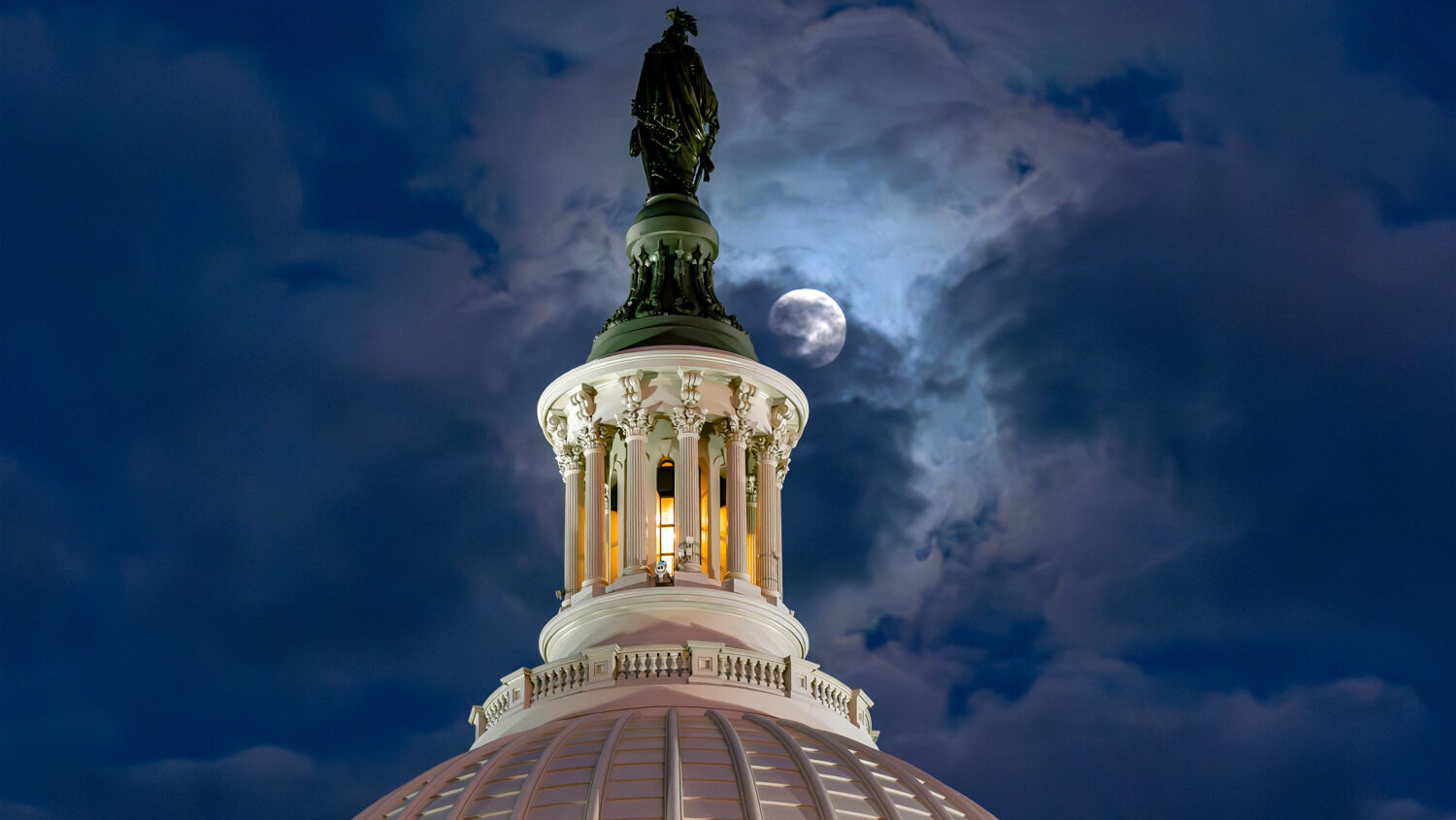
FILE - The moon emerges from the clouds over the U.S. Capitol dome in Washington, Dec. 2, 2025. (AP Photo, J. Scott Applewhite)
(AP Photo, J. Scott Applewhite)
WASHINGTON (AP) — Just as the Senate prepared to launch into a late-night vote series, Republican Sen. John Kennedy of Louisiana went to the floor to vent.
Frustrated and seemingly exhausted Wednesday, Kennedy said he wanted more time to debate his amendments to a budget resolution to fund immigration enforcement agencies. But he had another complaint.
“Frankly I am worried about the health of some of our members,” Kennedy said as 9 p.m. approached. “Not that they’re in bad health, but it’s hard to stay up all night.”
More than 6 hours later, just past 3:30 a.m., senators wrapped up another marathon voting session on amendments and filed out of the chamber, dazed, tired and resigned to soon doing it all again.
It’s a complaint as old as the Congress, with leaders in both major political parties often turning to the torturous grind of an overnight session to exhaust members, overcome objections and push legislation to passage. But it’s a scenario that is playing out again and again, nearly business as usual, as the House and the Senate fracture and careen from one crisis to the next.
Lawmakers say it’s a symptom of a broken Congress that leaders are increasingly forced to govern in the dead of night.
“The dysfunction is getting worse,” said Republican Sen. Kevin Cramer of North Dakota, who has been in Congress for 14 years. Lawmakers have become “less mature,” he said, as a growing number act only in their own self-interest and hold up bills or delay proceedings.
“It’s not a healthy lifestyle,” Cramer said, for the country or the lawmakers. “There’s less concern for the team effort.”
Late-night fights have become the norm
In the last few weeks, Congress has repeatedly debated pressing national issues at night — leading to confusion and turmoil in both chambers.
Much of the drama has centered, as it increasingly does, on government funding.
In late March, Senate Republicans struck a deal with Democrats to reopen most of the Department of Homeland Security, including the Transportation Security Administration, while Democrats continued to block money for Immigration and Customs Enforcement and Border Patrol after the shootings of two protesters in Minneapolis. It was a breakthrough, and Majority Leader John
Thune, R-S.D., passed the spending bill by voice vote — meaning there were no objections on either side — just past 2 a.m.
Senators then flew home for a two-week recess, leaving final passage to the House. But House lawmakers who were asleep when the final Senate agreement was announced woke up and angrily rejected it, saying they wouldn’t pass legislation that didn’t include funding for the immigration enforcement agencies. Senators were then forced to figure out a new plan for reopening the department, and it remains unresolved.
An equally contentious matter, the renewal of surveillance powers for federal spy agencies, also devolved into an after-hours affair.
House GOP leaders kept members in session well past midnight last week while trying and ultimately failing to pass different versions of a foreign surveillance bill. Scrambling to pass an extension of the law ahead of a Monday deadline, leaders eventually cobbled together a 10-day extension past 2 a.m.
Members of both parties were exasperated by the last-minute mayhem.
“Who the hell is running this place?” said Rep. Jim McGovern, D-Mass. He said Republicans threw the bill together “on the back of a napkin in the back room in the middle of the night.”
“Just about everyone agrees that this is serious stuff, the kind of debate that Congress ought to have in the open,” McGovern said.
Tennessee Rep. Andy Ogles, a Republican and member of the House Freedom Caucus who opposed the leadership bills, said the outcome was predictable.
“We warned them that this was gonna happen,” Ogles said. “Unfortunately, here we are at 2 in the morning.”
Time-consuming partisan bills push Senate into late nights
The late-night vote series in the Senate this week was part of an arcane, complicated process called budget reconciliation that GOP leaders are using to try to fund the two immigration enforcement agencies that Democrats continue to block. It’s become the default mode of governing for majorities in Congress as bipartisanship on major issues fades away.
Reconciliation allows the Senate majority to bypass the filibuster and pass budget-related bills along party lines. First, though, they have to get through two lengthy series of votes — and that’s where the dreaded “vote-a-rama” comes in.
The process is open-ended, which means lawmakers in both parties can offer as many amendments as they want to put the other side on record — or, as Republican Sen. Lisa Murkowski of Alaska describes it, “to make each other miserable.”
Leaders generally hold the votes in the middle of the night, as they did Wednesday into Thursday, in hopes of exhausting both sides and forcing senators to stay on the floor and vote quickly. But instead of waiting around between amendment votes, Murkowski walked back and forth between the chamber and her “hideaway,” a small office each senator has in the Capitol building.
“I’m at 14,291 steps,” she said just after 11 p.m., looking at her smartwatch, which was also telling her that her bedtime was approaching. She said if she couldn’t sleep, she might as well get more exercise.
Senators went through the same reconciliation process last year, in extremes, as they labored for weeks to pass President Donald Trump’s package of spending and tax cuts, which he dubbed One Big Beautiful Bill.
The bill had barely enough Republican support to pass, and the Senate and the House held nearly back-to-back all-night sessions to pass it by Trump’s July 4 deadline. In the Senate, GOP leaders kept the long vote series open for hours on end as they worked to win support from Murkowski and others.
“It’s insane,” Murkowski said of the late nights. “My mom always said, ‘Nothing good happens after midnight.'”
Overnights are not new but become more common
Overnight votes are certainly nothing new in Congress. The Affordable Care Act, President Barack Obama’s signature health care law, passed the Senate in the early hours of Christmas Eve in 2009 after weeks of negotiations, just in time for senators to get home for the holidays. Countless other big bills have been passed in the dead of night, as well.
But lawmakers say the after-dark routine has gotten worse and more frequent.
“Part of what’s changed here is there’s a lot of heavy lifting that you have to do to get a bill passed,” said Democratic Sen. Ron Wyden of Oregon, who has served in Congress since 1981, when he was elected to the House. “I think at some point you’ve got to have a forcing mechanism, and one of the easiest is to stay up until the wee hours so that everybody is basically trying not to fall asleep on national TV.”
Democratic Sen. Andy Kim of New Jersey, a relative newcomer to the Senate elected in 2024, said there’s an eventual question of whether anyone is watching.
In the middle of the night, he said: “Are the American people paying attention? How do we get the message out?”
Still, he said, it’s important that lawmakers get their work done at any hour, especially when there is a war going on with Iran and lawmakers take long stretches away from Washington.
“I don’t mind being here,” Kim said.