Hubble spies slow-motion fireworks show — in space
Jul 1, 2019, 12:21 PM | Updated: 12:25 pm
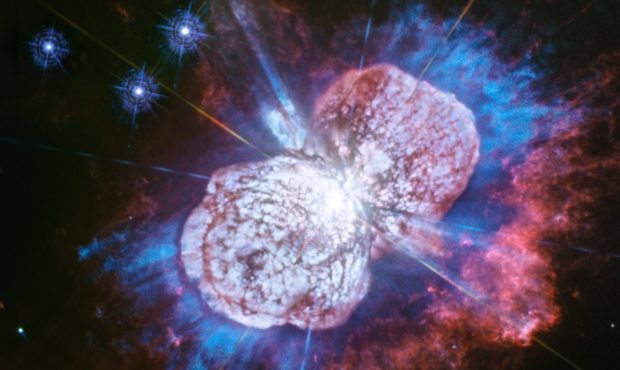
Although the timing of the latest image from the Hubble Space Telescope coincides with the upcoming July 4 holiday, the cosmic fireworks captured in it have been unfolding over two centuries. Image: NASA Full Credit: NASA/ESA/N. Smith/J. Morse
By Ashley Strickland, CNN
(CNN) — Although the timing of the latest image from the Hubble Space Telescope coincides with the upcoming July 4 holiday, the cosmic fireworks captured in it have been unfolding over two centuries.
The source of the show is 7,500 light-years from Earth in the double star system Eta Carinae, which is in the Carina or Ship’s Keel constellation. The Great Eruption, a gigantic explosion, happened in the system in 1838.
This caused it to be the second-brightest star in the sky during April 1844. Only Sirius, a star a thousand times closer to us, was brighter. At the time, Eta Carinae could even be used for ships navigating the southern seas.
Although the star faded, the display endures all these years later.
Eta Carinae is no stranger to chaotic outbursts and has sent pieces of itself out into space before. But the Great Eruption was different. Of the two stars in the system, the larger one is a gigantic unstable star approaching the end of its lifespan.
A new theory brings up the possibility that three stars once existed in the system and the Great Eruption happened when the main star cannibalized one of the other stars. That would have sent more than ten times the mass of our sun shooting out into space.
Explosions in space leave signatures behind. In this case, a giant shape formed by gas and dust reminiscent of fireworks remains around the stars. Together, the clouds that radiate heat and glow with magnesium gas are called the Homunculus Nebula.
The material ejected from the star’s outburst in 1838 collided with other material that had been thrown off of the star before and shock waves heated all of the ejected material.
Hubble has imaged the star in many ways over decades. The latest image captures the nebula in ultraviolet light which appears in blue. The red seen in the image is glowing nitrogen.
“We’ve discovered a large amount of warm gas that was ejected in the Great Eruption but hasn’t yet collided with the other material surrounding Eta Carinae,” Nathan Smith, lead investigator for Hubble at the University of Arizona’s Steward Observatory, said in a statement. “Most of the emission is located where we expected to find an empty cavity. This extra material is fast, and it ‘ups the ante’ in terms of the total energy of an already powerful stellar blast.”
The streaks of light in the image appear much like sunbeams filtering through clouds or dust on Earth. Here, the star’s light is going through dust and casting a shadow.
The ultraviolet image reveals a new look at the star system, revealing the magnesium gas in a way that could be used to study other stars or nebulae.
As for Eta Carinae, the final show will happen when the system explodes into a supernova that eclipses the Great Eruption. Astronomers don’t know if this has already happened because the brilliant burst of starlight produced by the event won’t reach us for 7,500 years.
The-CNN-Wire
™ & © 2019 Cable News Network, Inc., a Time Warner Company. All rights reserved.