Bionic hands aren’t just for Luke Skywalker
Aug 18, 2026, 9:50 AM | Updated: 10:14 am
SALT LAKE CITY — In a galaxy far, far away, Luke Skywalker, in a tiff with a close family member, lost a hand. So, he got an artificial replacement and moved on with his heroic life.
Simply science fiction? Not anymore.
Alexander “Avi” Davidson, a therapist from Tampa, Florida, has been visiting the Utah NeuroRobotics Lab at the University of Utah this year to try a bionic hand that, like Skywalker’s, is connected to his nervous system. He controls it with his thoughts and receives a sense of touch from his artificial fingers.
Davidson was 16 when he climbed a telephone pole to get a picture of a sunset, slipped and grabbed a live power line, and then fell 35 feet to the ground. Months later, he woke from a coma to find out he was paraplegic and was missing his left hand.
Related: Utah Bionic Leg named a 2023 ‘best invention’ by TIME magazine
Although he’d tried a number of myoelectric hands over the years, none proved as useful as an old-fashioned prosthetic with a hook.
“There are limitations to how much I can lift with it (the myoelectric hand he was wearing the day we interviewed him) or how much control I have or if it accidentally gets triggered when I don’t mean it to and it just starts spinning in circles when I don’t want it to,” he said.
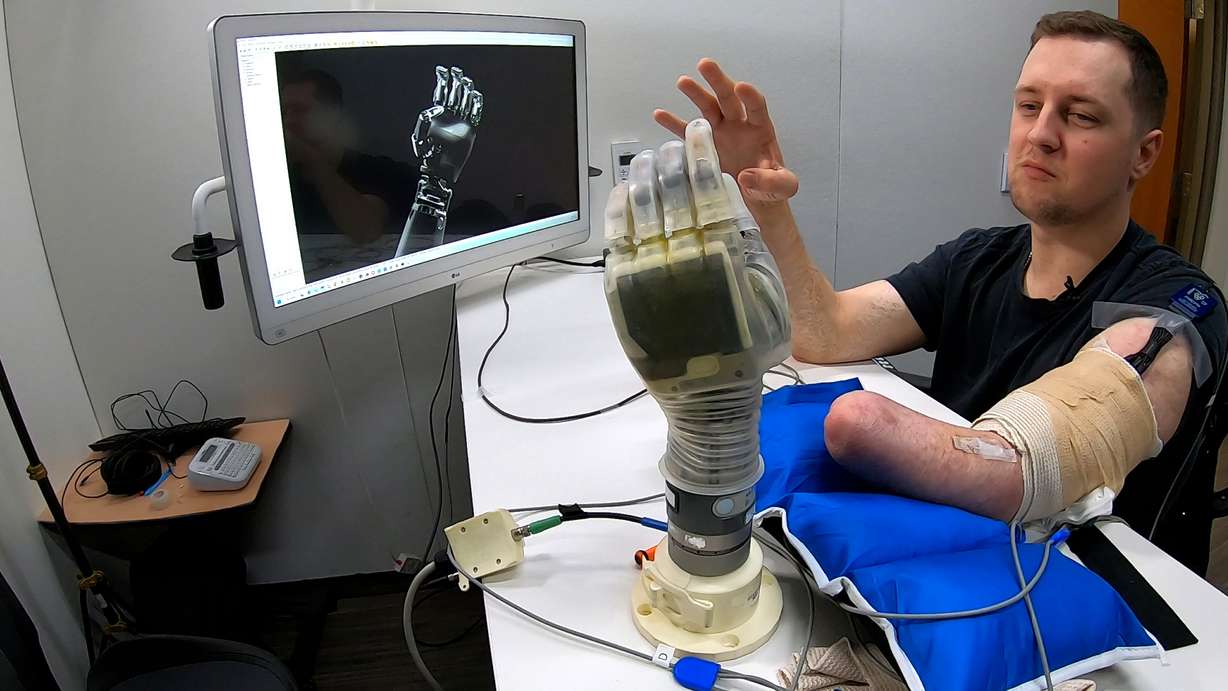
Alexander “Avi” Davidson, a therapist from Tampa, Florida, trains AI software to understand how his brain communicates with his hand on Feb. 3. (Photo: Peter Rosen, KSL)
Whereas people with hands don’t need to think much about how to use them, Davidson had to think a lot about how to use those high-tech hands.
“I tend to switch to that one (the hook) just out of the simplicity of it,” he said.
Inspired by science fiction
Last year an acquaintance, Stephen Saddow, a biomedical engineer at the University of South Florida, referred Davidson to the research project at the Utah NeuroRobotics Lab, a joint venture between the College of Engineering and the College of Medicine, in the Neilsen Rehabilitation Hospital at the University of Utah.
“A lot of my interest in this field of brain-computer interface started at an early age,” said Jacob George, who heads the lab. “I think a lot of us get inspired by science fiction. I grew up with Star Wars. I grew up with things like Terminator.”
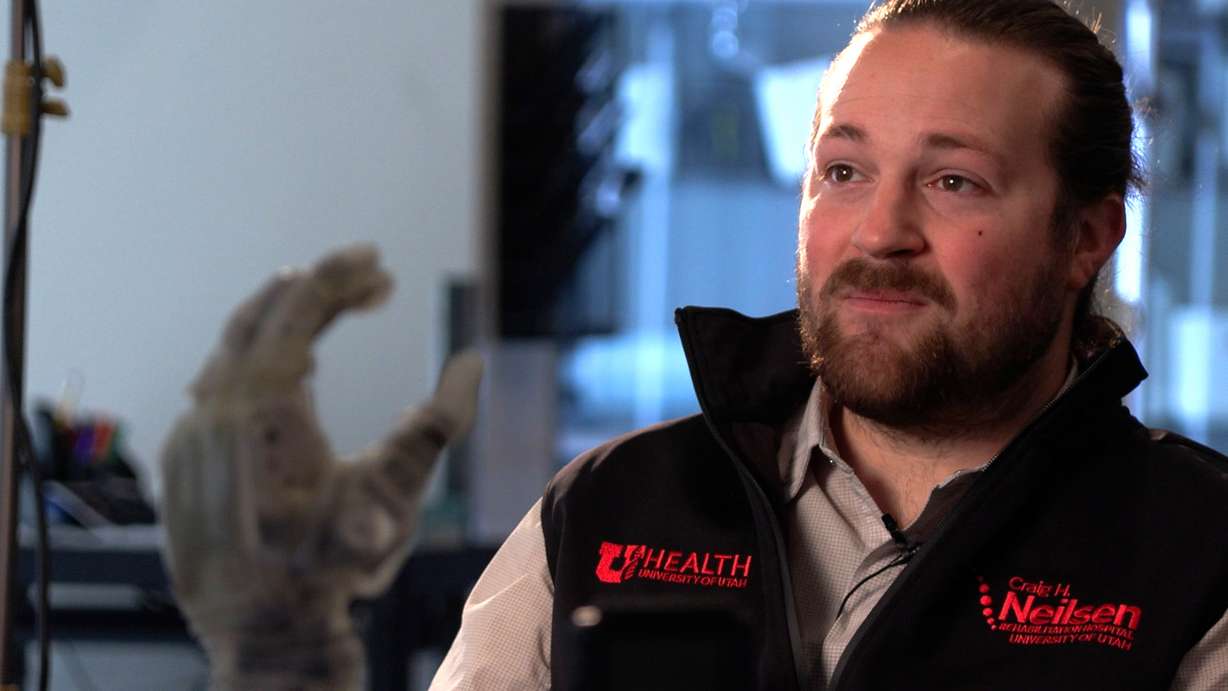
Jacob George runs the Utah NeuroRobotics Lab at the University of Utah’s Neilsen Rehabilitation Hospital on Feb. 11. (Photo: Peter Rosen, KSL)
He is the latest engineer to pick up the mantle of a research project that stretches back decades, as he, postdoctoral fellow Marshall Trout and other researchers are using a computer-nerve interface developed at the university to connect an off-the-shelf bionic prosthetic, a LUKE arm (Mr. Skywalker’s first name is an acronym for Life Under Kinetic Evolution), directly to an amputee’s nervous system.
University engineers also had a hand (no pun intended) in developing the prosthetic hardware.
Davidson is the first to field test the system for an extended period. He will use it at home for a year.
George says it’s a feedback loop, moving a finger with a thought and then getting the feedback of touch, “that gives rise to what we call a sense of embodiment, which is when a person now all of a sudden believes that the limb is a part of themselves and not just a tool that they’re using.”
Researchers at the neurorobotics lab are working on ways to get this technology into people’s hands without any surgery.
“I’m going to be able to actually feel with my hand. That’s an insane concept,” Davidson said.
Before he agreed to participate in the trial, Avi, who is an Orthodox Jew, consulted a rabbi about whether he’d be able to use the hand during the Sabbath. Orthodox Jews typically refrain from operating electrical switches during the Sabbath. The rabbi, who Davidson said specializes in these high-tech questions, said, “Yes,” he could use the hand, but only for truly necessary functions.
‘Like riding a bike’
So, earlier this year, surgeons attached tiny physical interfaces to the nerves and some muscles in Davidson’s left arm.
A few days later, Trout hooked Davidson up to a computer. Davidson thought about moving a hand that wasn’t there, and AI software learned how his brain talked to his hands.
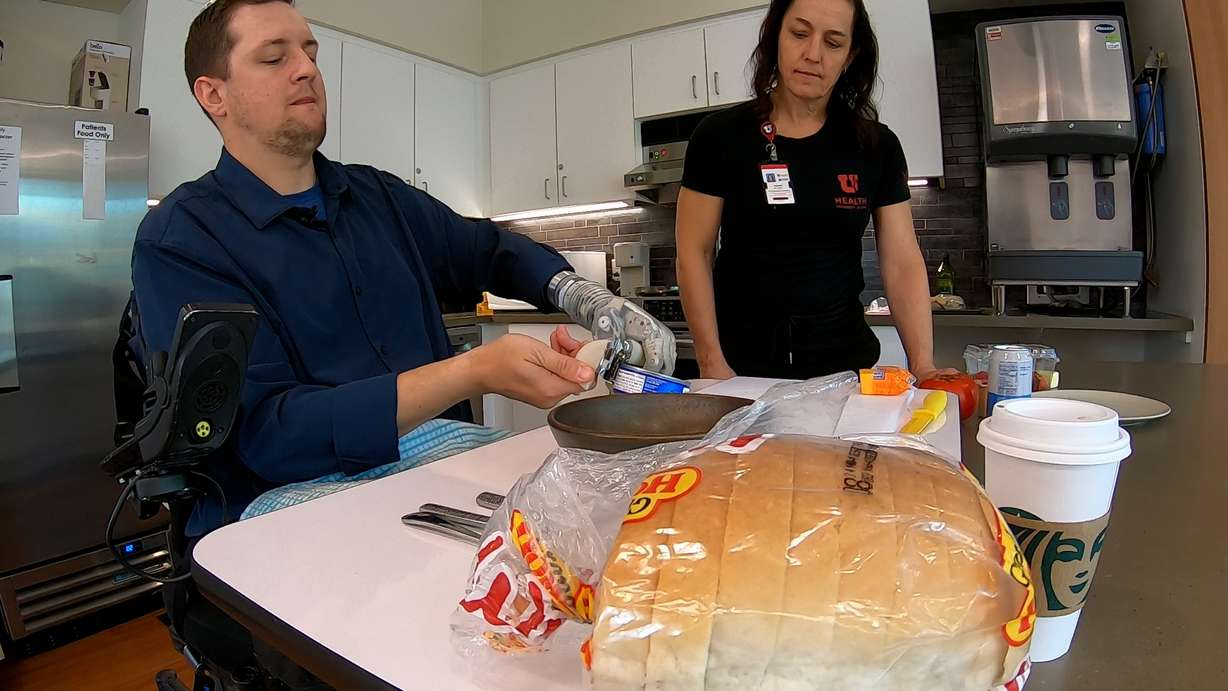
Alexander “Avi” Davidson, a therapist from Tampa, Florida, and occupational therapist Leanne Seckinger make a tuna melt sandwich on April 17. (Photo: Peter Rosen, KSL)
“In a lot of ways, it’s like riding a bike. Like you don’t forget. Your body doesn’t forget how to use your hand,” George said.
Davidson went home to let his arm heal from the surgery and returned to Utah in April to practice using his new hand, which, at first, wasn’t completely functional. Without a sense of touch and wrist rotation, making his own breakfast with guidance from occupational therapist Leanne Seckinger was a cumbersome affair — a pile of granola landed in his lap.
Lunchtime the next day, with wrist rotation and some sense of touch, he made a tuna melt. Making the sandwich still required a lot of patience and effort, in part because of the weight of the metal hand.
His wife texted him a congratulatory tuna-melt merit badge.
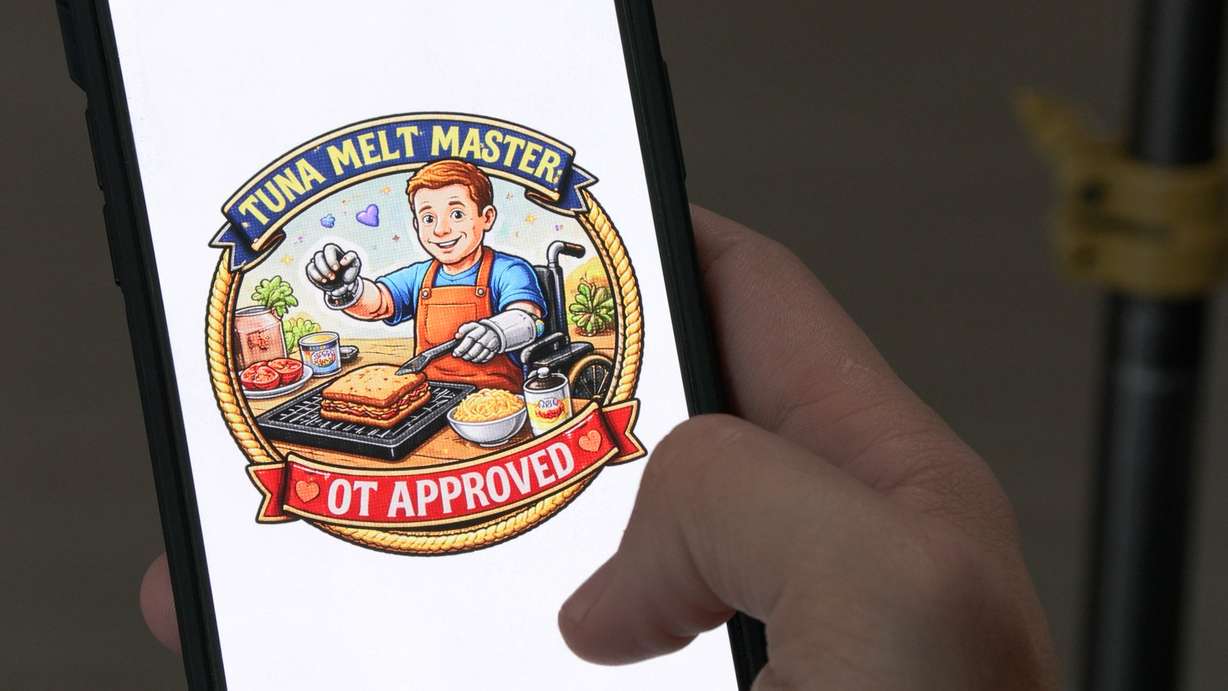
A tuna-melt merit badge sent by Alexander “Avi” Davidson’s wife on April 17. (Photo: Peter Rosen, KSL)
Davidson, who says his mother raised him on Broadway musicals and his father raised him on Star Wars, agrees the process seems like science fiction but says it addresses down-to-earth issues.
“Can I cut my own food? Can I have a cup of coffee? Can I play a game of chess? Can I read a book, and hold it with my hand and rely on it? Can I drive a car?” he said. “Being able to regain a sense of independence.”
Davidson made a list of all the things he wanted to do with his new hand — cooking, using chopsticks, playing cards.
At the top of his list: Davidson, who was left-handed before his accident, wanted to hold his wife’s hand with that hand.
“This will actually literally be a part of me that I will feel, and I can hold her hand, and I can beat her at thumb wrestling finally,” he said.
Cuts to the program
Because of the Trump administration’s cuts to the National Institutes of Health, Davidson, who was originally going to continue using the hand after the year-long trial, may need to give it back, according to George. Eight other amputees who were also going to participate in the trial now will not have the opportunity, he said.
Davidson began the home trial at the beginning of July and — just judging from Instagram videos of opening packs of Magic cards and holding individual cards, putting a key on a key ring and opening a can — has clearly improved his dexterity.
He wrote in an email that, thanks to weekly occupational therapy Zoom calls with Seckinger, he now has the dexterity to pick out individual pieces of Mike and Ike candies for his wife.
He writes that he is now struggling with using an added articulation of the thumb.
Davidson says he does have a sense that the LUKE hand is “his” hand. He recalled riding in the car, holding a cup of coffee in one hand and texting his wife, who was driving, with the other. His wife commented to him that she’d never seen him do two things at once.
He wrote, “The days that I don’t wear it, I notice it missing and that certain tasks become more complicated, and I have to rely on old styles of movement.”
He says the realism of his sense of touch varies by digit.
He says his thumb feels “spot on,” but his middle finger feels “zappy,” and feedback from that finger gives him a “pins and needles” feeling in his nerve.
And, yes, Davidson has held his wife’s hand with his new left hand.
“It brings tremendous joy to feel her hand in mine as something that I thought I would never experience,” he wrote. “She will occasionally touch one of my fingers and ask me which one she’s touching, and I normally get it right.”