UTAH

How did crocodiles and alligators survive extinction? New Utah research may have the answer

Apr 19, 2025, 1:00 PM

A crocodilian skull from the Eocene period at the Natural History Museum of Utah in Salt Lake City ...

A crocodilian skull from the Eocene period at the Natural History Museum of Utah in Salt Lake City on Jan. 28. A new study looks at how existing crocodile, alligator and gharial species survived mass extinction events. (Jack Rodgers, Natural History Museum of Utah)

(Jack Rodgers, Natural History Museum of Utah)

SALT LAKE CITY — Earth has experienced at least five “mass extinction” events throughout its existence, but some species have been able to survive these major shifts.

Utah researchers say they believe they now know how existing crocodile, alligator and gharial species were able to survive the last two extinctions — each tens of millions of years ago — which could help understand how certain species can survive future events. It all has to do with being able to adapt to sudden shifts in surroundings, says Randy Irmis, curator of paleontology at the Natural History Museum of Utah and a professor at the University of Utah’s Department of Geology and Geophysics.

“These animals that lived on land and were fairly generalist in what they ate — they mostly ate animal matter, but they might eat bugs and small crustaceans, as well as small lizard-sized animals as well — those sort of species that had flexible diets and lived on land tended to be the ones that survived these mass extinction events,” Irmis told KSL.com. “Whereas, things that were very specialized in what they ate or where they lived were more at risk (of) extinction.”

Irmis was part of a research team whose findings were published Wednesday in the journal Palaeontology. The study is the culmination of almost a decade of work.

Keegan Melstrom, an assistant professor at the University of Central Oklahoma, started working on the study when he was a doctoral student at the University of Utah under Irmis’s tutelage. Melstrom had previously researched the relationship between reptile diet and the complexity of their teeth, applying it to fossils millions of years old.

While previous studies have focused on how invertebrates have evolved, the team wrote that research is “not evenly distributed phylogenetically” when it comes to vertebrates and mass extinction events. The little research available indicated that dietary ecology played some type of role.

This time, the research focused on skull shape and diets.

The team examined the skulls of nearly 100 extinct crocodylomorphs and 20 more extinct crocodylians collected from six continents, all of which spanned more than the last 200 million years, according to the paper. This allowed time to review species that would have lived around the time of the end-Triassic extinction, about 201 million years ago, and the end-Cretaceous extinction, 66 million years ago.

They were compared with over 100 combined mammal and lepidosaur species, along with a few other species, including living alligators, crocodiles and gharials.

It wasn’t easy work, which is why the study took so long to compile. Melstrom traveled to museums across the world to review many of the fossils and compile all the data. However, the research yielded interesting results.

“Extinction and survivorship are two sides of the same coin,” he said in a statement. “Through all mass extinctions, some groups manage to persist and diversify. What can we learn by studying the deeper evolutionary patterns imparted by these events?”
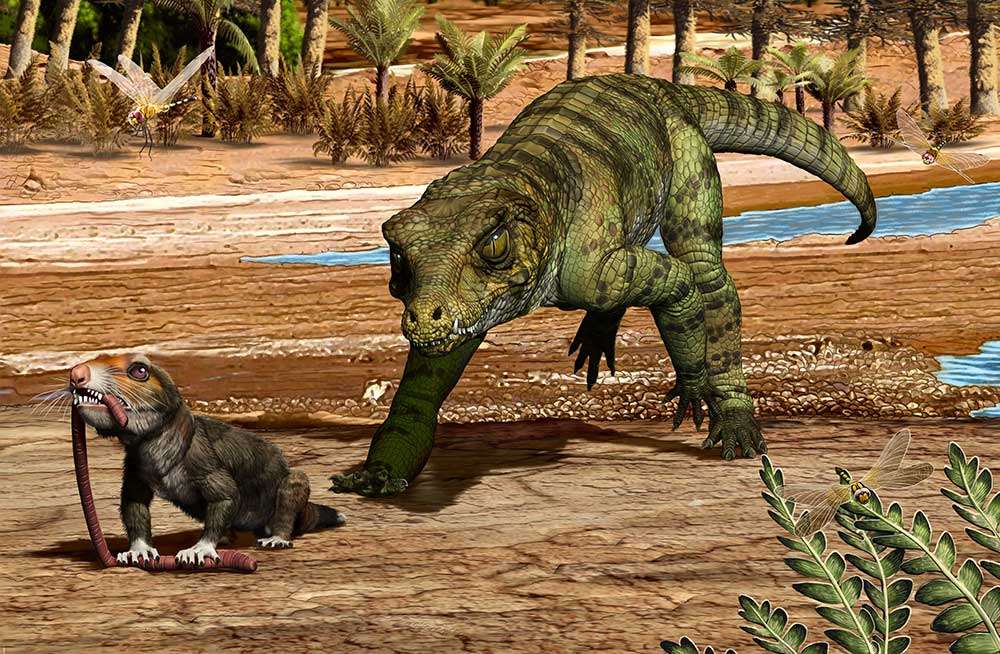
Some 215 million years ago. in what is now northwestern Argentina, the terrestrial crocodylomorph Hemiprotosuchus leali prepares to devour the early mammal relative Chaliminia musteloides.
Some 215 million years ago. in what is now northwestern Argentina, the terrestrial crocodylomorph Hemiprotosuchus leali prepares to devour the early mammal relative Chaliminia musteloides. (Photo: Jorge Gonzalez via University of Utah)

The finding that flexibility seemed to matter when it came to crocodile, alligator and gharial species was somewhat surprising. Previous research leaned toward that being a factor for mammals that also survived catastrophic events, but the new study found more similarities in the species that survived, despite different responses over the last two major extinction events, Irmis adds.

Future studies may focus on other fossil parts or even other reptile species during this time.

In the meantime, this study might offer a window into the future of crocodile-like species, especially how they handle current or future threats like habitat loss. Irmis points out that many of the current species are still fairly flexible in their diet, but that might not be enough if they now deal with new challenges, including certain human pressures.

“Crocodiles are really flexible and adaptable if we give them a chance,” he said. “In terms of making sure they persist for a long time, it’s really a matter of preserving their habitat and not hunting them to extinction.”

Read the full story at ksl.com

Related:

Crocodiles and alligators were once vegetarians, Utah researchers say

Authorities seize 750-pound alligator named Albert from New York home

We want to hear from you.

Have a story idea or tip? Send it to the KSL NewsRadio team here.

Utah

A "no fireworks" sign is pictured near Popperton Park in Salt Lake city on June 25. Cities througho...

Kennedy Camarena, KSL

Where you can and can’t light personal fireworks this Pioneer Day

Utah Governor Spencer Cox has issued a "hybrid fireworks policy" for the Fourth of July. Here's what that means for your city.

8 hours ago

Utah Deaf mentor and performer Jojo Savea is one of the American Sign Language performers bringing ...

Eric Cabrera

Deaf Utah performer, interpreter, helps kids experience favorite shows in a new way through ASL

Utah mentor and performer Jojo Savea is one of the American Sign Language performers bringing popular children's programming, including "CoComelon," to deaf audiences.

9 hours ago

The Davis County SAR team prepares to hike up the Fernwood Trail in Layton on Sunday, April 21, 202...

Don Brinkerhoff

Utah search and rescue teams urge preparation as heat, storms prompt rescues

Search and rescue teams across Utah are busy this year. Here's what you can do to lighten the physical and financial load.

11 hours ago

Hannah Freeze speaks during a press conference about new water shares for Great Salt Lake at Memory...

Carter Williams, KSL

Cox appoints new Great Salt Lake commissioner as lake continues to slide

Gov. Spencer Cox has named Hannah Freeze as the state's new Great Salt Lake commissioner, replacing Brian Steed, who stepped down earlier this year. Freeze was named deputy commissioner of the state office last year.

13 hours ago

A woman in Nephi was arrested after police said she made threatening calls to city workers while im...

Bryanna Willis

Nephi woman arrested after posing as a federal official and threatening city workers, police say

A woman in Nephi was arrested after police said she made threatening calls to city workers while impersonating a federal officer.

13 hours ago

A section of state Route 153 in Beaver Canyon is washed out. Utah Department of Transportation offi...

Becky Bruce

Emergency declared in portions of Utah after wildfires, flooding in three counties

Declaring an emergency after the flooding and wildfires that struck Beaver, Piute and Sevier counties allows the state to devote more resources to recovery.

14 hours ago

Sponsored Articles

...

Bear Lake

Road trip ready: How Bear Lake became the go-to destination for Western U.S. travelers

Whether you are chasing pristine beaches, fresh raspberry shakes, or endless water sports, this sponsored guide—brought to you in partnership with Bear Lake —uncovers everything you need to plan the ultimate getaway.   There’s nothing quite like the thrill of hopping in the car with your favorite snacks in tow and heading out for a […]

...

Harper Clinic

A new standard of care: How Harper Clinic’s IOP is changing the face of mental health treatment in Utah

This article is sponsored by Harper Clinic, a Utah-based clinic offering FDA-approved TMS therapy for treatment-resistant depression.    Utah’s mental health crisis is leaving many residents caught in an uncomfortable middle ground: struggling too much for weekly therapy alone, but unable to step away from work, parenting or daily life for inpatient treatment. As demand […]

...

Harper Clinic

Breaking free from depression: How Harper Clinic’s TMS Therapy can help

This article is sponsored by Harper Clinic, a Utah-based clinic offering FDA-approved TMS therapy for treatment-resistant depression.    The weight of depression is real. Many people spend years fighting it, adjusting medications, managing side effects and wondering if this is simply how life is going to feel.   According to the World Health Organization, depression affects […]

mental health...

Andrew Adams, KSL

Library discussions bring men’s mental health to the surface

Therapists say it’s common for men to repress things like trauma, grief, stress and anxiety. Now, a new weekly series of discussions aims to help men bring it all to the surface.

...

Bear Lake Convention & Visitors Bureau

Cozy up in Bear Lake: Discover the magic of a winter getaway

SALT LAKE CITY – The holiday season shines brightest when time slows down and loved ones gather. Gifts, decorations and festive music come and go, but shared experiences tend to last much longer. Research supports that idea. Dr. Theresa E. DiDonato told Psychology Today that vacations can strengthen relationships by creating meaningful time away from daily […]

...

Harper Clinic

Rewriting the path to healing: Inside Harper Clinic’s whole-person mental health model

OREM — A few decades ago, you’d have had a hard time finding a doctor to treat both your mind and body; And a century ago, you’d have been hard-pressed to find a doctor to treat your mind at all. Today, medical professionals are understanding more and more the undeniable connection between the body and […]

How did crocodiles and alligators survive extinction? New Utah research may have the answer