Thick ground sediment could mean more shaking during a Wasatch Front earthquake
Jun 4, 2025, 7:00 PM | Updated: Jun 5, 2025, 11:13 am

A crack in the wall in the gym at Cyprus High School in Magna is pictured on Monday, April 6, 2020. (Kristin Murphy/Deseret News)
(Kristin Murphy/Deseret News)

SALT LAKE CITY — Shaking from a future Utah earthquake could be amplified by sediment thickness, according to a new University of Utah study.
Researchers installed an “extensive network” of seismic probes across the valley. Many were put in place in the month following the 2020 Magna earthquake, when there were plenty of aftershocks to be monitored.
According to Fan-Chi Lin, an associate professor of geology and geophysics and the study’s leader, researchers set out to understand the area’s sedimentary structure.
“One of the biggest questions we had was why our observations didn’t agree with previous studies,” Lin said.
Currently, scientists rely heavily on the Wasatch Front community velocity model to predict future seismic behavior. Although it’s a useful tool, limited sampling and inconsistent documentation pose limitations.
According to the U of U, analyzing the data collected after probes were installed gave researchers a look into the composition of the sediments beneath the valley floor. The basin was once the bottom of ancient Lake Bonneville.
“In a basin, seismic shaking is amplified,” Lin said. “It’s very important to understand the thickness and rigidity of sediment to better assess potential shaking.”
Per Lin, the study’s findings reinforced what geologists already knew—thicker sediments can increase the hazards presented during earthquakes through amplified shaking.
The team has since proposed a revision of the Wasatch Front velocity model. Although it’s largely consistent with its predecessor, the U said it indicates thicker sediment.
How does sediment impact Utah earthquake shaking?
According to the Washington Surveying and Rating Bureau, seismic waves travel through the ground during an earthquake. When they move through bedrock and into sediment, their vibrations grow larger, resulting in stronger shaking.
Although a number of factors determine an earthquake’s strength and impact, the U of U said sediment thickness can “dramatically elevate hazard levels.”
A better understanding of the structures beneath the Earth’s surface can help researchers form better predictions of future seismic events, according to Lin.
“That will allow us to collaborate with engineers to determine which buildings are potentially hazardous when the big earthquake hits,” Lin said.
‘Many houses are vulnerable’
“Many houses in Salt Lake are unreinforced masonry and could be vulnerable in a big quake,” Lin said. “Buildings should be reinforced and people should be prepared.”
The 2020 Utah earthquake, which shook at a magnitude of 5.7, caused millions of dollars in damage to structures throughout the valley, particularly in Magna, the city nearest the epicenter.
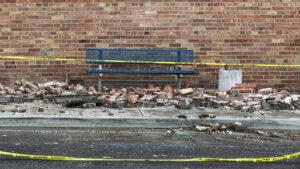
FILE: Caution tape surrounds the VFW building on Magna’s Main Street on Tuesday, March 24, 2020, following a 5.7 magnitude earthquake that was centered near the city on March 18. (Steve Griffin/Deseret News)
Although many buildings in the Salt Lake, Ogden, and Provo areas are vulnerable to earthquake damage, the study said hope is not lost for them. Some structures can be retrofitted to increase their strength in the event of a large quake.
The full study was published by the American Geophysical Union.
More research news: Data collected in Alta area helps scientists better understand elusive bird species