Truth and Trust part 2: spotting fake news
Oct 29, 2018, 1:55 PM
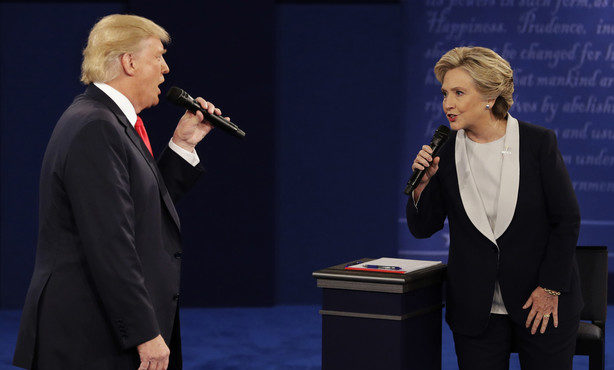
File photo of Hilary and Donald Clinton, taken during the second presidential debate on Oct. 9, 2016. (AP Photo/John Locher, File)
(AP Photo/John Locher, File)
SALT LAKE CITY — Last week, we told you about the rise of false information spread via social media. This week, we go to the experts to learn how to fact-check and verify what you see online – so you can tell what’s fake news and what’s real.
In part one of our series, “Truth and Trust,” University of Utah Professor Shannon McGregor explained that bots – automated advertising generators – and sometimes, real people are both generating all sorts of messages on all sides of the political issues. The FBI said the same bots produce messages for audiences on the right and the left, politically.
In part, McGregor says a lack of digital regulation makes it easier for fake news to spread. But there are ways to fact-check and verify.
“If it looks sort of ‘too good to be true’ in terms of, it matches up too well with what you would like to believe, do a double check on that,” she advises.
They work, she says, with volume.
“Tweeting local things that seem like local news, building up followers, building up trust, and then being able to be activated at any moment to sow misinformation,” she says.
She says sometimes the name of a publication will tell you that you’re getting spin – such as Conservative Tribune or Progressive Tribune. But other times, social media pages, posts, websites and advertisements are much more subtle. So, she says, start your research with a simple click.
“You can see it at the very bottom usually,” McGregor says. “It’s in grey, it’s little, but the actual URL of where a post is coming from,”
Fact-checking websites staffed by journalists and researchers are also helpful, even on local issues, to find out what’s trustworthy and truthful about issues, candidates or even advertisements. She recommends factcheck.org and politifact.org as two good resources that are also transparent about how they work.
“There’s an entire page on their website that delves into what they do to gauge all of this,” McGregor says.
KSL Digital Producer Matthew Jacobson has ways to tell if people Tweeting at him are actually bots, rather than people.
“[Things like] Posting from the same website over and over again, or retweeting the same website over again,” Jacobson says.
He recommends typing Twitter handles into Indiana University’s Botometer. We tried @realDonaldTrump, President Donald Trump’s Twitter handle. On the Botometer scale, the president was verified at 0.1 out of 5, meaning he checks out as a real person behind a real account, and not a bot.
Jacobson also trusts adfontesmedia.com, which charts media organizations and commentators, along with their newsgathering techniques, any regurgitation, and potential biases.
“NBC News is just barely to the left of the neutral line” on that site, Jacobson says. “The Wall Street Journal, which you’ll hear is this huge conservative newspaper, is actually just barely to the right.”
Jacobson is glad social media sites are deleting fake accounts, but he calls it only half the battle when it comes to fake news.
“The other half has to be waged by those of us who are not bots,” he says.
Facebook is continuing to combat misinformation online. The social media giant says it has removed 810 accounts and pages from its platform.
In a blog post, it says the deleted accounts have consistently broken their rules against spam and coordinated inauthentic behavior. It previously announced the removal of similar accounts in July and August. Facebook has now removed a total of 559 pages and 251 accounts.