Gerrymandering reforms already taking root in many states
Jun 27, 2019, 2:54 PM
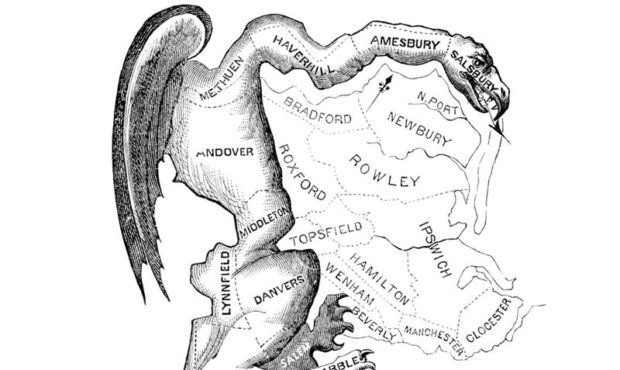
This political cartoon drawn by Elkanah Tisdale in 1812 lampooned then-Massachusetts Gov. Elbridge Gerry, who signed the bill that created the oddly-shaped district in his state. (Boston Gazette, March 1812).
(Boston Gazette, March 1812)
While ruling that it had no authority to resolve partisan gerrymandering claims, the U.S. Supreme Court noted Thursday that states could act on their own to try to limit the role of politics in drawing congressional and state legislative districts.
Several states already have done so, including some where voters adopted constitutional amendments last year.
In most places, state lawmakers and governors are responsible for drawing and approving political district maps following each U.S. Census. But a growing number of states have shifted the task to independent or bipartisan commissions or have changed their redistricting criteria to reduce the likelihood of partisan gerrymandering.
Here are some of the states using commissions or other nontraditional methods for the next round of redistricting, which will take place after the 2020 Census.
ALASKA: A five-member commission draws districts for the state House and Senate under a 1998 amendment to the state constitution. Two members are appointed by the governor and one each by the presiding officers of the House and Senate and the chief justice of the Supreme Court. Districts must be compact, contiguous and contain “a relatively integrated socio-economic area.” Alaska has only one congressional district.
ARIZONA: Congressional and state legislative districts are drawn by a five-member commission established under a ballot measure approved by voters in 2000. Twenty-five potential redistricting commissioners are nominated by the same state panel that handles appeals court nominees. The Legislature’s two Republican leaders choose two commissioners from 10 Republican candidates, and the two Democratic leaders chose two from their party’s 10 nominees. Those four commissioners then select the fifth member, who must be an independent and serves as panel chairman. The constitution says “competitive districts” should be drawn as long as that doesn’t detract from the goals of having compact, contiguous districts that respect communities of interest.
Democrats have accused Gov. Doug Ducey, a Republican, of influencing the commission’s composition by stacking the appellate court panel that narrows the field of potential candidates. The panel has eight Republicans and five independents, but no Democrats.
CALIFORNIA: Voters approved a pair of ballot measures, in 2008 and 2010, creating a 14-member commission to draw congressional and state legislative districts. A state auditor’s panel takes applications and selects 60 potential redistricting commissioners — 20 Democrats, 20 Republicans and 20 others. The state Assembly and Senate majority and minority leaders each can eliminate two nominees from each political category. Eight redistricting commissioners — three Democrats, three Republicans and two unaffiliated members — are randomly selected from the remaining pool of candidates. Those commissioners then select an additional two Democrats, two Republicans and two unaffiliated members. Approving a map requires nine votes, including three from each political category of members. The constitution says the districts should be compact and keep cities, counties and communities of interest together to the extent possible.
COLORADO: Congressional and state legislative districts will be drawn by a 12-member commission, under a pair of constitutional amendments approved by voters last November. The commission will consist of four Republicans, four Democrats and four independents selected from a pool of applicants. Half will be chosen randomly and the rest by a judicial panel. Nonpartisan legislative staff will draft proposed maps for the commission’s approval; maps will require at least eight votes, including two from independents. The state Supreme Court will then review the maps to determine whether legal criteria were followed. The districts must be compact, preserve communities of interest and “maximize the number of politically competitive districts.”
HAWAII: Congressional and state legislative districts are drawn by a nine-member commission. The majority and minority party leaders in the House and Senate each appoint two commissioners. Those eight then pick a ninth commissioner. If they can’t agree, the ninth member is appointed by the state Supreme Court. Districts cannot be drawn to “unduly favor a person or political faction.”
IDAHO: A six-member commission is responsible for drawing both congressional and state legislative districts. Two-thirds of the commissioners must vote to approve a map. The majority and minority party leaders in each legislative chamber each select one person to serve on the commission; the state chairmen of the Republican and Democratic parties also each select a commissioner. Mapmakers should avoid “oddly shaped” districts and preserve “traditional neighborhoods and local communities of interest.”
IOWA: The nonpartisan Legislative Services Agency draws maps for congressional and state legislative districts, which are submitted to the Legislature for approval. Districts must consist of “convenient contiguous territory” and be reasonably compact. Districts cannot be drawn to favor a political party, incumbent or other person or group.
MICHIGAN: Under a constitutional amendment approved by voters last November, congressional and state legislative districts will be drawn by a 13-member citizens’ commission. It will consist of four Democrats, four Republicans and five independents randomly selected by the secretary of state from among applicants. Approval of districts will require a majority vote with support of at least two Democrats, two Republicans and two independents. If that fails, each commissioner would submit a plan and rank their options by preference, with the highest-ranked plan prevailing. In case of a tie, the secretary of state would randomly select the final plan. Districts must be compact, contiguous, limit splitting of counties and cities, “reflect the state’s diverse population and communities of interest,” not favor or disfavor incumbents, and not provide a disproportionate advantage to any political party.
MISSOURI: A constitutional amendment approved by voters last November will require a new nonpartisan state demographer to draft maps for state House and Senate districts. The demographer is to design districts to achieve “partisan fairness” and “competitiveness” as determined by statistical measurements using the results of previous elections. Districts also shall be contiguous and limit splits among counties and cities. Compact districts are preferred but rank last among the criteria. The maps will be submitted to a pair of existing bipartisan commissions for approval. The governor will appoint a 10-member commission for the Senate districts, choosing five Republicans and five Democrats from among nominees submitted by the state parties. For the House, the governor will appoint an equal bipartisan commission of 16 members from nominees submitted by Republican and Democratic congressional district committees. Congressional districts still will be drawn by the state Legislature.
MONTANA: A five-member commission draws state legislative districts and would also draw congressional districts if Montana’s population grows enough to have more than one. The majority and minority leaders of each legislative chamber appoint one member each. Those four then select a fifth member, who serves as chairman. If they can’t agree on the final member, the state Supreme Court makes the appointment. Districts must be compact and contiguous.
NEW HAMPSHIRE:- Lawmakers in June passed a bill to create a 15-member independent redistricting commission. Republican Gov. Chris Sununu has not taken a public position on the bill yet. The bill calls for House and Senate leaders of both parties to nominate 10 people each from the applicant pool, and then pick five from the other party’s list. Those 10 would then together select the remaining five members. The commission would be required to hold public meetings in each of the state’s counties, and the maps it develops would be approved by the Legislature.
NEW JERSEY: Congressional districts are drawn by a 13-member commission, which requires a majority vote to approve a map. The majority and minority leaders of each legislative chamber and the chairmen of the state’s two major parties each appoint two members. Those 12 select one more member. A separate 10-member commission draws state legislative districts, with the chairmen of the two major political parties each appointing five members. If they can’t agree on a plan, the Supreme Court appoints an 11th member. State legislative districts must be contiguous and as compact as possible.
NEW YORK: Under a constitutional amendment approved by voters in 2014, a 10-member commission will draft districts for both Congress and the state Legislature. The majority and minority leaders of each chamber each appoint two members to the commission. Those eight members then select the other two commissioners. Their maps are submitted to the Legislature for approval. Districts shall be compact and contiguous and shall not be drawn to discourage competition or to favor incumbents, particular candidates or political parties.
OHIO: A pair of voter-approved amendments will require minority-party support to enact new congressional and state legislative districts that last a full decade. Under a plan approved in 2015, state legislative districts will be drawn by a seven-member commission consisting of the governor, auditor, secretary of state and one person appointed by each of the majority and minority party leaders in the House and Senate. To last 10 years, the maps need support from at least two members of each party; otherwise, they are valid for just four years. For congressional districts, voters approved a measure last May that requires the Legislature to pass a redistricting plan by a three-fifths majority with the support of at least half the members of the majority and minority parties. If that fails, districts are to be drawn by the seven-member commission and approval requires support from at least two members of each party. If that fails, the Legislature may pass a plan by a three-fifths vote with the support of at least one-third of the majority and minority party members. If that fails, the Legislature may pass a plan by a majority, but it would remain in effect for only four years.
PENNSYLVANIA: State legislative districts are drawn by a five-member commission under a procedure dating back several decades. The majority and minority leaders of the House and Senate each appoint one member, and those four then select a fifth person to serve as chairman. If they cannot agree on a chairman, the Supreme Court appoints one. Districts must be compact and contiguous and respect municipal boundaries. Congressional districts are drawn by the Legislature and sent to the governor for approval.
UTAH: Congressional and state legislative districts will be drawn by a seven-member commission, under a constitutional amendment approved by voters last November. The commission will be composed of one gubernatorial appointee, two appointees by Republican legislative leaders, two appointees by Democratic legislative leaders and two political independents appointed by majority and minority party legislative leaders. The commission’s recommended maps will be submitted to the Legislature for final approval. Districts shall be compact and contiguous, preserve communities of interest and not favor or disfavor incumbents. Partisan voting records may not be considered.
VERMONT: A commission submits plans for state House and Senate districts to the state Legislature, which can approve or change them. The governor appoints one commissioner from each of the state’s political parties that have had at least three state lawmakers for six of the past 10 years. The chairs of those parties appoint one member each. The chief justice appoints the committee chair. Districts should be compact and contiguous and recognize “patterns of geography, social interaction, trade, political ties and common interests.”
WASHINGTON: Congressional and state legislative districts are drawn by a five-member commission under a constitutional amendment approved by voters in 1983. The majority and minority party leaders in both legislative chambers each appoint one commissioner, who cannot be an officeholder or lobbyist. Those four members then select a fifth, non-voting member who serves as chairman. Lawmakers can amend the commission’s maps with a two-thirds vote of each chamber, but their changes can shift no more than 2 percent of the population among districts. Districts should be comprised of “convenient, contiguous and compact territory” and not drawn to purposely “favor or discriminate against any political party or group.”