How new Colorado River cuts will impact states, residents
Aug 18, 2022, 11:45 AM
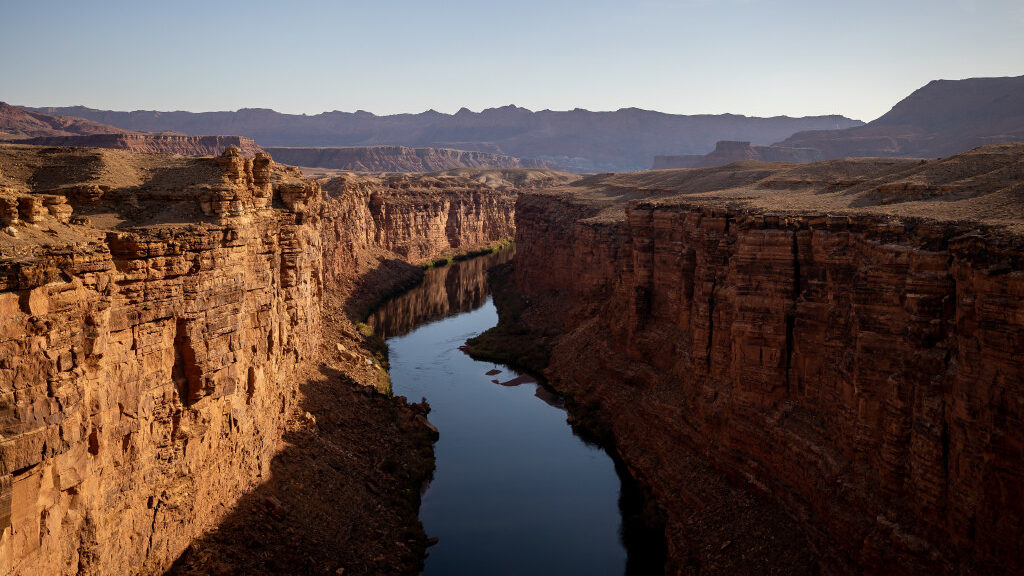
The Colorado River flows through Marble Canyon as seen from the Historic Navajo Bridge in Coconino County, Ariz., on Wednesday, July 20, 2022. (Spenser Heaps, Deseret News)
(Spenser Heaps, Deseret News)

WASHINGTON (AP) — Arizona and Nevada residents won’t face bans on watering their lawns or washing their cars despite more Colorado River water shortages.
But U.S. officials announced Tuesday there will be less water available next year for them from the river that serves 40 million people in the West and Mexico and a farm industry worth billions of dollars. Observers warn that a reckoning is still coming for the growing region because the water crisis is expected to generate future cuts.
A look at the crucial source of water for the Western U.S. and the water cuts.
WHY IS THE COLORADO RIVER THREATENED?
There are two Colorado Rivers in the U.S. — the 1,450-mile (2,334 kilometer) powerhouse of the West and the over 800-mile (1,287-kilometer) river that starts and ends in Texas.
The river that faces cuts is the longer one. It supplies seven states plus Mexico but its flow has dropped drastically over time because of water overuse by farming and growing populations, hotter temperatures, evaporation and less melting snow in the spring to replenish the river.
And for years, the seven states that receive the river’s water have diverted more water from it than what was replenished by nature.
WHO DO LAKE MEAD AND LAKE POWELL SERVE?
Lake Mead supplies water to millions of people in Arizona, California, Nevada and Mexico.
Cuts for 2023 are triggered when predicted water levels fall below a certain threshold — 1,050 feet (320 meters) above sea level.
Additional cuts will be triggered when projected levels sink to 1,045 and 1,025 feet (319 and 312 meters). At a certain point, levels could drop so low that water can no longer be pumped from the reservoir.
Eventually, some city and industrial water users will be affected.
Lake Powell’s levels are also falling and extraordinary steps have been taken to keep water in the reservoir on the Arizona-Utah border.
Colorado, New Mexico, Utah and Wyoming get water from tributaries and other reservoirs that feed into Lake Powell. Water from three reservoirs in those states has been drained in recent years to maintain water levels at Lake Powell and protect the electric grid powered by the Glen Canyon Dam.
WHAT IS BEING CUT AND WHY?
The federal government started cutting some states’ supplies this year to maintain water levels in the river and its key reservoirs. New water cuts will build on those reductions — which all but eliminated some central Arizona farmers’ supply of Colorado River water and to a much lesser extent, reduced Nevada and Mexico’s share.
Lake Mead and Lake Powell — the two largest Colorado River reservoirs — are about a quarter full, threatening water supplies and the generation of hydroelectric power that provides electricity to millions of people.
Along the reservoirs’ edges, “bathtub rings” of minerals outline where the high water line once stood, highlighting the challenges the West faces as a ‘megadrought’ tightens it grip on the region.
HOW IS THE RIVER SHARED?
Colorado, Wyoming, Utah and New Mexico share the Colorado River in what’s called the river’s upper basin. Arizona, Nevada and California form the lower basin.
From its headwaters in Colorado, the river and its tributaries eventually flow south of the border into Mexico, which also uses its water. The river’s water traditionally flowed through Mexico and reached the Gulf of Calfornia, but rarely does so anymore because so much is used by farms and cities. Among those who depend on the water are nearly 30 federally recognized Native American tribes .
In the Southwest, water stored in Lake Mead and Lake Powell — the two largest manmade reservoirs in the U.S. — is divvied up through legal agreements among the seven Colorado River basin states, the federal government, Mexico and tribes. The agreements determine how much water each entity gets, when cuts are triggered and the order in which the parties must sacrifice some of their supply.
Under a 2019 drought contingency plan, Arizona, Nevada, California and Mexico agreed to give up shares of their water to maintain water levels at Lake Mead. This year’s cuts are part of that plan — and as a result, state officials knew they were coming.
WHICH PARTIES WILL BE AFFECTED BY THE CUTS?
Arizona, Nevada and Mexico.
Arizona was hardest hit, again, and will receive 79% of its total share next year. But that’s only 3% less than what it got this year, after federal officials slashed its supply.
Nevada will receive about 92% of its total supply next year. Most residents will not feel the cuts thanks to water conservation, reuse and the state not using its full allocation.
California has been spared because it has more senior water rights than Arizona and Nevada. That means it doesn’t have to give up its water first, according to the hierarchy that guides water law in the American West.
Mexico will get about 93% of its total supply. The water is used in cities and farming communities in northwestern Mexico, which is also enduring a severe drought.
WHO WILL LOSE WATER?
Farmers in central Arizona, among the state’s largest producers of livestock, dairy, alfalfa, wheat and barley, lost most of their Colorado River allocation this year when the government implemented its first shortage. Some farmers were compensated with water through deals with cities like Phoenix and Tucson.
More farmers will likely need to leave their land fallow — which some farmers in the region have been paid to do by state agencies and others — and rely even more on groundwater. Others will be forced to grow more water-efficient crops such as durum wheat and guayule and find other ways to use less water.
Western water suppliers have planned for such shortages by diversifying and conserving their water sources. But intensifying drought depleting reservoirs faster than scientists predicted — and the resulting cuts — will make it harder for farms and cities to plan for the future.
“Most people are also not prepared for the kind of difficult choices that we need to make,” said Mark Squillace, a professor of environmental law at the University of Colorado. “And that’s sort of the situation we’re facing in the Colorado River.”
Phoenix will lose some water it would otherwise store in underground basins as a water reserve, said Cynthia Campbell, the city’s water resource management advisor. That happened this year, too. The city will rely more water from Arizona’s Salt and Verde rivers.
Campbell said Phoenix residents and businesses won’t be affected. The city that was a sleepy desert community in the 1950s is now the nation’s 5th largest.
Nevada will also face cuts, but residents won’t face big impacts. The state does not use its full supply of Colorado River water and most water used indoors by businesses and homes in the populous southern part of the state is recovered, treated and delivered recycled back to Lake Mead.