
Sharks use Earth’s magnetic field as a GPS, scientists say
May 16, 2021, 5:40 PM
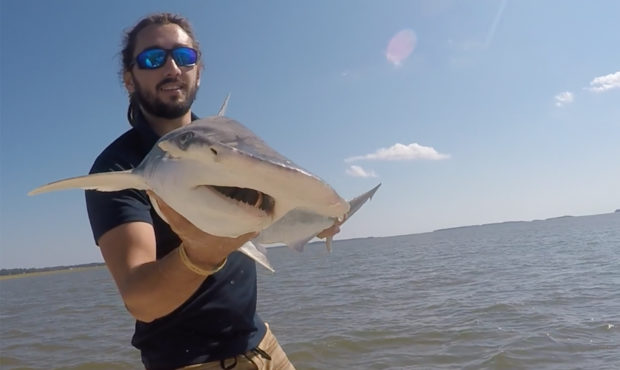
In this Sept. 2015 photo taken by Colby Griffiths on the North Edisto River in South Carolina, scientist Bryan Keller holds a bonnethead shark. Keller is among a group of scientists that found sharks use the Earth’s magnetic field as a sort of natural GPS when they navigate journeys that take them thousands of miles across the world’s oceans. (Photo courtesy Bryan Keller via AP)
(Photo courtesy Bryan Keller via AP)
PORTLAND, Maine (AP) — Sharks use the Earth’s magnetic field as a sort of natural GPS to navigate journeys that take them great distances across the world’s oceans, scientists have found.
Researchers said their marine laboratory experiments with a small species of shark confirm long-held speculation that sharks use magnetic fields as aids to navigation — behavior observed in other marine animals such as sea turtles.
Their study, published this month in the journal Current Biology, also sheds light on why sharks are able to traverse seas and find their way back to feed, breed and give birth, said marine policy specialist Bryan Keller, one of the study authors.
“We know that sharks can respond to magnetic fields,” Keller said. “We didn’t know that they detected it to use as an aid in navigation … You have sharks that can travel 20,000 kilometers (12,427 miles) and end up in the same spot.”
The question of how sharks perform long-distance migrations has intrigued researchers for years. The sharks undertake their journeys in the open ocean where they encounter few physical features such as corals that could serve as landmarks.
Looking for answers, scientists based at Florida State University decided to study bonnethead sharks — a kind of hammerhead that lives on both American coasts and returns to the same estuaries every year.
Researchers exposed 20 bonnetheads to magnetic conditions that simulated locations hundreds of kilometers (miles) away from where they were caught off Florida. The scientists found that the sharks began to swim north when the magnetic cues made them think they were south of where they should be.
That finding is compelling, said Robert Hueter, senior scientist emeritus at Mote Marine Laboratory & Aquarium, who was not involved in the study.
Hueter said further study is needed to find how the sharks use the magnetic fields to determine their location and whether larger, long-distance migrating sharks use a similar system to find their way.
“The question has always been: Even if sharks are sensitive to magnetic orientation, do they use this sense to navigate in the oceans, and how? These authors have made some progress at chipping away at this question,” he said.
Keller said the study could help inform management of shark species, which are in decline. A study this year found that worldwide abundance of oceanic sharks and rays dropped more than 70% between 1970 and 2018.
Researchers say the bonnethead’s reliance on Earth’s magnetic field probably is shared by other species of sharks, such as great whites, that make cross-ocean journeys. Keller said it’s very unlikely bonnetheads evolved with a magnetic sensitivity and other traveling sharks did not.
___
Follow Patrick Whittle on Twitter: @pxwhittle






