At a key moment in talks that led to the Gaza ceasefire, Trump refused to take no for an answer
Oct 9, 2025, 12:36 PM | Updated: 2:44 pm

A demonstrator waves a flag at the President’s Circle in support of Palestine at the University of Utah in Salt Lake City on Monday, April 29, 2024. (Marielle Scott, Deseret News)
(Marielle Scott, Deseret News)
WASHINGTON (AP) — After months of gridlock, the Israel-Hamas ceasefire in Gaza came together in a matter of days after a deft maneuver — or perhaps a misunderstanding — by President Donald Trump that boxed in the two adversaries.
Either way, efforts to wind down the devastating war unleashed by Hamas’ Oct. 7, 2023, attack on Israel have seen a breakthrough, and the last 48 hostages — 20 of them believed to be alive — are set to be returned under the agreement announced Wednesday.
Major questions remain, including over governance and reconstruction of a territory that largely has been destroyed as well as whether Hamas will disarm — a key Israeli demand that the militants have not yet publicly accepted.
But it appears for now as though the fighting will pause, because at a critical moment last week, Trump took Hamas’ very conditional response to his proposal as a yes.
An Israeli strike on a US ally
In early September, long-running ceasefire talks mediated by the U.S., Egypt and Qatar were at a standstill.
Trump’s Mideast envoy had walked away weeks earlier, blaming Hamas. The militant group then accepted a proposal that mediators said was almost identical to one approved by Israel, but there was no public response from Israel or the U.S.
Hamas stuck to its position that it would only release the remaining hostages in return for hundreds of Palestinian prisoners, a lasting ceasefire and a full Israeli withdrawal from Gaza. Israeli Prime Minister Benjamin Netanyahu rejected those terms, saying the war would only end with Hamas’ surrender and the return of all the captives, with Israel maintaining open-ended security control over Gaza.
On Sept. 9, explosions rocked Doha and smoke rose over the steel and glass skyline of Qatar’s capital.
Israel had carried out an airstrike on Hamas leaders and negotiators as they had gathered to consider the latest ceasefire proposal in Qatar, a close U.S. ally and mediator. The strike killed five lower-ranking Hamas members and a Qatari security forces member.
It infuriated Gulf Arab leaders and angered the White House. Trump quickly went into damage control, seeking to reassure Qatar.
The strike alarmed U.S. allies across the region, including countries like Turkey and Egypt that have hosted Hamas political leaders. The war that Trump had pledged to end was at risk of spiraling across the Middle East once again.
The strike united Gulf Cooperation Council countries in a way not seen since the bloc’s 1981 inception as a counterweight to post-revolutionary Iran.
It caused the seven GCC members, which include Saudi Arabia, Qatar and the United Arab Emirates, to rethink what had been relatively moderate stances on Israel and led some to believe Israel was now a bigger threat to regional security and stability than Iran, according to Arab diplomats familiar with conversations at the bloc’s last summit in Doha. They were not authorized to publicly discuss the private conversations and spoke on condition of anonymity.
Such a shift could have had profound implications for the Trump administration’s anti-Iran push, which relies heavily on being able to respond from two major U.S. military bases in Bahrain and Qatar. And it might have doomed the signature diplomatic achievement of Trump’s first term: the Abraham Accords, in which Bahrain and the United Arab Emirates normalized relations with Israel.
Two weeks after the Doha strike, Trump met with the leaders of eight Arab and Muslim nations on the sidelines of an annual gathering of world leaders at the United Nations that highlighted Israel’s growing isolation. The president said it was his “most important meeting.”
Secretary of State Marco Rubio said Thursday that efforts “took a turn” at that meeting, with the U.S. building a coalition behind Trump’s plan.
A ceasefire plan and an ultimatum
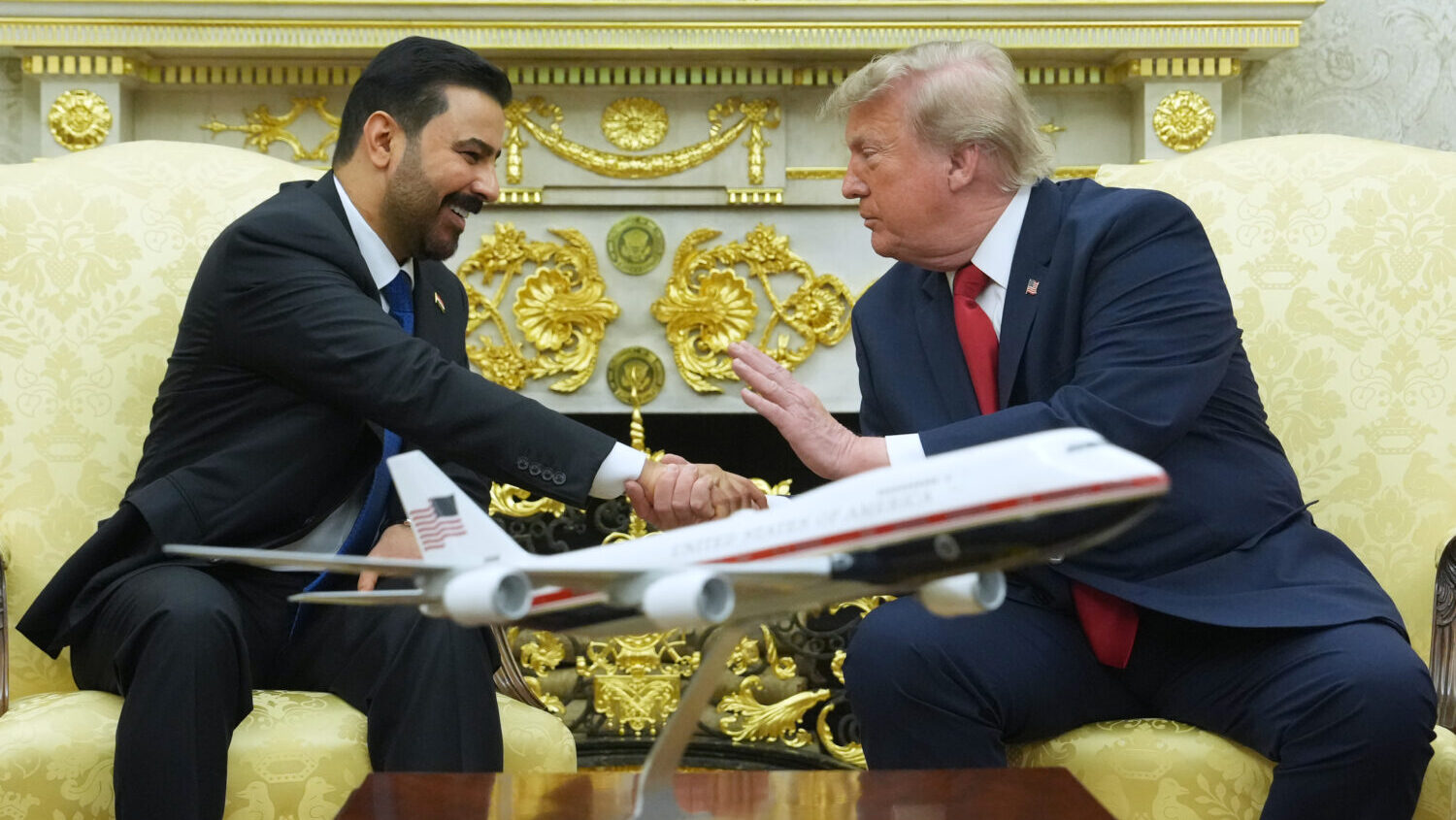
Trump unveiled his 20-point peace plan less than a week later — during Netanyahu’s fourth visit to the White House this year. Trump also made a show of trying to soothe angry Qatari officials.
Trump dialed up Qatari Prime Minister Mohammed bin Abdulrahman Al Thani and spoke to him before handing the phone to Netanyahu. The prime minister read from a written apology, expressing his regret for Israel violating Qatari sovereignty with the strike.
The White House later published photos of a grim-faced Trump with the phone awkwardly perched in his lap.
In a press conference in Washington after the Sept. 29 meeting, Netanyahu said he had accepted Trump’s plan.
Rubio said Trump’s negotiators then stepped up their efforts through intermediaries in Qatar and Egypt to get Hamas on board, while Trump held phone calls and meetings with world leaders.
The U.S. plan calls for Hamas to release all the remaining hostages within 72 hours of the ceasefire in return for hundreds of Palestinian prisoners, to give up power in Gaza and to disarm.
The plan essentially demanded Hamas’ surrender. Trump said the militant group had days to think it over and issued a stark warning.
“If this LAST CHANCE agreement is not reached, all HELL, like no one has ever seen before, will break out against Hamas,” Trump wrote on social media last week. “THERE WILL BE PEACE IN THE MIDDLE EAST ONE WAY OR THE OTHER.”
Hours later, and ahead of schedule, Hamas submitted its response.
A crucial move by Trump
Hamas reiterated its willingness to release all hostages in exchange for Palestinian prisoners and to give up power to other Palestinians. But it said other elements of Trump’s plan required more negotiation and offered nothing about disarming, a key Israeli demand.
The response was clearly a “yes, but.”
The U.S. and Israel could have taken it as a “no” and blamed Hamas for the failure to reach a ceasefire on Israel’s terms, as they had in the past. Israel could have vowed to press ahead with its invasion of Gaza City or even expand it.
But when the Hamas response landed late Friday, Israel was largely shut down for the Sabbath, and Trump was first to respond.
“Based on the Statement just issued by Hamas, I believe they are ready for a lasting PEACE. Israel must immediately stop the bombing of Gaza, so that we can get the Hostages out safely and quickly!” he wrote on his Truth Social site.
U.S. officials declined to comment on Trump’s thinking. If he misread Hamas’ response, no one was in any mood to correct him — neither Hamas, which had sidestepped his ultimatum, nor Netanyahu, who would not want to be seen as spoiling the president’s deal.
In a brief statement later that night, Netanyahu said Israel was preparing for the implementation of the “first stage” of Trump’s plan — the release of hostages — and was still committed to ending the war according to its own principles.
It made no mention of the fact that Hamas had not accepted some key demands.
There was room to negotiate, and a desperation on the part of the international community, key Arab players — and likely Trump himself — to end a war that has killed tens of thousands of Palestinians and destabilized the region.
Israeli Foreign Minister Gideon Saar said Thursday that he and many other Israeli officials were skeptical about Hamas’ heavily qualified acceptance. But he said Trump’s decision to frame it as a sign of momentum proved to be a “brilliant” move.
Trump “not only seized an opportunity but created an opportunity by saying, ‘Well, it’s positive, and let’s move from there.’ And eventually it worked,” Saar told Fox News.
In an interview with Fox News host and ally Sean Hannity after announcing the agreement, the president said he hoped it would help repair Israel’s international standing.
“I spoke to Bibi Netanyahu just a little while ago,” Trump told Hannity, using the Israeli prime minister’s nickname. “I said, ‘Israel cannot fight the world, Bibi.’ They can’t fight the world. And he understands that very well.”
___
Krauss reported from Ottawa, Ontario.