SCIENCE + TECHNOLOGY

University of Utah brain study finds possible link to anxiety

Jun 12, 2023, 6:17 AM | Updated: Oct 25, 2023, 3:41 pm
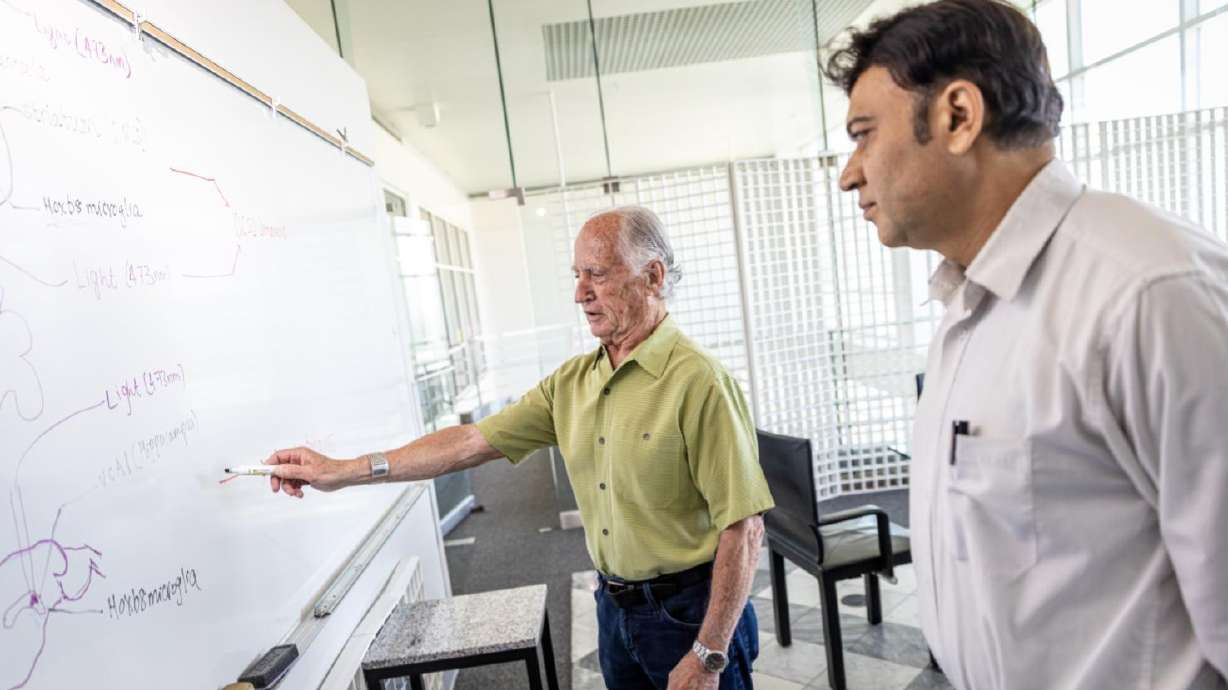
Scientists Mario Capecchi, left, and Naveen Nagarajan discovered that brain cells called the microg...

Scientists Mario Capecchi, left, and Naveen Nagarajan discovered that brain cells called the microglia were the source of a mutation in a gene called Hoxb8 — a gene that caused mice to exhibit anxiety-related and obsessive-compulsive behaviors. Scientists Mario Capecchi, left, and Naveen Nagarajan discovered that brain cells called the microglia were the source of a mutation in a gene called Hoxb8 — a gene that caused mice to exhibit anxiety-related and obsessive-compulsive behaviors. (University of Utah Health)

(University of Utah Health)

SALT LAKE CITY — Over 33% of adults in Utah have reported having symptoms of anxiety and/or depression — a figure that has only climbed in recent years. But a study conducted by University of Utah Health scientists may be one of the first steps toward understanding the root causes of anxiety and anxiety-related conditions, including obsessive-compulsive disorder.


In the study, published a few weeks ago in the scientific journal Molecular Psychiatry, researchers discovered through cell stimulation that a specific brain cell called microglia doesn’t just act as “a trash collector” — a cell that disposes of the brain’s dying neurons — but it can also control anxiety-related behaviors.Naveen Nagarajan, a geneticist, neuroscientist and lead author of the study, and Nobel laureate Mario Capecchi first discovered that microglia contained a gene mutation called Hoxb8, which caused mice to exhibit anxiety-related and obsessive-compulsive behaviors, such as overgrooming themselves pathologically.To further understand the microglia’s functions, the scientists employed optogenetics, a method that uses a laser to stimulate cells through a combined feat of genetic engineering and laser technology. Both scientists then proceeded to expose microglia cells in their mice test subjects and record how they reacted.By using laser exposure to open light-sensitive channels and cause an influx of ions into the microglia, switching the laser on and off allowed them to switch on and off the anxiety, according to Capecchi.

The results, Nagarajan said, were astonishing.

When lighting up the microglia in different areas in the brain, the mice would demonstrate anxiety-related behaviors, such as grooming themselves, freezing or generally increased anxiety. When switching off the laser, the behaviors immediately stopped.

“What it means for human health, or what it means for the future is that the discovery is just not restricted to stimulating the cells and seeing the behavior. The discovery is that these microglia cells make an essential role in controlling neural circuit function,” Nagarajan said.

By understanding how the microglia could control neural activity, Nagarajan and Capecchi could then look into how controlling the microglia functions and potentially manage anxiety.

Capecchi added how the imbalance between two different types of microglia also contributes to anxiety. As both types remain balanced, he said, the anxiety and pathological grooming would be manageable; it’s only when they’re imbalanced that the pathological behavior dominates.

“Some anxiety and grooming is actually beneficial. We use anxiety to motivate us and grooming to comfort us,” Capecchi said. “It’s simply that too much when anxiety becomes chronic or grooming becomes pathological that it is too bad.”

To further the experiment, the scientists will need to look into the types of chemicals the microglia release and how it triggers neurological behaviors. By looking into the chemical causes of the microglia reactions, Nagarajan said, they can better determine the root causes of anxiety — and, from there, figure out a way to best treat the disorder.

“We can correct those differences by targeting those particular receptors or those particular chemicals that are being released by microglia — so that will actually bring us close to therapies,” Nagajaran said. “We will be in a position to say that this effect will be more specific than all the other drugs that are currently being used in the field or in the market, which to some extent, alleviate the symptoms, but it never cures the disease.”

But the process of creating a drug and discovering therapies is still a long process that will take years to complete, according to Capecchi.

“We’re at the beginning of the stages, but it’s a brand new beginning because nobody thought about using this kind of approach,” Capecchi said. “The work is just — it’s just unveiling, it’s just coming out. There are hundreds of questions we can ask now.”

Related: Where is anxiety in children coming from?

We want to hear from you.

Have a story idea or tip? Send it to the KSL NewsRadio team here.

Science + Technology

FILE: Massive antennas, part of the Atacama Large Millimeter/ submillimeter Array (ALMA) radio tele...

Adithi Ramakrishnan, AP Science Writer

In a sweet discovery, astronomers find sugar lurking in the space between stars

Astronomers have detected a type of sugar, called erythrulose, in space that's also found in raspberries and self-tanners.

8 days ago

During a meeting of the Cache County Council on June 23, county official Brian Abbott presented a p...

Bryanna Willis

Cache County Council joins other Utah counties by placing a hold on data center approval

The Cache County Council has placed a temporary pause on approving data centers while city officials look into a data center's impact.

20 days ago

After the defeat of three Utah leaders who helped move the Stratos data center project forward, a r...

Tim Vandenack, KSL

Data center developers move forward despite voter backlash aimed at Sen. Adams, others

After the defeat of three Utah leaders who helped move the Stratos data center project forward, a rep from O'Leary Digital, the firm spearheading the plans, says the efforts will continue.

27 days ago

FILE - Computer scientist Fei-Fei Li speaks during the Clinton Global Initiative, Sept. 24, 2024, i...

Matt O'Brien, AP Technology Writer

All the world’s a robot-staging ground for tech entrepreneurs building ‘physical AI’

A growing number of AI entrepreneurs are dedicating themselves to models that teach AI systems how to react in a physical environment.

27 days ago

Sen. John Curtis speaks at the Scott C. Keller Business Building at UVU in Orem On May 4. Curtis in...

Cami Mondeaux, Deseret News

Kids are talking to AI more than ever. John Curtis wants rules to ensure their safety

Sen. John Curtis introduced a bipartisan bill on Tuesday to establish a federal framework regulating online chatbots, particularly as it relates to usage by teenagers and young children.

28 days ago

Forward-facing sonar products are not only helping anglers increase their catch, they're also raisi...

Jack Dura, Associated Press

Some anglers praise forward-facing sonar, others say high-tech fishing ruins a day at the lake

Forward-facing sonar products are not only helping anglers increase their catch, they're also raising questions about why people go fishing in the first place and whether fish populations can survive the new technology.

1 month ago

Sponsored Articles

...

Bear Lake

Road trip ready: How Bear Lake became the go-to destination for Western U.S. travelers

Whether you are chasing pristine beaches, fresh raspberry shakes, or endless water sports, this sponsored guide—brought to you in partnership with Bear Lake —uncovers everything you need to plan the ultimate getaway.   There’s nothing quite like the thrill of hopping in the car with your favorite snacks in tow and heading out for a […]

...

Harper Clinic

A new standard of care: How Harper Clinic’s IOP is changing the face of mental health treatment in Utah

This article is sponsored by Harper Clinic, a Utah-based clinic offering FDA-approved TMS therapy for treatment-resistant depression.    Utah’s mental health crisis is leaving many residents caught in an uncomfortable middle ground: struggling too much for weekly therapy alone, but unable to step away from work, parenting or daily life for inpatient treatment. As demand […]

...

Harper Clinic

Breaking free from depression: How Harper Clinic’s TMS Therapy can help

This article is sponsored by Harper Clinic, a Utah-based clinic offering FDA-approved TMS therapy for treatment-resistant depression.    The weight of depression is real. Many people spend years fighting it, adjusting medications, managing side effects and wondering if this is simply how life is going to feel.   According to the World Health Organization, depression affects […]

mental health...

Andrew Adams, KSL

Library discussions bring men’s mental health to the surface

Therapists say it’s common for men to repress things like trauma, grief, stress and anxiety. Now, a new weekly series of discussions aims to help men bring it all to the surface.

...

Bear Lake Convention & Visitors Bureau

Cozy up in Bear Lake: Discover the magic of a winter getaway

SALT LAKE CITY – The holiday season shines brightest when time slows down and loved ones gather. Gifts, decorations and festive music come and go, but shared experiences tend to last much longer. Research supports that idea. Dr. Theresa E. DiDonato told Psychology Today that vacations can strengthen relationships by creating meaningful time away from daily […]

...

Harper Clinic

Rewriting the path to healing: Inside Harper Clinic’s whole-person mental health model

OREM — A few decades ago, you’d have had a hard time finding a doctor to treat both your mind and body; And a century ago, you’d have been hard-pressed to find a doctor to treat your mind at all. Today, medical professionals are understanding more and more the undeniable connection between the body and […]

University of Utah brain study finds possible link to anxiety