How a Twitter account with a cat avatar took on Beijing
Dec 10, 2022, 9:39 PM
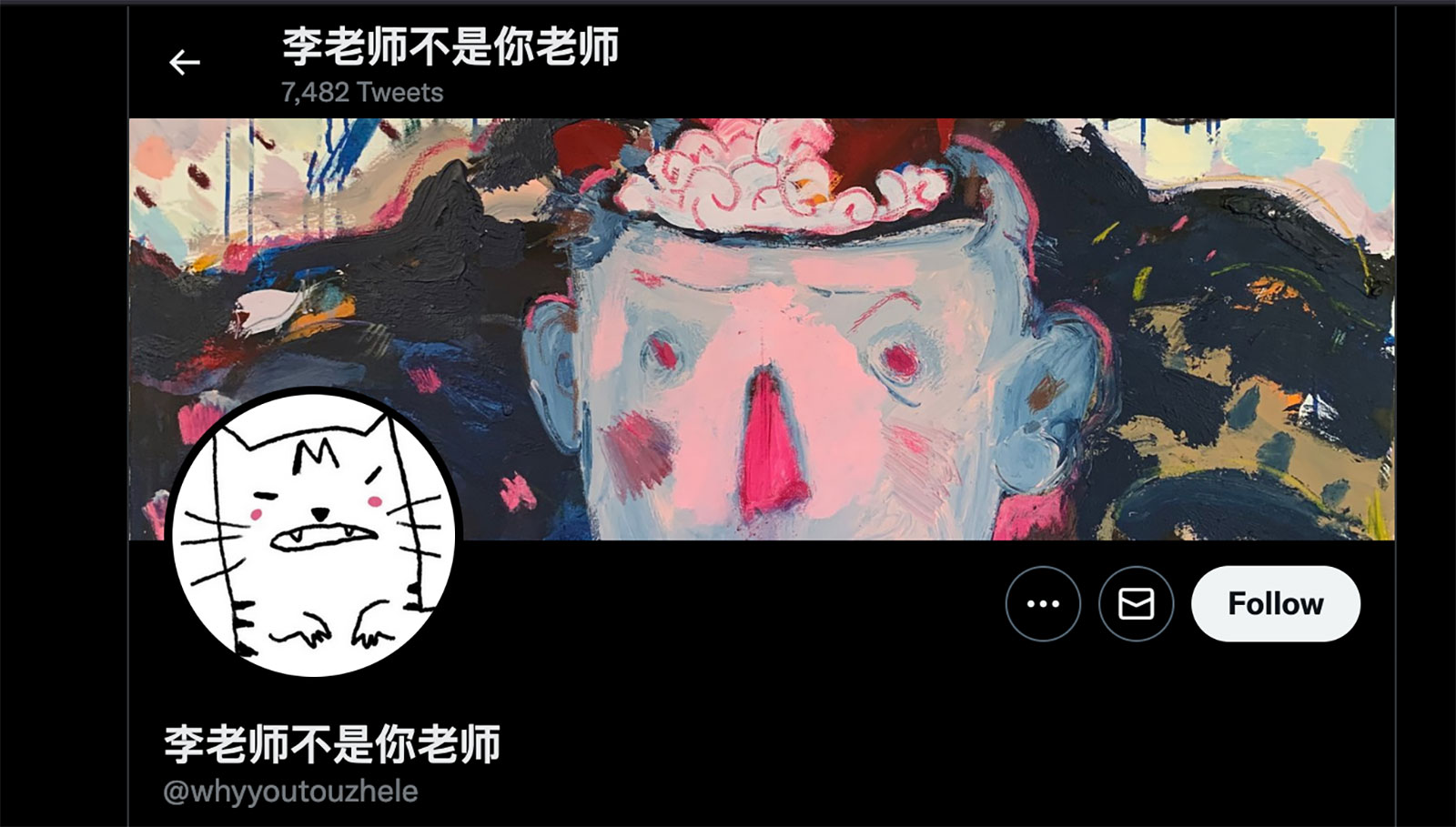
Li's Twitter page has gained 800,000 followers in a matter of weeks.(Twitter)
(Twitter)
(CNN) — The unprecedented protests that swept China late last month, posing the biggest challenge to leader Xi Jinping’s authority since he came to power, had a peculiar focal point: a Chinese Twitter account with a cat avatar.
As people took to the streets to call for greater freedoms and an end to zero-Covid restrictions, the account “Teacher Li is Not Your Teacher” live-tweeted the demonstrations in real-time, offering a rare window into just how quickly and widely the eruption of dissent reverberated across the country.
Inside China, videos, photos and accounts of the protests were swiftly censored online. But participants, witnesses and others who knew how to scale the Great Firewall would send them to “Teacher Li,” which became a crucial source of information for people in China and beyond. (Twitter, like many other social media platforms and news sites, is blocked in China, but it’s accessible via a VPN.)
Behind the account is Li, a bespectacled 30-year-old painter, who spent most of his waking hours glued to a chair in front of a curved monitor and a pastel-colored keyboard — thousands of miles away from the protests in a living room corner in Italy.
“I haven’t seen sunlight in what seems like a long time,” Li told CNN, a week after the protests broke out.
For days on end, he waded through an endless flood of private messages in his Twitter inbox, sent by people across China with updates to share about the demonstrations and their aftermath. He posted them on their behalf, shielding the senders from the scrutiny of Chinese authorities.
In recent years, Beijing has extended its crackdown on dissent to the foreign platform, detaining and jailing Chinese Twitter users who criticized the government. But through Li, these anonymous voices of dissent were converged and amplified.
“This account may become a symbol that Chinese people are still pursuing freedom of speech,” Li said. “When you post something within China, it will quickly disappear. This account can document all these historical events and moments that cannot be saved inside the country.”
Li received thousands of submissions a day — and up to dozens per second at the height of the protests. His following quadrupled in two weeks to more than 800,000. Journalists, observers and activists monitored his feed closely, and some of his posts were aired on televisions across the world.
“I didn’t have the time to react at all. My only thought at the time was to document what was happening,” Li said. “The influence is beyond my imagination. I didn’t expect billions of clicks on my feed in such a short period of time.”
As his profile grew, Li caught the attention of the Chinese authorities. As the security apparatus went after the protesters in China with a sweeping campaign of surveillance, intimidation and detention, Li also came into their crosshairs.
Last Saturday, Li was tweeting away when he received an anxious phone call from his parents back home in eastern China — they had just had another visit from the police, they told him.
“As soon as I started to update Twitter, they called my parents to tell me to stop posting. And then they went to our house at midnight to harass my parents,” Li said.
It was their second police visit of the day. In the morning, a local police chief and a handful of officers had already called on Li’s parents. They accused Li of “attacking the state and the (Communist) Party” and presented a list of his tweets as “criminal evidence.”
“They wanted to know if there were any foreign forces behind me, whether I received any money, or paid people money for their submissions,” Li said.
Li told his parents he wasn’t working for anyone, and no money was involved. His father pleaded for him to “pull back from the brink” and stop posting.
“I can’t turn back now. Please don’t worry about me,” Li told him. “I don’t think I’m doing anything wrong.”
“You’re an artist, you shouldn’t touch politics,” his father said.
“Elephant in the room”
Li’s father knew what it was like to be on the wrong side of politics. Born to a Nationalist army officer in 1949, he was persecuted as a “counter-revolutionary” growing up under Mao Zedong’s tumultuous reign. In his adolescence, he could no longer stand the torment and fled to the hills in southern China, where he found work in a factory.
In the latter half of the Cultural Revolution, which swept China in the 1960s and 1970s, he was enrolled into a college as a “worker-peasant-soldier” student (admitted not on academic merit but class background), and stayed after graduation to work as an art teacher.
Since the brutal crackdown on the Tiananmen pro-democracy protests in 1989, “Don’t touch politics” has become a mantra for a generation of Chinese. As the country pivoted its focus to economic growth, an unspoken social contract was struck — that people would give up political freedoms for stability, material comfort and freedoms in their private lives.
But under leader Xi, that implicit deal is looking increasingly precarious. His zero-Covid policy has shuttered businesses, hampered economic growth and pushed youth unemployment to record levels; his authoritarian agenda has expanded censorship, tightened ideological control and squeezed personal freedoms to an extent unseen in decades.
“Chinese people are not keen on politics, but politics is constantly intruding into their lives. They assume there is an elephant in the room, but the elephant is gradually growing bigger and squeezing everyone’s life,” Li said. “That’s why we’re seeing the explosion (of dissent) now.”
In China’s largest cities, from the eastern financial hub of Shanghai to the capital Beijing, the southern metropolis of Guangzhou and Chengdu in the west, political demands were chanted along with slogans against Covid tests and lockdowns. Many young people held up sheets of white paper in a symbolic protest against censorship, demanding the government give them back the freedom of speech, the press, movies, books and arts.
Their calls resonated deeply with Li, who grew up learning how to paint and watching foreign cartoons and films (he has a toy Yoda from Star Wars on a shelf next to his chair) during an era when China seemed freer and more open to the world.
From Weibo to Twitter
Li said he did not seek out politics — instead, like many young Chinese who took to the streets, he was unwittingly swept up by political currents. He described himself as someone who had been “pushed along” by the tides, “chosen by history” by chance to document an important chapter of it.
“I was someone who painted and scribbled cringy love stories,” Li wrote in a statement addressed to Chinese officials on November 28. “All of this is supposed to be far away from me. But you, with your control of speech, made me who I am.”
Li would not even have been on Twitter — let alone be one of its most influential Chinese-language users — if censorship hadn’t become so suffocating on Weibo, China’s own Twitter-like platform.
Li was among the earliest users of Weibo, dating back to 2010. “I was lucky to have witnessed that era — it was, in fact, pretty free,” he said.
Liberal intellectuals, lawyers and journalists and other influential commentators led critical discussions on social issues — sometimes issuing scathing criticism or ridicule of officials.
From the internet, Li learned about human rights lawyer Pu Zhiqiang and dissident artist Ai Weiwei, which — among other things — gradually shifted his political views. (Li called his younger self a “little pink” — a somewhat derogatory term for China’s young and fierce nationalists. He used to find stories about his father’s tormented youth hard to believe. “Our country is so strong and powerful, how could these kinds of bad things happen?” he recalled himself asking.)
By 2012, Li had become more critical of society. At 19 years old, the budding artist held his first personal exhibition at a gallery in the eastern city of Jinan. He named it “Picasso at the Circus” — meant to “mock this absurd society, which is like a circus filled with funny animals,” according to an introduction of the event.
The relative freedom on Chinese social media was fleeting. Censorship started to tighten before Xi came to power, and the clampdown on free speech and outspoken commentators only accelerated.
Things got even worse during the pandemic. On Weibo, countless accounts were banned for speaking out on a variety of issues, from feminism to the human cost of zero-Covid. Earlier this year, Li lost 52 accounts in the span of two months. “My accounts would survive for about four or five hours — with the shortest record being 10 minutes,” Li said. “I treated it as a performance art.”
He lost his last Weibo account by retweeting a photograph of a 15-year-old Uyghur girl in detention, who was featured in the BBC’s investigation on the Xinjiang Police Files. “I wanted to be brave for once, for her. It was well worth it,” he said on Twitter. “Having seen her face, I won’t be able to fall asleep tonight if I just sit by and not retweet it.”
After exhausting all the means to create new accounts, Li switched to Twitter. “It felt liberating because you no longer need to use acronyms or code names,” he said.
On Chinese social media, people have become accustomed to speaking in coded language to avoid censorship: “zf” means the government, “zy” means freedom, and the most sensitive term of all — the name “Xi Jinping” — can never be mentioned without triggering censorship or worse repercussions (Some internet users have been taken in for questioning by police for sharing memes or jokes about Xi in group chats). Instead, the top leader is often referred to simply as “him” or “that man.”
And so on November 26, when Li saw in his Twitter inbox a video showing crowds openly chanting “Xi Jinping, step down!” on the streets of Shanghai, under the close watch of police, he was dumbfounded.
“We can’t even discuss him on the internet. It is beyond everyone’s imagination that such a slogan would be shouted out on Urumqi Road,” Li said, referring to the site of the Shanghai protest.
“I’m a little embarrassed to tell you that I froze for a second when I heard the slogan. But I told myself that if they dare to shout it, I should be brave enough to document it. So I wrote it out word by word (in a Twitter post),” he said.
Backlash and regret
Among the thousands of direct messages Li received in his inbox were death threats. “I get a lot of anonymous harassment saying I know who you are, where you live, and I will kill you,” he said.
He ignored them and stayed focused on processing updates on the protests. But when he stepped away from his computer, the dark thoughts would come back to haunt him.
These threats, as well as the police harassment of his parents, weighed heavily on Li’s mind. But he is determined to carry on.
“This account is more important than my life,” he said. “I will not shut it down. I’ve arranged for someone else to take over if something bad happens to me.”
By the first week of December, the demonstrations had largely petered out. Some protesters received phone calls from the police warning them against taking to the streets again, others were taken away for questioning — and some remained in detention.
But in a major victory for the protesters, China announced on Wednesday a dramatic overhaul of its pandemic policy, scrapping some of the most onerous restrictions in the clearest sign yet the government is moving away from its draconian zero-Covid policy.
Like many protesters, Li will have to continue to face the consequences of his political defiance. He has not returned home to his parents since 2019, due to China’s border restrictions and the skyrocketing prices of plane tickets. The easing of domestic Covid measures has raised hopes that China is a step closer to opening its borders. But Li may never be able to go home again.
“When I saw people taking to the streets and holding up pieces of white paper, I knew I had to sacrifice something of myself, too,” he said. “I’m mentally prepared, even if authorities won’t let me see my parents again.”
Looking back, Li said he found absurdity in the fact that China’s stringent censorship of the press and the internet has made him, a painter as far away as Italy, a key documenter of the country’s most widespread protests in decades.
In the heat of the moment, he didn’t have the time to mull over whether it was all worth it. But he knows his life’s path is forever changed.
“I don’t think I am a hero. Those who took to the streets, they are the real heroes,” he said.
Now, Li has only one regret — that his Twitter name and handle were not chosen thoughtfully enough.
“If an account is to leave a mark in history, it should have a serious name,” he said.
His Twitter name is a self-mockery of his own accent: people from his home province cannot differentiate the pronunciations of “Li” — his surname — and “ni”, meaning “You.”
And his Twitter handle @whyyoutouzhele is a dig at Chinese Foreign Ministry spokesperson Zhao Lejian’s comments last year that foreign reporters should “touzhele,” or “chuckle to themselves,” for being able to live safely in China during the pandemic. The phrase has since been used widely on Chinese social media in a sarcastic way to criticize zero-Covid.
But Li is extremely proud of his Twitter avatar — a doodle of his tabby cat.
“The cat is now known to the Chinese diaspora around the world. But at the same time, it has also become the most dangerous cat on the Chinese internet,” he said.