ENVIRONMENT

What oily, sticky tar seeps can teach us about saving Great Salt Lake

Apr 22, 2023, 2:23 PM | Updated: Apr 24, 2023, 10:01 am
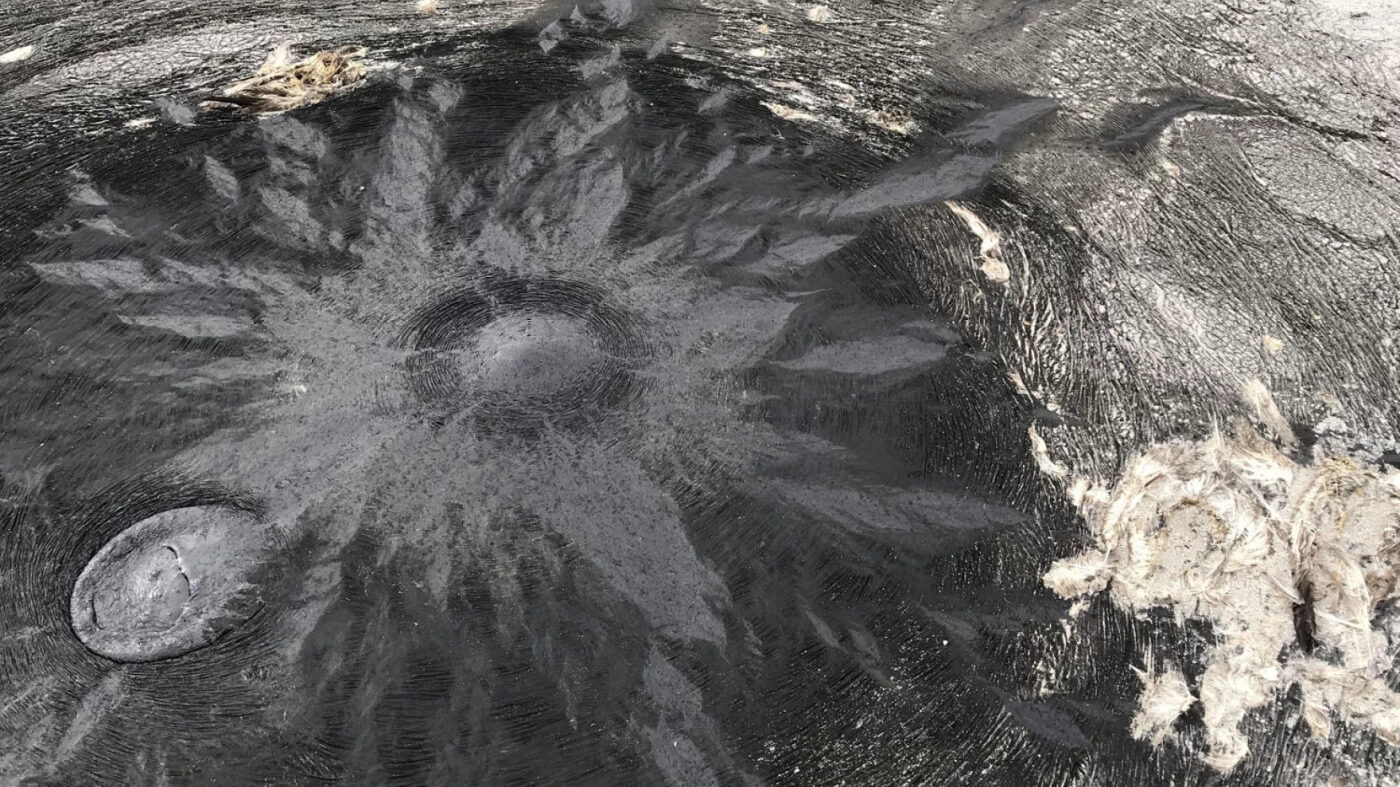
tar seeps on the shore of the great salt lake become more visible as the water level drops. they ca...

Tar seeps on the shore of the great salt lake become more visible as the water level drops. they can form beautiful patterns as they ooze and freeze. (courtesy gretchen henderson)

(courtesy gretchen henderson)

This article is published through the Great Salt Lake Collaborative, a solutions journalism initiative that partners news, education, and media organizations to help inform people about the history and the plight of the Great Salt Lake.

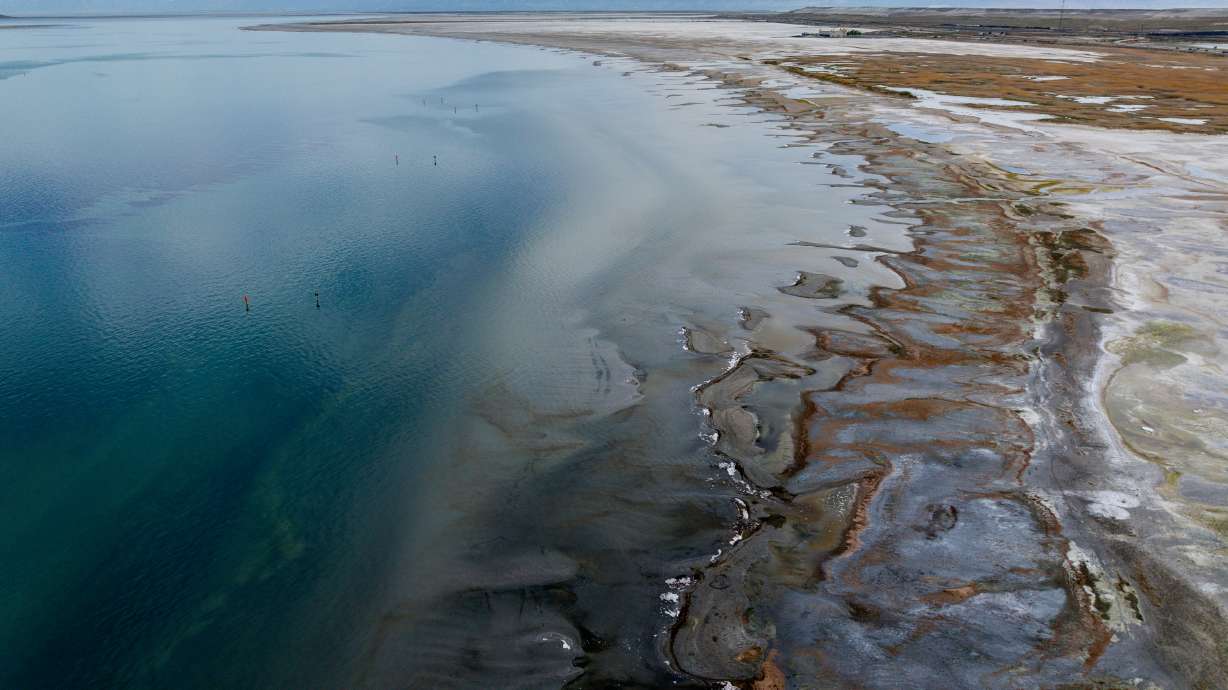
SALT LAKE CITY — Near Spiral Jetty on the northeast shore of Great Salt Lake, there is a phenomenon known as tar seeps. Sticky, black oil bubbles up to the dry lake bed and entraps unsuspecting birds and small mammals. These seeps have become more exposed as the lake shrinks.

“They ooze up from tectonic fractures beneath the earth’s surface and spread out like sticky flypaper,” said Gretchen Henderson, author of the forthcoming book “Life in the Tar Seeps: A Spiraling Ecology from a Dying Sea.

“During summer, they’re very sticky. You want to stay away from them. But then in winter, they freeze into these beautiful patterns.”

She first fell in love with the Great Salt Lake when she was a University of Utah visiting professor of environmental humanities.

Henderson, who is now a senior lecturer at the University of Texas at Austin, warns people who visit to be careful as they walk around the seeps. Animals that get stuck in the tar can become fossilized over time.

“[The tar seeps] are a natural phenomenon, but they really are a barometer for climate change,” Henderson said. “They tell time in reverse.”

Henderson uses the tar seeps as a metaphor for how, like these birds, society can become stuck without realizing it.

These kinds of connections are an important part of saving the lake, Henderson said.

Throughout the book, she personifies the lake and relates her own life to the tar seeps. She was once hit by a car in a crosswalk — a surface of man-made asphalt that she likens to the natural asphalt of the tar seeps.

Through that personal connection, she developed a relationship with the lake.

“All the different ways that we impact the earth and engage with the earth came to life in this remote place,” she said.

With misunderstanding and denial around climate change, Henderson said people need to find their own links to the lake.

“Stories have that capability to not only speak to the mind, but speak to the heart and build empathy, as we are able to relate to the Great Salt Lake as a living body of water.”

Henderson spoke at the University of Utah Tuesday, April 18 at 2 p.m. as a guest of the Tanner Humanities Center.

This interview has been edited for length and clarity.

Ciara Hulet: You talked about these tar seeps as beautiful. I don’t think I would consider them beautiful. Is that the kind of thinking you feel like people need to better connect with the lake and want to save it? 

Gretchen Henderson: Absolutely. Sometimes the overlooked places — what could be called the disabled places, the wounded places — have just as much value and need that same kind of care and attention. Sometimes we as a human species need to turn up the volume of our own multi-sensory engagement and also think about the inherited ways of seeing [the Great Salt Lake as] stinky and ugly. But if we look a little bit closer and try to see it on its own terms, we may actually get a different sense.

CH: Do you really think “love” could save the lake?

GH: I think it’s a question of what does that love do in a sense of transformative action. How does that work its way into our everyday engagement of use of not only water, but natural resources more generally? And thinking in terms of respect and reciprocity, how can that turn into transformative collective action for how we steward the planet, especially [in] challenging places that aren’t as easy to love?

CH: How can someone who hasn’t really fallen in love with the lake start to develop a relationship with it? 

GH: There are a lot of on-the-ground [opportunities], either field trips out to Great Salt Lake through the Great Salt Lake Institute and other collectives, and through the Utah Museum of Fine Arts to visit Spiral Jetty. But do it in a way that’s not about eco-recreation in terms of what we can take or what we can receive, but also how we can pay closer attention to the lake on its own terms.


We want to hear from you.

Have a story idea or tip? Send it to the KSL NewsRadio team here.

Environment

Sections of Capitol Reef National Park and Zion National Park were issued with flash flood warnings...

Joe R. Wirthlin Jr, KSL and Carter Williams, KSL

Tornado warning issued in Tooele County; flood warnings in southern Utah

Flash flood warnings were issued across portions of southern Utah on Thursday, including in Springdale and Pine Valley in Washington County.

15 hours ago

Flags in front of the Capitol fly at half-staff in Salt Lake City on Tuesday. The flags were lowere...

Emily Walker, Deseret News

Utah leaders honor the lives of fallen firefighters

Gov. Spencer Cox ordered that Utah flags fly at half-staff beginning Tuesday, and stay lowered until the last day of internment of two firefighters who died fighting the Widemouth 2 Fire.

15 hours ago

A plane drops fire retardant around the Rocky Canyon Fire near Henefer on Monday. The Summit County...

Joe R. Wirthlin Jr, KSL

Summit County Sheriff’s Office lifts fire evacuations from Henefer

Summit County officials announced that residents in Henefer could return to their homes on Thursday, but warned that evacuations could return.

16 hours ago

A firefighting helicopter moves toward the Rocky Canyon Fire in Henefer on Tuesday. Utah's percenta...

Carter Williams, KSL

Why Utah’s percentage of human-caused fires has fallen well below the national average

Utah is within 100,000 acres of having its worst fire year in terms of acreage lost, but this year likely won't be the worse for human-caused fires.

17 hours ago

FILE: A loader moves coal at the Huntington power plant in Huntington, Tuesday, March 24, 2015. (Ra...

Don Brinkerhoff, KSL

Coal’s economic impact on Carbon and Emery counties

Carbon and Emery counties would be economically devastated if the Hunter and Huntington coal-powered plants were to shut down, a review by the University of Utah and the Kem C. Gardner Policy Institute found.

2 days ago

The Great Salt Lake from the Great Salt Lake State Park and Marina in Magna on April 21. While just...

Adam Small, KSL

Great Salt Lake not expected to hit new low in 2026; but what if it does in the future?

At 4,190.4 feet above sea level, Utah's Great Salt Lake is quickly approaching its second-lowest level ever recorded. But on the brighter side, water officials say we'd have already h it a record low if not for the work done by Utahns to conserve.

2 days ago

Sponsored Articles

Whether you are chasing pristine beaches, fresh raspberry shakes, or endless water sports, this spo...

Bear Lake

Road trip ready: How Bear Lake became the go-to destination for Western U.S. travelers

Whether you are chasing pristine beaches, fresh raspberry shakes, or endless water sports, this sponsored guide—brought to you in partnership with Bear Lake —uncovers everything you need to plan the ultimate getaway.

How Harper Clinic's IOP is changing the face of mental health treatment in Utah....

Harper Clinic

A new standard of care: How Harper Clinic’s IOP is changing the face of mental health treatment in Utah

As demand for mental health care continues to rise across Utah County, Orem's Harper Clinic says it is trying to close the gap with a more comprehensive approach to mental health treatment.

The weight of depression is real. Many people spend years fighting it, adjusting medications, manag...

Harper Clinic

Breaking free from depression: How Harper Clinic’s TMS Therapy can help

Breaking free from depression: How Harper Clinic's TMS Therapy can help.

mental health...

Andrew Adams, KSL

Library discussions bring men’s mental health to the surface

Therapists say it’s common for men to repress things like trauma, grief, stress and anxiety. Now, a new weekly series of discussions aims to help men bring it all to the surface.

...

Bear Lake Convention & Visitors Bureau

Cozy up in Bear Lake: Discover the magic of a winter getaway

SALT LAKE CITY – The holiday season shines brightest when time slows down and loved ones gather. Gifts, decorations and festive music come and go, but shared experiences tend to last much longer. Research supports that idea. Dr. Theresa E. DiDonato told Psychology Today that vacations can strengthen relationships by creating meaningful time away from daily […]

...

Harper Clinic

Rewriting the path to healing: Inside Harper Clinic’s whole-person mental health model

OREM — A few decades ago, you’d have had a hard time finding a doctor to treat both your mind and body; And a century ago, you’d have been hard-pressed to find a doctor to treat your mind at all. Today, medical professionals are understanding more and more the undeniable connection between the body and […]

What oily, sticky tar seeps can teach us about saving Great Salt Lake