A ‘ring of fire’ solar eclipse is coming soon. Here’s what you should know
Oct 3, 2023, 8:30 AM
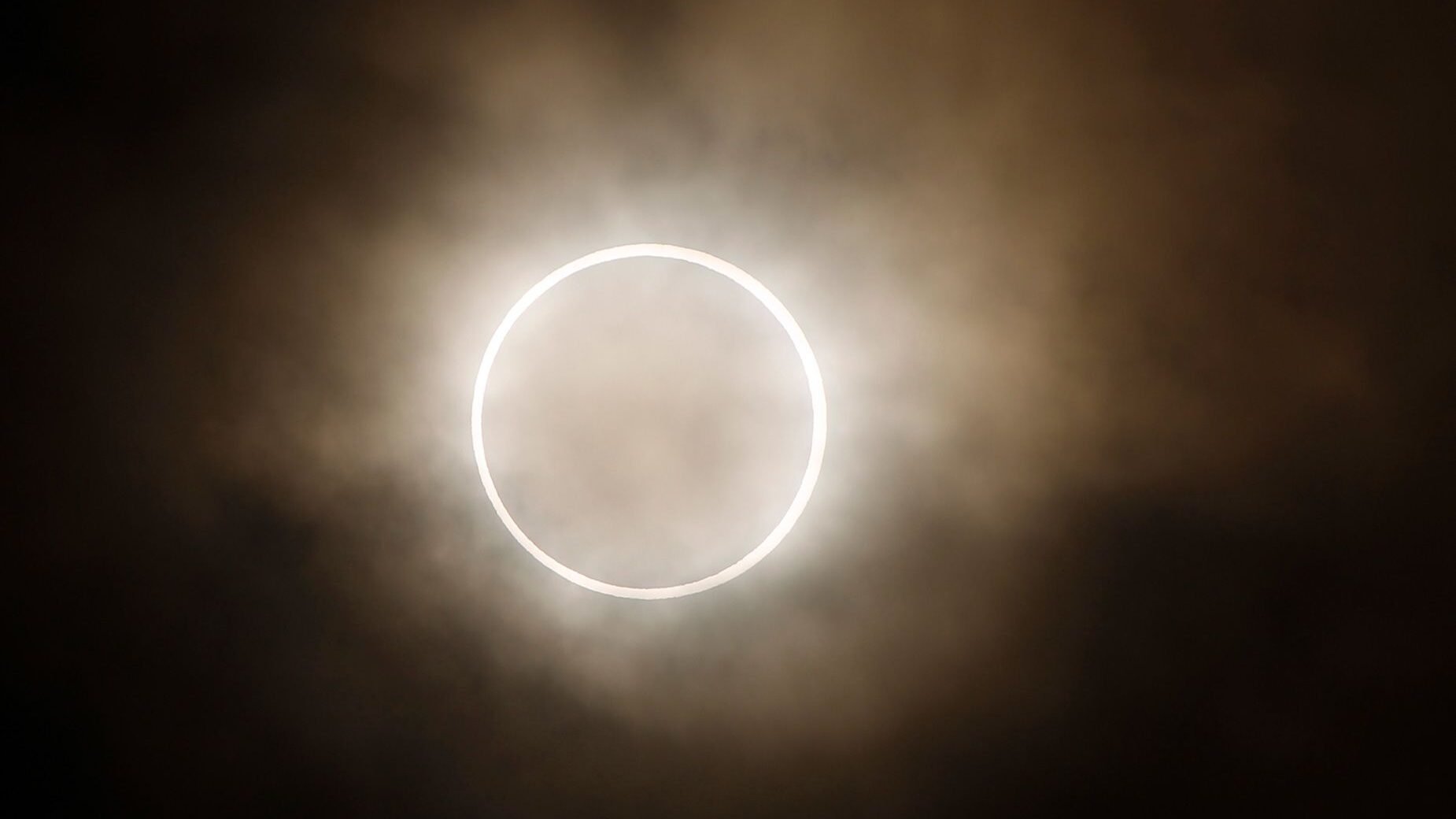
When the moon crosses between Earth and the sun during an annular solar eclipse, a signature "ring of fire" of sunlight is still visible. Photo Credit: Shuji Kajiyama/AP
(CNN) — An annular solar eclipse will make its appearance in the skies over North, Central and South America on Oct. 14, creating a singular spectacle for those in its path — and a rare opportunity for scientists.
The dazzling celestial event will allow millions of people to witness “the awe and the wonder of seeing a beautiful ring of fire eclipse,” said Peg Luce, acting director of the Heliophysics Division at NASA headquarters.
The “ring of fire” nickname comes from the appearance of annular solar eclipses, which are like total solar eclipses, except the moon is at the farthest point in its orbit from Earth, so they can’t completely block the sun. Instead, the sun’s fiery light surrounds the moon’s shadow, creating the so-called ring of fire.
The annular solar eclipse will begin in the United States at 9:13 a.m. PT (12:13 p.m. ET) and pass from the Oregon coast to Texas’ Gulf Coast, appearing in Oregon, Nevada, Utah, New Mexico and Texas. The lunar shadow will also be visible in parts of California, Idaho, Colorado and Arizona. The eclipse will end in the US at 12:03 p.m. CT (1:03 p.m. ET).
After leaving the US, the eclipse will cross Mexico, Belize, Honduras, Panama and Colombia before ending off South America’s Atlantic coast at Natal, Brazil.
Weather permitting, a cresecent-shaped partial solar eclipse, where only part of the sun is covered by the moon, will be visible October 14 in all 49 continental US states, including Alaska, according to NASA. Use the agency’s interactive eclipse map to check when the eclipse will pass over your area.
Unable to see the eclipse? NASA will share a live stream beginning at 11:30 a.m. ET on eclipse day, sharing views from Albuquerque, New Mexico, Kirbyville, Texas, and White Sands, New Mexico, according to Kelly Korreck, eclipse program manager at NASA.
“The next annular eclipse seen in this part of the country is actually going to be in 2046,” Korreck said. “It’s going to be a long stretch before we will see this phenomenon again, so we’re really encouraging folks to go out there and observe safely.”
What to see
Those in the path of the annular eclipse will experience several phases of the event. First, as the moon begins to pass in front of the sun, it will create a crescent-shaped partial eclipse.
An hour and 20 minutes after the partial eclipse begins, the moon will move directly in front of the sun, creating the ring of fire (also called annularity). Depending on your location along the path, this phase will last between one and five minutes.
During annularity, the sky will grow darker, though not as dark as during a total solar eclipse when all of the sun’s light is blocked. Animals may behave like they do at dusk, and the air may feel cooler, according to NASA.
The moon will continue its trek across the sun for another hour and 20 minutes, creating another partial eclipse, before the moon moves out of sight.
Safe viewing
It’s never safe to look directly at the sun without using specialized protection, and there is no phase of an annular eclipse that is safe to view with the naked eye because the sun’s light is never completely blocked.
To view the annular eclipse, wear certified eclipse glasses or use a handheld solar viewer. Separately, you can observe the sun with a telescope, binoculars or camera that has a special solar filter on the front, which acts the same way eclipse glasses would.
“You need certified ISO 12312-2 compliant solar eclipse glasses. There are plenty of safe sellers online,” said Alex Lockwood, strategic content and integration lead for the Science Mission Directorate at NASA headquarters. “We cannot stress enough how important it is to obtain a pair of safe certified solar eclipse glasses in order to witness this annular event.”
Sunglasses won’t work in place of eclipse glasses or solar viewers, which are thousands of times darker and held to an international standard. Don’t use torn, scratched or damaged eclipse glasses or solar viewers.
Don’t look at the sun through any optical device — cameras lens, telescope, binoculars — while wearing eclipse glasses or using a handheld solar viewer, according to NASA. Solar rays can still burn through the filter on the glasses or viewer, given how concentrated they can be through an optical device, and can cause severe eye damage.
Eclipses can also be viewed indirectly using a pinhole projector, like a hole punched through an index card. These function by standing with your back to the sun and holding up the card. The pinhole projects an image of the sun on the ground or other surfaces. But never face the sun and look directly at it through the pinhole.
If you’re sitting outside for a while awaiting the eclipse, don’t forget to apply sunscreen and wear a hat to protect your skin.
The next eclipse
A total solar eclipse will be visible in parts of Mexico, Canada and more than 10 US states on April 8, 2024.
The eclipse will first appear over the South Pacific Ocean and begin its journey across North America. Mexico’s Pacific coast is the first point of totality on the path, expected at 11:07 a.m. PT.
The pathway will continue across Texas, Oklahoma, Arkansas, Missouri, Illinois, Kentucky, Indiana, Ohio, Pennsylvania, New York, Vermont, New Hampshire and Maine. Then, it will cross over Canada in southern Ontario, Quebec, New Brunswick, Prince Edward Island and Nova Scotia, ending on the Atlantic coast of Newfoundland at 5:16 p.m. (3:46 p.m. ET).
What we can learn from eclipses
Eclipses afford scientists the opportunity to study the sun and how it interacts with Earth in unique ways. NASA will launch three sounding rockets during the annular eclipse to monitor how the drop in sunlight impacts Earth’s upper atmosphere, called the ionosphere.
About 50 miles (80.5 kilometers) above Earth’s surface, the ionosphere is where air becomes electric. The sun’s ultraviolet rays separate electrons from atoms, creating an atmospheric layer full of charged particles. But at night, the atoms recombine to become neutral.
The eclipse causes a more drastic change as the temperature and density of the ionosphere drop and rise again over a shorter time scale.
“If you think of the ionosphere as a pond with some gentle ripples on it, the eclipse is like a motorboat that suddenly rips through the water,” said Aroh Barjatya, designer of the sounding rocket mission and a professor of engineering physics at Embry-Riddle Aeronautical University in Florida, in a statement. “It creates a wake immediately underneath and behind it, and then the water level momentarily goes up as it rushes back in.”
Atmospheric changes were detected in 2017 during a total solar eclipse across the US.
“All satellite communications go through the ionosphere before they reach Earth,” Barjatya said. “As we become more dependent on space-based assets, we need to understand and model all perturbations in the ionosphere.”
The rockets will launch before, during and after the peak of the eclipse, flying just outside of the path of annularity, to measure the changes that occur in the ionosphere between 45 and 200 miles (72 and 322 kilometers) above the ground.
Amateur radio operators will try an experiment during both the annular and total solar eclipses to see how these phenomena change the way radio waves travel. Operators in different locations will record the strength of their signals and how far they travel. Scientists are interested in tracking this distance because the sun directly influences the ionosphere, which allows radio communications to travel farther. But when the moon blocks the sun, that can change.
The sun is currently approaching solar maximum in mid-to-late 2024, and scientists are eager to capture this peak of activity through a variety of observations, like studying the sun’s corona, or hot outer atmosphere, that can only occur during eclipses.