Wasatch Front water managers concerned by new usage trends
Jun 10, 2025, 9:30 AM | Updated: 4:42 pm
SALT LAKE CITY — Salt Lake County water managers say they’re concerned about new water trends as the region’s irrigation season has gotten off to a warmer and drier start.
Related: Over half of Utahns believe the state won’t have enough water in 20 years
Water consumption in the Jordan Valley Conservancy District, which includes most of Salt Lake County, is up 15% from last year, which was up 12.5% from the previous year, officials posted on social media last week.
Salt Lake City Department of Public Utilities officials also reported on Thursday that usage within its service area is up 5% overall from its three-year average, while outdoor watering use is up 10%. The department supplies water to Utah’s capital city, as well as parts of Cottonwood Heights, Holladay, Midvale, Millcreek, Murray and South Salt Lake.
Officials from both agencies say they know they aren’t alone either.
“I’ve been hearing from across the Wasatch Front that water demand seems to be up,” said Laura Briefer, director of the Salt Lake City Department of Public Utilities.
Spring’s double-whammy
The uptick isn’t too unexpected after spring produced a double-whammy of sorts.
While Utah’s northern half experienced a normal snowpack this year, dry conditions prior to winter and an unproductive meteorological spring compromised the runoff efficiency. Utah’s meteorological spring — March 1 through May 31 — was the 11th warmest and 40th driest since 1895, according to National Centers for Environmental Information released on Monday.
Parts of the Wasatch region experienced even hotter and drier conditions overall, as well. Federal snowpack experts lowered runoff expectations as the warmer and drier conditions emerged because less water from the snow ends up in the streams, creeks and reservoirs that feed into the state’s lakes and reservoirs.
Dry soil conditions before the snowpack also increased the probability that more snowpack water would go into recharging the groundwater supply, meaning less water that flows into the state’s reservoirs. People also begin watering their lawns early when spring is warmer and drier than usual, which also pulls water from the system, Briefer adds.
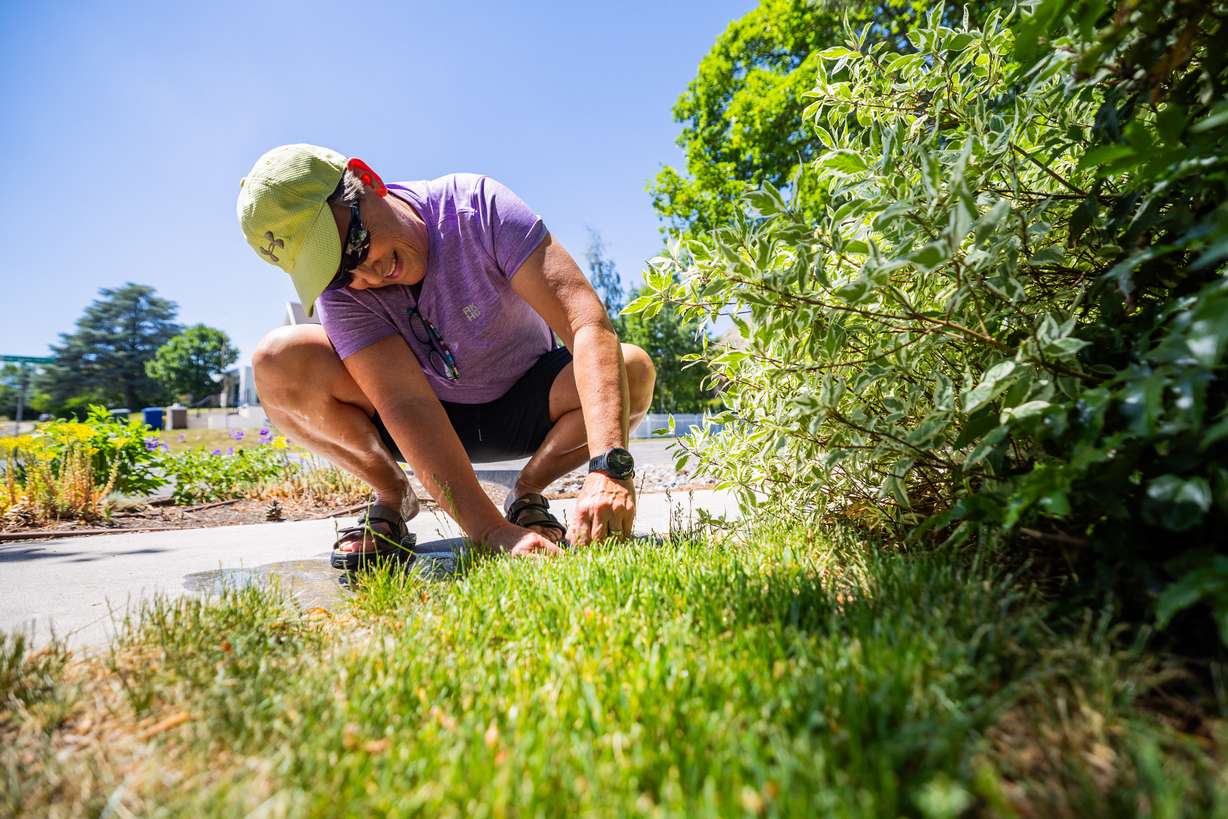 Connie Poss changes a sprinkler head at her home in the Capitol Hill neighborhood in Salt Lake City on Monday. (Photo: Tess Crowley, Deseret News)
The strong reservoir levels right now are “not a license to use water like it’s going out of style,” Kelly Good, community engagement manager for Jordan Valley Water Conservancy District, wrote in a Deseret News op-ed earlier this month.
“As the (drought) pressure has eased, our habits have slipped,” she wrote, referring to reservoirs as savings accounts with no overdraft protection.
That’s why water managers across the state have turned to conservation. Water consumption cuts were reported all across the state during the drought, but experts noticed a slight uptick last year, which they attributed to conservation “fatigue.”
State and local water managers have tried to combat it through messaging and programs, including Utah’s “Slow The Flow” campaign, which offers tips on how people can reduce their water consumption and rebates for water-saving measures. Salt Lake City has explored other tools like rain barrel programs and a partnership with Utah State University Extension to audit residents’ outdoor watering needs.
The cost of water appears destined to be the next step in the process. Salt Lake City is on the cusp of further adjusting tiered rates for its customers to address water habits. Its city council could vote as early as Tuesday to adopt a new rate structure that would go into effect in July, which would add a new block system with increasing water prices as people consume more water.
“The difference between our previous four-block system and proposed four-block system is that water users will get into the higher blocks more quickly, which will send a conservation message,” Briefer said, adding that the new rates will be year-round.
It’s a water conservation tactic that’s common in other Western states, and could be the next step for other parts of Utah following the passage of HB274 this year. It allows cities to tier water rates to create a financial incentive for people to reduce their water consumption.
“Until we start treating water like other utilities in our state, our state can’t continue to sustain the growth that we’re currently experiencing,” said Rep. Bridger Bolinder, R-Grantsville, earlier this year, as the bill cleared the legislative session.