Holiday fire hazards, an up-close look at how quick a mistake can ignite a devastating fire
Nov 21, 2025, 7:08 AM | Updated: 7:22 am
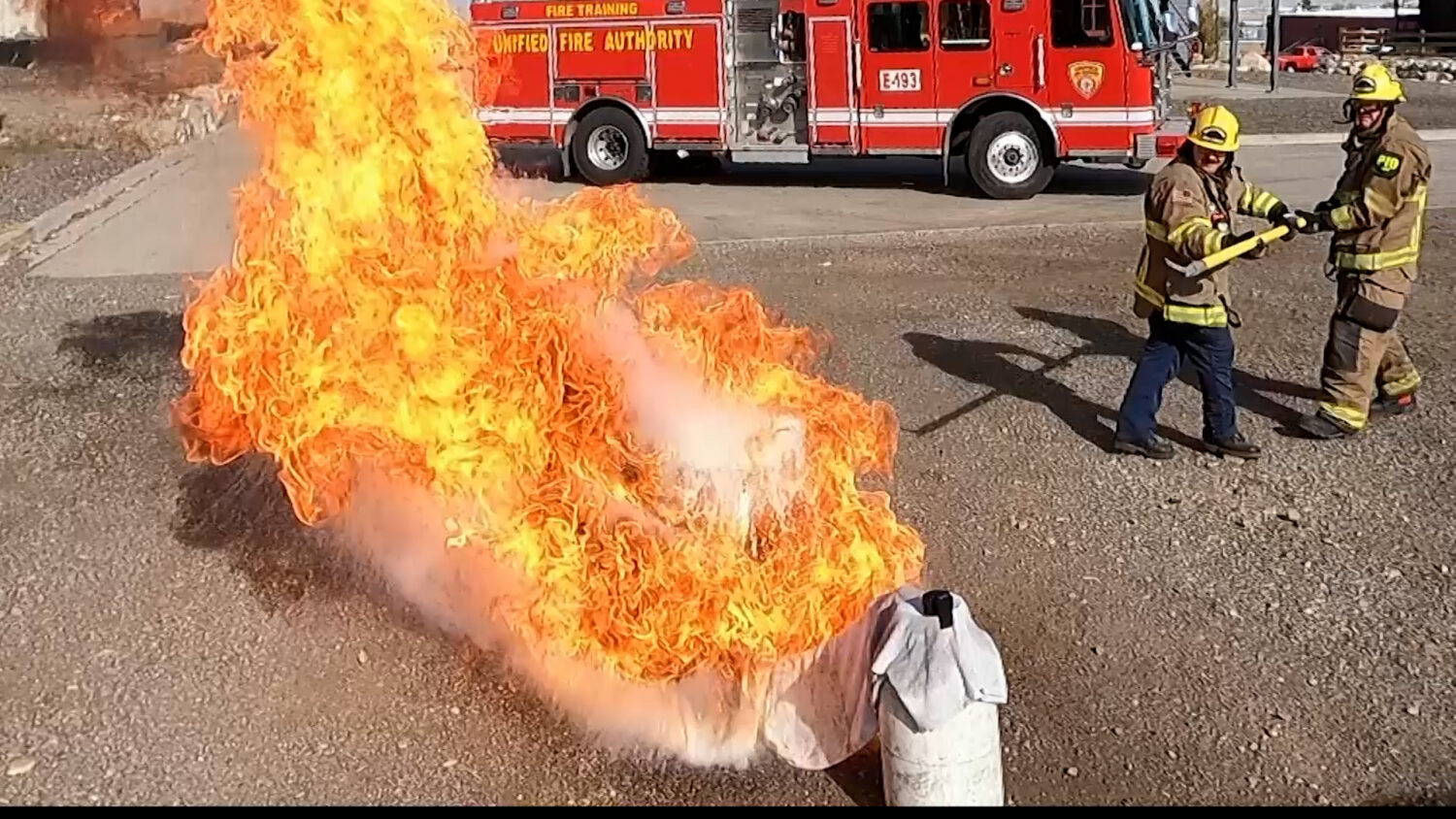
Fireball erupts as firefighters plunge a 24 lb. bird into a turkey fire with a max capacity of 16 lbs. (Mark Less, KSL TV)
(Mark Less, KSL TV)
MAGNA — Throwing water on grease fires. Mismanaging that turkey fryer. Letting a Christmas tree get thirsty. Yes, we are coming into an especially flammable time of year loaded with holiday fire hazards.
“The holidays are absolutely busy for us,” said Unified Fire Authority’s Benjamin Porter.
The numbers are staggering. The Federal Emergency Management Agency stated, “nearly 156,000 fires in the United States occur during the winter holiday season.”
They cost hundreds of millions of dollars in damage every season. And worse, people get hurt. Most of those fires happen while cooking.
At Unified Fire Authority’s training center in Magna, firefighters agreed to help me test out some of the things we are warned not to do.
Getting a handle on cooking fires
We started by cooking up bacon. Grease from bacon can catch fire if it gets too hot in the pan. It only took minutes for our bacon to go from sizzle to a manageable little grease fire.
We’ve all long been told that the last thing we should do with a grease fire is to pour water on it, even though that might be our gut instinct.
But we did just that — outside with firefighters on standby and not in a kitchen.
Huge flames burst forward in a fireball as the water helped the burning grease splatter and spread. Try to imagine those flames in your kitchen surrounded by cabinets and towels.
“When you have a grease fire, there’s a few simple ways to handle it,” said Porter. “Turn off the heat source. Cover it (the pan) with a lid. If you don’t have a lid, use some kind of dry chemical extinguisher or you can even use baking soda.”
Here’s a statistic about holiday fire hazards you should know. The peak day for home cooking fires is Thanksgiving Day. Last year, it saw close to a 400% jump in fires over the daily average, according to the National Fire Protection Association.
Fry the turkey, not your home!
So, next we gently dropped a 24-pound turkey into a turkey fryer.
Wait a minute!
The turkey fryer we used was only rated for 16 pounds. Plus, the instructions clearly stated the bird needs to be thawed first — which we didn’t do. What’s the worst that can happen?
Well, when that bird went in, it pushed a lot of the hot oil up over the pot and onto the burner, sparking flames as high as 15 feet. Imagine again just how those flames could have ruined your Turkey Day had the fire been on your wood deck or with wind blowing towards your home instead of being confined to a fire training center.

Fireball erupts as firefighters plunge a 24 lb. bird into a turkey fire with a max capacity of 16 lbs. (Mark Less, KSL-TV)
But even at the training center, controlling all we could, you can get a real sense of the danger of holiday fire hazards.
“This is a great example,” said Porter of the risk. “We took extra safety precautions. We made sure to have wet towels on top of everything, and you saw that towel still took (caught fire). Just goes to show how hot this stuff is.”
With turkey fryers, prevention is the best defense. Completely thaw the bird. Don’t use too much oil. Set it all up on a level concrete pad. And don’t leave it unattended.
“With a grease fire, the right thing to do is cover it,” said Porter.
But what about a turkey fryer fire that you can’t cover?
“Get resources coming — call 911,” Porter said. “Get yourself out of there.”
When your Christmas tree lights up
Cooking, though, is just one of many holiday fire hazards.
You’ve likely seen videos, such as this one posted on Instagram by the Unified Fire Authority showing a dried-out tree catch fire with flames high enough to reach a ceiling within a couple seconds.
But what about a tree that you neglected only a little bit?
“I bought both of these a week ago,” I told Porter about two small pine trees. “This one sat in my house, by a heat vent. not getting any water. But it’s in a pot.”
I watered the other tree every couple of days.
When we lit them, the results surprised even Porter — a longtime firefighter. The tree I neglected for only a week burned significantly faster.

Firefighter Benjamin Porter of the Unified Fire Authority expresses surprise about how significantly faster this tree not watered burned compared to a tree watered regularly. (Mark Less, KSL TV)
“Being only that it was a week without water and being that it was in a pot with soil, I expect it to not be this different,” he said. “This is incredible to see.”
Both trees eventually extinguished themselves at the fire training center. But, statistically, two of every five Christmas tree fires start in the living room.
And bear in mind that the danger isn’t just from flames from a fireplace or an unattended candle. 24% start thanks to just a hot lamp or bulb. Electrical distribution or lighting equipment is involved in 43% of Christmas tree fires.
“There’s been many times over the years where I personally have responded to home fires either on Christmas or Christmas Eve and it takes someone’s supposed to be, happiest days to the worst day of their life,” said Porter.