Identity of man found in cave 40 years ago revealed to be from Utah; has lengthy criminal history
Jan 1, 2020, 7:27 PM | Updated: Jan 3, 2020, 3:00 pm
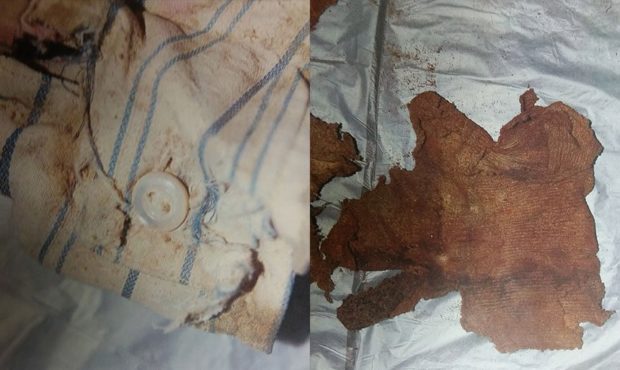
Joseph Henry Loveless was found wearing this shirt. His body was also wrapped in burlap. Photo: NamUs.gov via EIN

DUBOIS, ID (East Idaho News) — Nobody could have guessed the identity of a man whose body was found in the Civil Defense Caves in 1979.
For 40 years, anthropologists, scientists and investigators from Idaho State University all the way to the Smithsonian and the FBI tried to unravel the mystery of who this man was. The big question none of them could figure out was how long he had been in the caves.
The answers were revealed Tuesday during a riveting news conference held by Clark County Sheriff Bart Mary and others involved in the decades-long investigation.
The man’s remains were so well preserved, there was still skin on the body. Anthropologists believed that he had maybe only been in the caves for five to 10 years. When the DNA Doe Project finally put the genetic and genealogical pieces together, they learned he had been in the cave since 1916.
“Through our research, following the tireless experts of innumerable experts, we have identified Clark County John Doe. His name was Joseph Henry Loveless,” DNA Doe Project team leader Anthony Redgrave said. “Joseph Henry Loveless was born Dec. 3, 1870, in Payson, Utah territory.
Loveless was a notorious outlaw, bootlegger, jailbird and a vicious murderer, according to newspaper records from the era.
The revelation that the man anthropologists believed had likely died sometime between 1969 and 1979 had actually died in 1916 was a shocking revelation.
“This definitely threw most anthropologists — all anthropologists that looked at this (case),” ISU anthropology department assistant professor Samantha Blatt said.
Loveless’s torso, arms and legs have been recovered, but his head has never been found. Researchers have not been able to uncover a photo of him either. Fortunately, the wanted poster published from when he murdered his wife has a description of what he looked like, although he was going by a different name at the time.
“Walt Cairns, age about 40 years, height about 5 ft. 8 or 9 in., weight about 165 pounds, dark brown hair, slightly gray around ears, eyes bluish brown, medium complexion, has little or no eyebrows, small scar over right eye, tattoo of star on right hand between thumb and index finger, also tattoo of anchor same place on left hand; he wore a light colored hat, brown coat, red sweater, blue overalls over black trousers,” the poster reads.
A composite of what Loveless may have looked like was created by combining images of his closest relatives and from written descriptions.
The story of how scientists and historians identified Loveless is remarkable. Redgrave said this is now one of the oldest cases to be solved using DNA.
Road to identification
On Aug. 26, 1979, a family was searching for arrowheads in a cave near the entrance of the Civil Defense Caves just north of Dubois. Instead of arrowheads, they found something else.
Wrapped in burlap and buried in a shallow grave was the headless torso of a man. He was wearing a white shirt with blue pinstripes and a maroon sweater. He was also missing his arms and legs.
Earl Holden, the Clark County Sheriff at the time, had the area searched for any other remains, but to no avail. He believed, based on the clothing the man was wearing, that he was likely a gambler from 60 years prior.
Coroner Ernest Still performed an investigation and determined the man must have died within the last decade due to the presence of flesh and odor.
Still wasn’t the only one who thought that. In 1979, the top forensic anthropologist in the world, Dr. Doug Ubelaker from the Smithsonian Institute, believed the remains could have been anywhere from six months to ten years old.
“Already, at the beginning, no one could identify who this person was,” ISU anthropology department assistant professor Samantha Blatt said.
Twelve years later, an 11-year-old girl was exploring the cave when she discovered a hand sticking out of the ground. An excavation led by Idaho State University and the Idaho Museum of Natural History uncovered the man’s arms and legs.
In 1997, the remains were transferred to the ISU Anthropology Department where they have remained ever since.
In March 2019, Drs. Amy Michael and Samantha Blatt with the Idaho State University Anthropology Department decided to ask if DNA Doe Project would be willing to help try to identify the man in the cave.
DNA Doe Project is a nonprofit organization that uses a methodology known as genetic genealogy to identify unknown individuals by using their DNA to find their family tree. Volunteers search through records and other sources to piece the individual’s family history together until they are able to identify the person.
Led by team leader Anthony Redgrave, 14 volunteer genealogists spent more than 2,000 hours researching Clark County John Doe’s family tree. They found 31,730 individuals in the tree and narrowed their investigation down to 250 “DNA cousins.” Searching through those family trees, they tentatively identified the man as Joseph Henry Loveless.
The genealogists discovered Loveless’s parents were Latter-day Saint pioneers from the Utah valley and were polygamists, which made DNA Doe Project’s job much more difficult.
“Descendants of pioneers who have done their family history will know that their ancestors had many, many children – often with several different spouses during the time period that polygamy was practiced,” Redgrave said.
He explained that often leads to intermarrying, which can affect the DNA in unpredictable ways. It also leads to half-relationships or half-cousins where two people only share DNA with one parent. Redgrave said that even though they had numerous close DNA matches, it was difficult to work with and narrow down to one individual.
“We took a lot of extra effort to confirm our potential identity over the course of several days,” Redgrave said.
Even then, Clark County Sheriff Bart May wanted to make extra sure the identity was correct.
“I felt like we needed to take it a step farther to make sure we were 100 percent correct. So we tracked down living relatives, which was really hard to do. But we found an 87-year-old grandson who was willing to talk with us and meet with us and give us his DNA,” May said.
Through the grandson’s DNA, authorities were able to confirm the remains did belong to Joseph Henry Loveless.
“This was an amazing case because watching it progress, it was so difficult because of the intermarriages and the Latter-day Saints practice of polygamy. There were many, many complicated family relationships that we thought would take forever to untangle,” DNA Doe Project Co-founder Dr. Margaret Press said.
The outlaw
Finding out the body was Joseph Henry Loveless was one thing. Finding out details about his life was another. To do that, DNA Doe Project searched through eastern Idaho newspaper records.
The man they discovered had a notorious reputation.
Joseph Henry Loveless was born to Latter-day Saint pioneers Joseph Jackson Loveless and Sarah Jane Scriggins.
When he was 28, in 1899, Loveless married Harriett Jane Savage in Salt Lake City, Utah. Five years later, Harriett filed for divorce on the grounds of desertion and failure to support their child.
A year after the divorce, Loveless married Agnes Octavia Caldwell in Bear Lake County, Idaho. They had four children together but Loveless wasn’t the type to settle down. In 1914, he was arrested for bootlegging in Burley. A few months later he was again arrested for bootlegging in Burley but he managed to escape from jail — and it wouldn’t be the last time.
In 1916, newspaper records show a man named Walter Garron pulled off a daring escape by cutting his jail cell’s bars with a saw and then stopping a train.
“The news article is strangely worded but we assume he was being transported to jail on a train and somehow stopped the train in an attempt to escape it,” Redgrave said. “He was somehow caught and put in prison and escaped again anyway.”
Walter Garron was just one of the various aliases Loveless went by. Others included Walter Cairins, Curran, Currans, Cairns, Curnans and Charles Smith.
On May 5, 1916, Agnes Loveless was found dead in the tent she, Loveless and their 8-year-old son lived in on the outskirts Dubois. Loveless was nowhere to be found and became the prime suspect. The problem was, he and his wife were using aliases at the time. The couple, both suspected bootleggers, were known in town as Charles and Ada Smith.
This led to confusion among researchers about who killed Agnes and where Loveless was. They eventually came to the conclusion that Charles and Ada Smith were, in fact, Joseph and Agnes Loveless.
On May 12, 1916, the Pocatello Chronicle published an article titled “Under Arrest on Murder Charge.” Law enforcement had arrested a man they believed to be Walter Currans (Joseph Loveless) for Ada Smith’s (Agnes Loveless) murder.
“Sheriff John Spencer of Fremont County in Spencer, Ida., charged (him) with beating out his wife’s brains. Her death resulted after 50 hours of intense agony. It is charged that the ax was wielded by her common-law husband in Dubois at an early hour Saturday morning after she had returned home from a dance in that city,” the article read.
According to the news article, their 8-year-old son found her and she had been beaten to death with an ax.
At Agnes’s funeral, one of their children was quoted as saying, “Papa never stayed in jail very long and he’ll soon be out.”
On May 23, 1916, Loveless escaped from jail again by cutting the bars using a saw he had hidden in his shoes.
After that, Loveless wasn’t seen again until his headless, dismembered corpse was discovered in 1979. It’s not clear who murdered Loveless, or how he was killed. There is a near certainty though that the murderer is also dead.
Despite that, the Clark County Sheriff’s Office plans to continue the investigation and hopefully discover who killed Loveless.
“This is one of the most exciting cases we have worked,” forensic genealogist Lee Redgrave, Anthony Redgrave’s wife said.