Why college is getting more expensive?
Jul 16, 2023, 12:00 PM
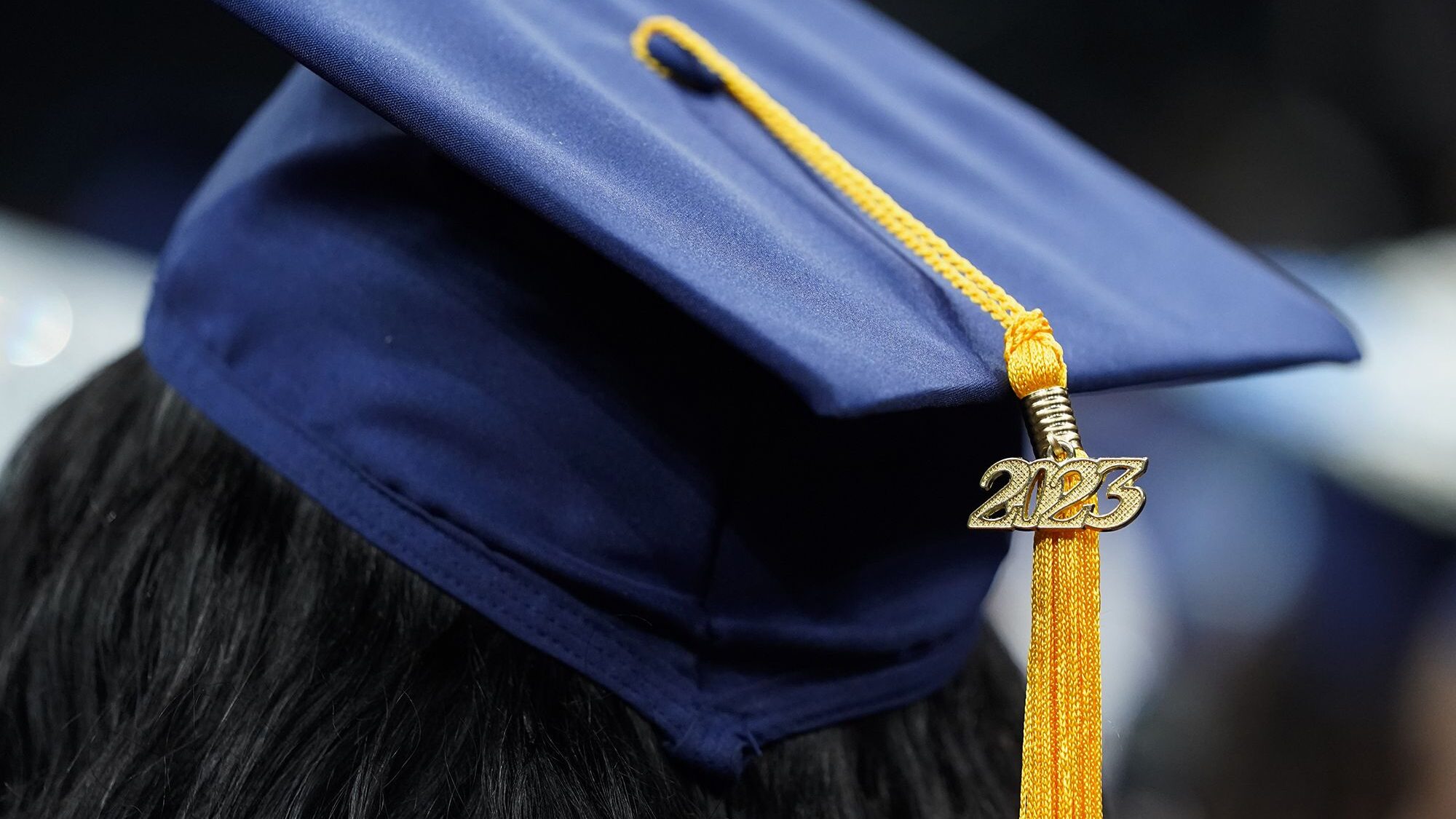
A tassel with 2023 on it rests on a graduation cap as students walk in a procession for Howard University's commencement in Washington on May 13. Photo credit: Alex Brandon/AP
NEW YORK (CNN) — The average American saved $5,011 last year. That means it would take them about 75 years to save up enough cash to send one child to a top-rated US university. College is really expensive. And it just keeps getting more expensive.
The average tuition at US private colleges grew by about 4% last year to just under $40,000 per year, according to data collected by US News & World Report. For a public in-state school, that cost was $10,500, that’s an annual increase of 0.8% for in-state students and about 1% for out-of-state.
But at highly rated or selective schools, the price tag increases substantially. Harvard University charges $57,246 in tuition and fees, per year, for undergraduate students. When you add in housing, food, books and other cost of living expenses, Harvard says you should expect to pay about $95,438 each year.
It wasn’t always this way. After adjusting for currency inflation, college tuition has increased 747.8% since 1963, the Education Data Initiative found.
And between 1980 and 2020, the average price of tuition, fees, room and board for an undergraduate degree increased by 169%, according to a report from the Georgetown University Center on Education and the Workforce.
That far outpaces wage increases.
Over the same 40-year period, earnings for workers ages 22 to 27 only increased by 19%, the report found.
That might explain why Americans’ confidence in higher education has dropped to a record low, according to a Gallup poll released this week. The June poll found that just 36% of Americans have confidence in higher education, down more than 20 percentage points from eight years ago.
“While Gallup did not probe for reasons behind the recent drop in confidence, the rising costs of postsecondary education likely play a significant role,” said Megan Brenan, a research consultant at Gallup.
So why is the price of college rising so rapidly?
The high cost of human teachers
It costs a lot to employ professors, said Catharine Hill, an economist with the education nonprofit organization Ithaka S&R and the former president of Vassar College.
“Higher education is primarily produced by skilled workers — faculty and administrators,” she said. “Their price in the economy has gone up.”
Real wages for US skilled workers have outpaced inflation by a couple of percentage points for long periods of time, but other industries have been able to offset those labor costs through productivity advances that reduce their reliance on skilled labor — things like AI and robotics.
But there aren’t many robots teaching college classes. You still need professors with expensive degrees to do that.
“We pretty much produce higher education the way we used to, which is a faculty member in front of a class of anywhere from 20 to 40 students,” said Hill. “That means that there haven’t been efficiency gains to reduce that cost.”
Some universities have been leaning more heavily on contingent, non-tenure track faculty with low pay and no access to employer-ee benefits in an attempt to save money. The higher education system has become increasingly dependent on this temporary labor, according to the National Education Association. Nearly 70% of US faculty members held a contingent position in fall 2021, up from 47% in 1987.
Competition for the richest families is driving up costs
Income inequality in the United States has grown significantly since the 1970s, and there’s a much wider gap between the rich and the average income earner today than there was back then.
In 2021, the top 10% of Americans held nearly 70% of US wealth, up from about 61% at the end of 1989, according to the Council on Foreign Relations. The top 1% of earners in the United States now takes home 21% of all the income in the United States, according to the Economic Policy Institute.
That means a top-ranked university can charge whatever it wants and will still find wealthy families willing and able to pay each year.
“Flagship schools are competing for talented students and families that can pay the sticker price,” said Hill. These families “don’t have any trouble writing that check,” and are willing to spend more in exchange for luxe services and well-maintained campuses. “They want small classes, they want nice dormitories, they want good food,” said Hill.
If a school tried to scale back on spending and cut back on those amenities, she said, “they wouldn’t end up attracting those students.”
Colleges currently spend more on administrative services and luxuries than they ever have in the past, according to a recent study by the American Council of Trustees and Alumni. That type of spending grew by 29% between 2010 and 2018, compared to a 17% increase in spending on instructional staff.
State subsidies fall
State legislatures are also contributing less in their budgets to public education than they used to.
Between 2020 and 2021, state funding for higher education declined in 37 states by an average of 6%, according to a recent NEA analysis. “This means colleges and universities must rely on students to pay the cost of college — and those students are borrowing to do it,” wrote the NEA in a report.
Many students at the nation’s top universities who qualify are receiving a healthy amount of financial aid and other subsidies, greatly reducing the price they ultimately pay for their degrees. But not everyone benefits from financial aid and other subsidies.
The net price of college
Yes, sticker prices are increasing. But the net price of college — that’s the amount that students and their families are actually shelling out — has been decreasing.
The average student at a private four-year college paid $32,800 for tuition and room and board last year. When adjusted for inflation, the actual price paid for private college has dropped by 11% over the past five years, according to College Board data.
For public colleges, the net price averages out at just over $19,000 and has dropped 13% over the past five years.
What comes next
“These kinds of discussions about whether this ‘college cost disease’ could possibly continue, they existed 50 years ago too, with people saying, ‘oh, it couldn’t possibly go above $30,000. It couldn’t possibly go above $40,000,’” said Hill.
“On some level, if incomes continue to rise the way that they’ve been rising, I think it will go on for a while.”
Before adjusting for inflation, the average student loan debt at graduation has increased 2807% since 1970, according to the EDI. Even after adjusting for inflation, the average debt increased by 317%.
Student debt explosion
Late last month, the Supreme Court put the kibosh on President Joe Biden’s student loan forgiveness program, blocking millions of borrowers from receiving up to $20,000 in federal student debt relief, just months before student loan payments are set to restart after a yearslong pause. On Friday, the Biden administration said 804,000 borrowers will have a total of $39 billion worth of debt wiped away in the coming weeks.
There is about $1.6 trillion in outstanding loan debt in the United States.