What Salt Lake City’s mayoral candidates have to say about Great Salt Lake’s future
Sep 28, 2023, 10:00 AM | Updated: Oct 23, 2023, 11:53 am

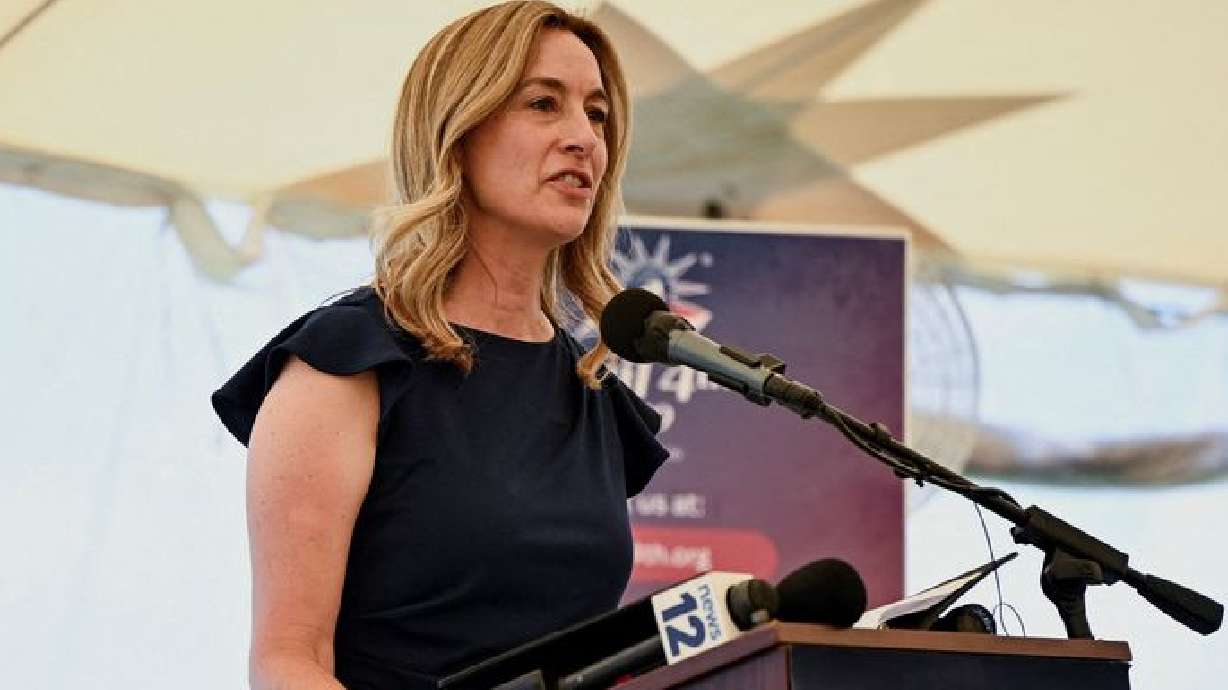
Salt Lake City's 2023 mayoral candidates, from left to right: community activist Michael Valentine, Salt Lake City Mayor Erin Mendenhall and former Salt Lake City Mayor Rocky Anderson. (Photo: Kristin Murphy and Laura Seitz, Deseret News)
(Photo: Kristin Murphy and Laura Seitz, Deseret News)
This article is published through the Great Salt Lake Collaborative, a solutions journalism initiative that partners news, education and media organizations to help inform people about the plight of the Great Salt Lake.
SALT LAKE CITY — Utah’s capital city will always be connected to the Great Salt Lake through its name.
And as the lake continues to struggle as a result of factors like drought and overconsumption, it will likely impact the city’s future in various ways, including more dust events. That’s why the topic figures to be one of many that city voters will consider ahead of this year’s mayoral race.
It’s also an issue that all three candidates — Salt Lake City Mayor Erin Mendenhall, former Salt Lake City Mayor Rocky Anderson and community activist Michael Valentine — have expressed concern over leading up to the Nov. 21 election.
With that in mind, the Great Salt Lake Collaborative reached out to all three candidates in this year’s race to ask them about their thoughts on the lake before residents fill out their ballots. Here is how they responded to a questionnaire on the subject.
Some answers have been edited for clarity and brevity.
Question: What is your personal relationship/history to the Great Salt Lake?
Anderson: “The Great Salt Lake has been ever-present in my life. I’ve been on the lake sailing and always moved by the beauty and magnificent presence of the (lake). As with the looming spectacular mountains surrounding us, the Great Salt Lake feels like a dependable old friend.
“My relationship with the (Great Salt Lake) has been far more intense since I first learned about the threat of a major disaster facing our region because of a long-time failure to exercise wise, informed stewardship of the lake and its water sources. The lake has now become a driving passion of mine, not unlike my obsession with the climate crisis for over 30 years.”
Mendenhall: “I love the Great Salt Lake. I am awestruck by the millions of migrating birds and the history of this lake being a relic of an ancient, inland sea and an important location to so many Indigenous peoples. The lake is both fragile and powerful, beautiful and austere.”
“I’ve visited the Shoreline Preserve with (Gillmor Sanctuary manager) Ella Sorensen in different seasons over several years, watching the impacts of less and less water on the gnats and flies, birds and brine. I visit Antelope Island with my family, feeling the spherical exoskeletons like sand between our toes at the lake’s edge. The uniqueness of the lake landscape and ecosystem is a complement to our capital city and our people, seeking balance, stability and a place to thrive.”
Valentine: “As an appreciator of our history … I look back on the days when we worked with our environment to add to our people’s lives. At the turn of the 20th century, the Great Salt Lake was a prime recreational destination and the main destination for that recreation was the Great Saltair.
“I have long dreamed of restoring this piece of Utah history to its fullest potential. I’ve already been working toward making this project a reality to emphasize the lake’s utmost importance to Utah culture, the personal and spiritual connection we all have to our environment, our lake.
“All of our breathtaking natural resources make Utah one of the greatest places in the world. I have a deep personal connection to the lake through the Great Saltair, that history, as a proud environmentalist and lover of all of Utah’s natural beauty and historic wonders.”
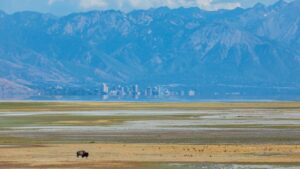
A bison grazes on a segment of the Great Salt Lake lakebed near Antelope Island with the Salt Lake City skyline in the background on Aug. 12. The future of the Great Salt Lake figures to be a major topic in this year’s mayoral race. (Carter Williams, KSL.com)
Question: With the many city priorities you will face as mayor, where do you rank the Great Salt Lake on a scale of 1 to 10 — and why?
Mendenhall: “Six (with 10 being the highest). The Great Salt Lake sits just after homelessness, affordable housing and air quality, which is not to say the lake isn’t important, but rather, as mayor, it’s my responsibility to weigh priorities on a scale of importance and ability to impact.
“Saving the Great Salt Lake is an existential environmental issue for Salt Lake City — no doubt about it — but the scope of the challenge involves so much beyond the city’s control that even with the landmark steps the city has taken the last two years, it being my top priority could not move the needle any further.”
Valentine: “At an 11. I have said I think the two most important issues facing us right now that need immediate attention (are) ending homelessness and housing everyone, and saving the Great Salt Lake.
“I am extremely concerned with the health of the lake and all of Utah and we have such little time to drastically act. It’s alarming when scientists say that Utah may be unlivable if the lake fails with toxic dust clouds that lay at the bottom of the lake. We have no choice but to save the lake and act now.”
Anderson: “The threatened Great Salt Lake ranks as a top priority. That would be a 1 if that’s ‘top priority’ or 10 if that’s ‘top priority.’
“The complete desiccation of the Great Salt Lake would be devastating to (Salt Lake City) residents and businesses because metals, including antimony, copper, zirconium, and arsenic, from the dry lake bed will blow into the city, resulting in heightened risks of severe respiratory illnesses, heart disease, lung disease, and cancers. The cascading effects would undermine, and perhaps entirely destroy, our neighborhoods, economic vitality and overall quality of life.
“The dust could lead to degradation of soil and speed snow melt, shortening winter sports seasons and reducing water supply later in the year. It would severely damage valuable wetlands, eliminate brine flies (vital in the ecosystem), devastate the conditions upon which brine shrimp … can exist, and threaten millions of migratory birds.”
Question: What’s your plan for assisting in saving the Great Salt Lake?
Valentine: “Sixty-eight percent of Utah water goes to alfalfa (and hay) farms in the desert. (It) contributes almost nothing to our local economy and people as most of the alfalfa gets shipped overseas. This is unstainable and we need to assist the farmers in transitioning to different crops.
“A lot of the water doesn’t even make it to the farmers as it gets lost through inefficient piping and infrastructure. The lake is a Utah concern and as mayor, I would do everything to bring coalitions together, leading from the city, to work with all parties to protect the lake. I support the recent lawsuits from … environmental groups against the inaction of the state. I would ask the (Environmental Protection Agency) to step in on a federal level and declare the lake an ecological disaster as we need all hands on deck immediately.”
Anderson: “Although individual conservation efforts are important for dealing with droughts, the Great Salt Lake will survive only if far less water is diverted for agricultural purposes. Under my leadership, (Salt Lake City) will create a coalition with surrounding communities to pursue legal remedies, legislation and public policy changes to protect the public interest in water conservation.
“Additionally, as I have done at my own home, turf should be eliminated or minimized. We should do everything possible to create a public and personal ethic of water conservation, including advertising campaigns and public challenges, raising awareness of the disastrous impacts of continued poor stewardship of the Great Salt Lake.”
Mendenhall: “Salt Lake City is focused on three impactful tools: conservation, contribution and communication.
“Conservation: … Earlier this year, I ordered a top-to-bottom review of water usage in every city-owned facility and park to identify new opportunities to conserve water. The results will inform significant city policy in my second term, though preliminary results are already helping us prioritize high-impact projects, like insulating our fleet vehicle wash station to save millions of gallons annually.
“Contribution: Salt Lake City is formalizing its annual contribution of 13 billion gallons of treated reclaimed water to ensure it goes to the Great Salt Lake in perpetuity. I’m also really excited about the Great Salt Lake Shoreline Heritage Preserve. The city has partnered to apply for a $10 million grant to help acquire and permanently conserve shoreline property, and I hope this is just the beginning.
“Communication: I will continue to take every opportunity to talk about the health of the lake and how protecting this fragile ecosystem is the key to maintaining our health, economy and quality of life.”
Question: What do you want residents, under your watch, to do to help save the lake?
Anderson: “We each have a responsibility to live sustainably and protect the environment. … The city has a responsibility to support conservation by educating and setting an example. Sprinklers running full blast on Washington Square during rainstorms will not happen when I’m mayor. Our government officials need to walk the talk.
“To achieve necessary changes for saving the (lake), we must recognize that even if every household permanently stopped watering lawns, that would not be a major factor in saving the (Great Salt Lake). While alfalfa (and hay) farming represents only 0.2% of the Utah economy, it uses 68% of available water.
“The most critical action that residents can take is to effectively push their elected officials and other policymakers at every level of government to take necessary measures immediately to sufficiently reduce the diversion of water for agricultural purposes.”
Mendenhall: “Being smarter and more judicious in our water use is, day-in-day-out, the best thing residents can do to help save the Great Salt Lake. This means looking at your landscaping, not over-watering, fixing faulty plumbing, considering water-wise appliances and fixtures in your house.
“And our residents must be a vocal part of our constant advocacy to our elected leaders in the state Legislature and Congress. Our city accounts for a fraction of water that can make its way to the lake, and we need statewide solutions to avoid its demise.
Valentine: “It’s important they get involved and stay informed, that they write their leaders and demand immediate actions, that they vote with the lake in mind, and support lawsuits from environmental groups. If they own houses and yards, they (should) convert to xeriscaping and sustainable water usage.”
Question: How would the depletion of the Great Salt Lake affect the future of your city?
Mendenhall: “There wouldn’t be a Salt Lake City without the Great Salt Lake. Losing the lake would have an enormous impact on our livable environment, public health, population stability, economy, tourism and more.
“Our people would suffer not only the physical impacts of the toxicity rendered on our air quality, but they would undoubtedly struggle with mental health impacts — from losing trust in our leaders who let this happen, to fearing for the well-being of their loved ones, to the stress of having to decide that they can no longer stay and thrive in this place they love.”
Valentine: “The better question is, how wouldn’t it affect the city? Scientists have repeatedly said that the lake collapsing would make large portions of Utah unlivable, with arsenic dust clouds and toxic storms. The vast majority of Utahns live along the Wasatch Front right next to the lake.
“Our capital city is right next to the lake in a valley that already sees some of the worst air quality in the world. We are staring down at the very near possibility of nightmare scenarios that are hard to even comprehend with climate change and the impacts that will have. We must act, we must avert disaster and unite all of us together to avoid environmental collapse.”
Anderson: “The depletion of the Great Salt Lake would severely undermine the quality of life in Salt Lake City. Residents will leave to avoid the high risk of poisoning, adverse health effects, and continued declines in property values.
“Salt Lake City) will not be able to attract, and will lose, businesses. Regional recreation and economic drivers, like winter sports, will wither, because of early snow melts. Our city will be irrevocably altered, much like what is anticipated with the ongoing desiccation of Lake Urmia in Iran.”
All of the questions and complete answers can be found on the Great Salt Lake Collaborative website.