Historic moon mission ends with splashdown of Orion capsule
Dec 12, 2022, 5:00 AM
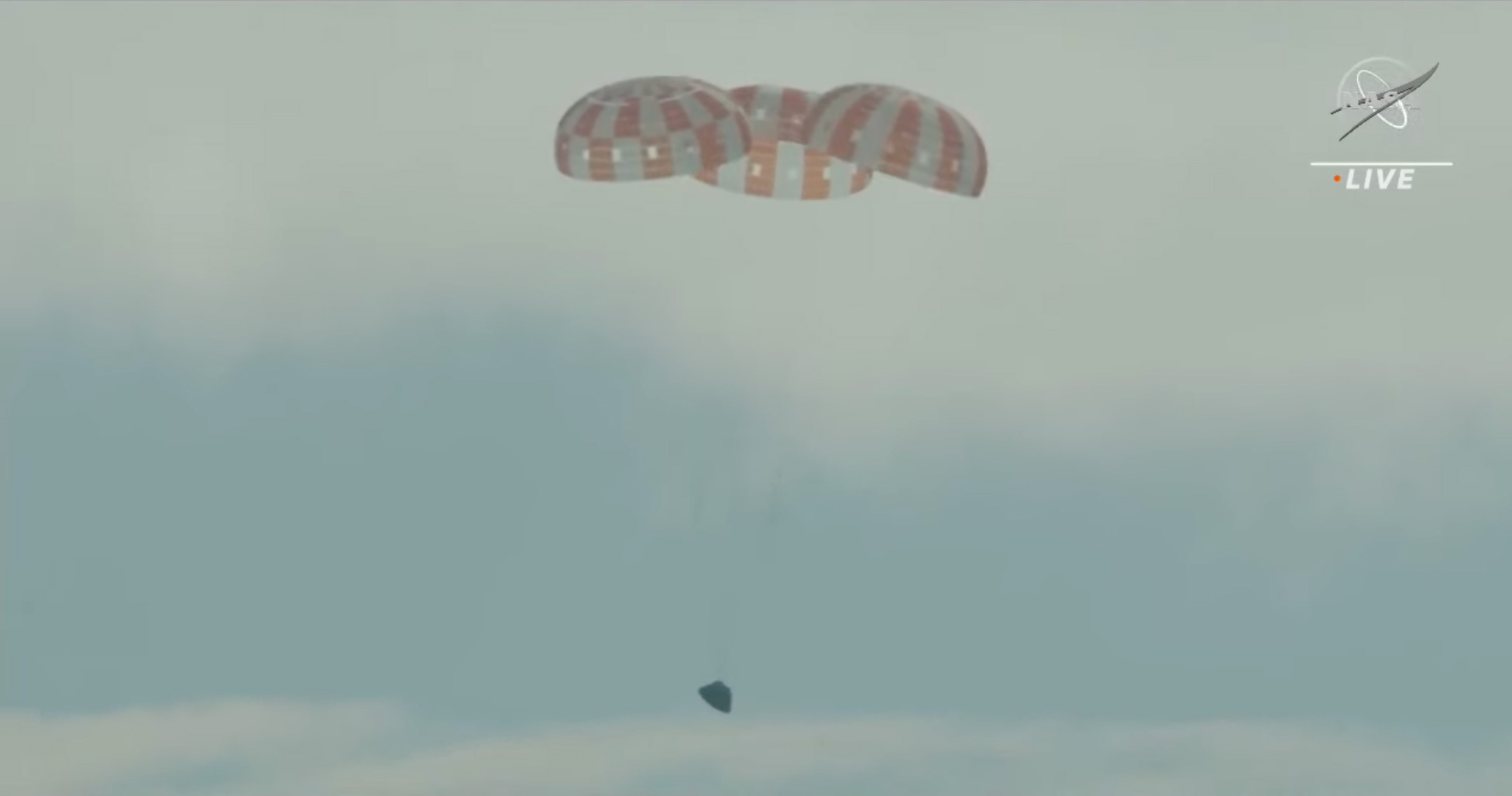
The Orion capsule, with its three main parachutes deployed, approaches the surface of the ocean. (NASA/YouTube via CNN)
(NASA/YouTube via CNN)
(CNN) — The Artemis I mission — a 25½-day uncrewed test flight around the moon meant to pave the way for future astronaut missions — came to a momentous end as NASA’s Orion spacecraft made a successful ocean splashdown Sunday.
Related: Two Utah Girl Scouts win badge riding to the moon on Artemis 1
The spacecraft finished the final stretch of its journey, closing in on the thick inner layer of Earth’s atmosphere after traversing 239,000 miles (385,000 kilometers) between the moon and Earth. It splashed down at 12:40 p.m. ET Sunday in the Pacific Ocean off Mexico’s Baja California.
This final step was among the most important and dangerous legs of the mission.
But after splashing down, Rob Navias, the NASA commentator who led Sunday’s broadcast, called the reentry process “textbook.”
“I’m overwhelmed,” NASA Administrator Bill Nelson said Sunday. “This is an extraordinary day.”
The capsule then spent six hours in the Pacific Ocean, with NASA collecting additional data and running through some tests before the rescue team moved it. That process, much like the rest of the mission, aims to ensure the Orion spacecraft is ready to fly astronauts.
The capsule is expected to spend less time in the water during crewed mission, perhaps less than two hours, according to Melissa Jones, the recovery director for this mission.
A fleet of reovery vehicles — including boats, a helicopter and a US Naval ship called the USS Portland — were waiting nearby.
A NASA Twitter account confirm the capsule was on the USS Portland at 6:40 pm ET.
“This was a challenging mission,” NASA’s Artemis I mission manager, Mike Sarafin, told reporters Sunday afternoon. “And this is what mission success looks like.”
What happened
The spacecraft was traveling about 32 times the speed of sound (24,850 miles per hour or nearly 40,000 kilometers per hour) as it hit the air — so fast that compression waves caused the outside of the vehicle to heat to about 5,000 degrees Fahrenheit (2,760 degrees Celsius).
“The next big test is the heat shield,” Nelson had told CNN in a phone interview Thursday, referring to the barrier designed to protect the Orion capsule from the excruciating physics of reentering the Earth’s atmosphere.
The extreme heat also caused air molecules to ionize, creating a buildup of plasma that caused a 5½-minute communications blackout, according to Artemis I flight director Judd Frieling.
INTERACTIVE: Trace the path Artemis I will take around the moon and back
As the capsule reached around 200,000 feet (61,000 meters) above the Earth’s surface, it performed a roll maneuver that briefly sent the capsule back upward — sort of like skipping a rock across the surface of a lake.
There are a couple of reasons for using the skip maneuver.
“Skip entry gives us a consistent landing site that supports astronaut safety because it allows teams on the ground to better and faster coordinate recovery efforts,” said Joe Bomba, Lockheed Martin’s Orion aerosciences aerothermal lead, in a statement. Lockheed is NASA’s primary contractor for the Orion spacecraft.
“By dividing the heat and force of reentry into two events, skip entry also offers benefits like lessening the g-forces astronauts are subject to,” according to Lockheed, referring to the crushing forces humans experience during spaceflight.
Another communications blackout lasting about three minutes followed the skip maneuver.
As it embarked on its final descent, the capsule slowed down drastically, shedding thousands of miles per hour in speed until its parachutes deploy. By the time it splashed down, Orion was meant to be traveling about 20 miles per hour (32 kilometers per hour). NASA officials, however, did not yet have an exact splashdown speed at a 3:30 pm ET press conference.
The temperature in the Orion crew cabin maintained balmy temperatures between 60 degrees to 71 degrees Fahrenheit based on data, Howard Hu, NASA’s Orion Program manager, observed.
While there were no astronauts on this test mission — just a few mannequins equipped to gather data and a Snoopy doll — Nelson, the NASA chief, has stressed the importance of demonstrating that the capsule can make a safe return.
The space agency’s plans are to parlay the Artemis moon missions into a program that will send astronauts to Mars, a journey that will have a much faster and more daring reentry process.
Orion traveled roughly 1.3 million miles (2 million kilometers) during this mission on a path that swung out to a distant lunar orbit, carrying the capsule farther than any spacecraft designed to carry humans has ever traveled.
A secondary goal of this mission was for Orion’s service module, a cylindrical attachment at the bottom of the spacecraft, to deploy 10 small satellites. But at least four of those satellites failed after being jettisoned into orbit, including a miniature lunar lander developed in Japan and one of NASA’s own payload that was intended to be one of the first tiny satellites to explore interplanetary space.
On its trip, the spacecraft captured stunning pictures of Earth and, during two close flybys, images of the lunar surface and a mesmerizing “Earth rise.”
Nelson said if he had to give the Artemis I mission a letter grade so far, it would be an A.
“Not an A-plus, simply because we expect things to go wrong. And the good news is that when they do go wrong, NASA knows how to fix them,” Nelson said. But “if I’m a schoolteacher, I would give it an A-plus.”
With the success of the Artemis I mission, NASA will now dive into the data collected on this flight and look to choose a crew for the Artemis II mission, which could take off in 2024. The crew announcement is expected in early 2023, NASA officials said Sunday afternoon.
Artemis II will aim to send astronauts on a similar trajectory as Artemis I, flying around the moon but not landing on its surface.
The Artemis III mission, currently slated for a 2025 launch, is expected to put boots back on the moon, and NASA officials have said it will include the first woman and first person of color to achieve such a milestone.